What Is GTO Deviation in Poker?
A GTO deviation is a deliberate move away from balanced play to exploit an opponent's specific leak. Learn when deviating wins more than staying balanced.
On this page · 7 sections
GTO deviation is the act of deliberately stepping away from a balanced, game-theory-optimal strategy to punish a specific mistake an opponent is making. Balanced play is unbeatable in the long run, but it is only maximally profitable against another perfect player — and those barely exist. Every real opponent makes consistent errors, and a GTO deviation is how you turn their error into your extra profit. In short, GTO is your map, and deviations are the shortcuts you take when you can see the road ahead.
Why Pure GTO Leaves Money on the Table
A GTO strategy is designed to be unexploitable: no matter what your opponent does, they cannot beat it in the long run. That is a defensive property. It guarantees you never lose to a given player, but it does not guarantee you win the most.
Think of GTO as refusing to lose and deviation as trying to win big. When your opponent folds far too often to river bets, a balanced strategy keeps bluffing at its equilibrium frequency — but you could be bluffing far more and printing chips. Sticking to balance there is like having a coupon and refusing to use it.
What a Deviation Actually Looks Like
Every deviation follows the same shape: find where the opponent’s frequencies differ from the range or actions GTO expects, then move hard in the opposite direction:
- They over-fold → bluff more than balance suggests and bet thinner for fold equity.
- They over-call (a station) → cut bluffs toward zero and value bet wider and bigger.
- They never bluff → over-fold your bluff-catchers to their aggression.
- They over-bluff → call down lighter and let them barrel into you.
This is the mechanical heart of exploitative play. GTO tells you the baseline; the deviation is the exploit built on top of it.
A Worked Example
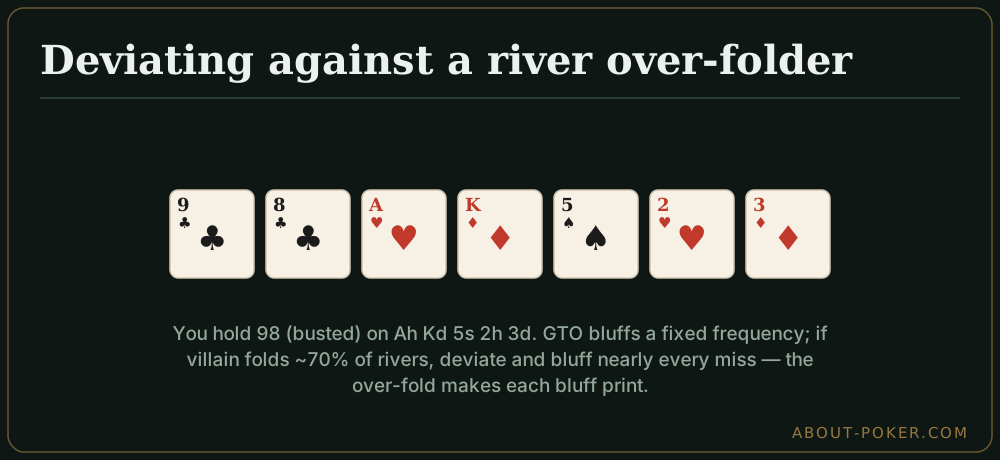
The GTO solution says that on a particular river you should bet a polarized range and bluff roughly one-third of your bets, and your opponent should defend by calling enough to make your bluffs break even. That balanced call frequency is often near the minimum-defense number — for a pot-sized bet, defending about 50% of your range.
Now you notice this specific villain folds the river far too much — closer to 70% of the time. GTO does not care; it bets its fixed bluff frequency. But you deviate: you start bluffing nearly every missed draw and bottom-of-range hand, because a 70% folder hands you a profit on almost every bluff. You have abandoned balance on purpose, and against this player it is the single most profitable thing you can do.
The Cost of Deviating
Here is the catch. The instant you deviate, you become exploitable. If you crank your bluffs up to punish a folder and they suddenly wake up and start calling, your over-bluffed range gets stacked. A deviation is a bet that your read is both correct and stable.
That is why deviations are safest against weaker players who cannot or will not counter-adjust, and most dangerous against strong regulars who notice patterns. Good players hold their deviations loosely, size them to the confidence of the read, and snap back to balance the moment the opponent adjusts.
When to Deviate and When to Stay Balanced
Deviate when three things are true: you have a reliable read, the leak is large enough to matter, and the opponent is unlikely to counter-exploit you. That describes most of the field at low and mid stakes, where deviating is where the real money lives.
Stay balanced when you have no read, when the opponent is a tough thinker who could turn your deviation against you, or when the pot is small and the exploit is marginal. GTO is your default; deviation is the exception you earn with information.
Common Mistakes
- Deviating on one hand. A single showdown is noise, not a read.
- Bluffing a station because “GTO bluffs here.” The whole point is to stop.
- Never snapping back. A stale deviation against an adjusted opponent bleeds chips.
- Over-deviating on tiny edges. Small leaks are not worth the exposure.
Quick Checklist
Ask: what does balanced play do here, exactly how is this opponent deviating from that, and does my read justify the exposure I take on by deviating? If the answer is a clear, repeatable leak, move hard against it. If not, fall back to the GTO baseline and wait for better information.
Frequently asked
What is a GTO deviation in poker?
A GTO deviation is a deliberate departure from a balanced, game-theory-optimal strategy in order to exploit a specific mistake an opponent is making. You give up your unexploitable status to win more chips against a player whose leak you have identified.
Why would you deviate from GTO?
Because GTO is only maximally profitable against another perfect player. Real opponents make consistent errors — folding too much, calling too much, never bluffing — and deviating lets you punish those errors for far more than a balanced strategy would earn.
Is deviating from GTO risky?
Yes. The moment you deviate you become exploitable yourself, so a deviation is only correct if your read is accurate and the opponent cannot counter-adjust. Against tough, observant players, deviations can be turned back against you.
What is the most common profitable GTO deviation?
Reducing or eliminating your bluffs against calling stations, and over-folding versus players who never bluff. These are the two biggest and most reliable population leaks, so deviating against them prints money at low and mid stakes.