What Is Gutter in Poker?
A gutter in poker is slang for a gutshot: an inside straight draw with one missing rank and just four outs. Learn what it means and how to play it.
On this page · 7 sections
Gutter is casual poker slang for a gutshot, which is an inside straight draw. It means you are missing exactly one rank in the middle of a potential straight, so only one specific number completes your hand. Because that single rank appears four times in the deck, a gutter has just four outs, making it one of the weaker draws you will play.
You will hear the term at live tables and in chat boxes far more than in strategy books, but it describes something every player must handle correctly. Chasing gutters carelessly is a common beginner leak, while using them as semi-bluffs is a skill that separates thinking players from the rest.
What a gutter actually is
A straight needs five ranks in a row. A gutter is when you hold four of those five ranks but the missing one sits in the middle, not on either end. Only one rank fills the gap, and it comes in four suits, so you have four outs.
Compare that to an open-ended straight draw, where two different ranks on either end complete the straight for a total of eight outs. The gutter is exactly half as strong in raw outs, which is why it demands more care. If you want the deeper mechanics, our full guide to what a gutshot is breaks it down further.
The math of a gutter
Four outs is a small number, so the odds are modest:
- Roughly 8.5 percent to hit on the next single card, about 10.5 to 1 against.
- Roughly 16.5 percent to complete by the river when you have both the turn and river to come, about 5 to 1 against.
A useful shortcut is the rule of four and two: with two cards to come, multiply outs by four for your approximate percentage, so 4 outs times 4 equals about 16 percent. With one card to come, multiply by two, giving about 8 percent. These estimates are close enough for real decisions at the table.
A worked example
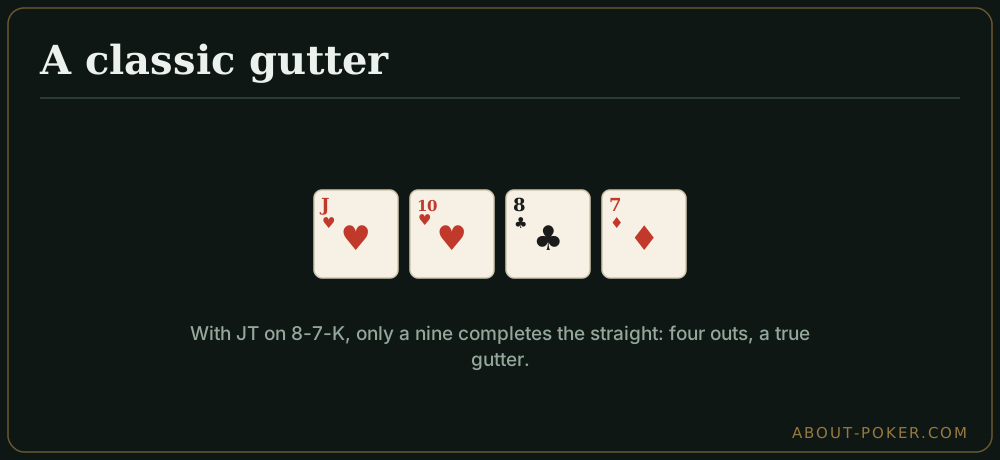
You hold 8h 9h and the flop comes 6c 7d Kd. To make a straight you need a five or a ten. Wait, that is actually an open-ender. Let us adjust to a true gutter: you hold Jh Th and the flop is 8c 7d Kd. Now you need a nine, and only a nine, to make the straight from seven-eight to jack-ten.
There are four nines in the deck, so you have four outs, a classic gutter. If your opponent bets half the pot on the turn, you are getting 3 to 1 on a call while your one-card odds are about 10.5 to 1. Calling for the straight alone loses money. You would only continue if you also pick up extra equity, such as two overcards or a backdoor flush, or if you plan to use the draw as a semi-bluff to fold out better hands.
Why gutters are dangerous and useful
The danger is that a gutter is easy to overvalue. It looks like a straight draw, so beginners chase it at bad prices and slowly bleed chips. Four outs simply is not enough equity to call big bets on its own.
The usefulness is in aggression. A gutter makes a good semi-bluff because when you bet, you can win two ways: your opponent folds now, or they call and you complete the straight. Betting a hand like the one above turns a weak draw into a hand with real fold equity plus backup outs. This is the difference between chasing and applying pressure, a theme covered in our guide to draws in poker.
Common gutter mistakes
- Calling too much for four outs. The odds rarely justify calling big bets to hit one rank. Check the price against the roughly 5 to 1 by-the-river math.
- Ignoring extra equity. A gutter with two overcards or a backdoor flush can jump to eight or more effective outs, which changes everything.
- Never bluffing with it. A bare gutter that can never win a big pot is a fine candidate to bet as a semi-bluff, especially on scary boards.
- Chasing on a wet, multi-way board. Even if you hit, your straight may not be the nuts. Beware gutters when a flush or higher straight is possible.
Quick checklist
- Count your outs. A pure gutter has four.
- Compare pot odds to the roughly 10.5 to 1 single-card odds.
- Add any overcards or backdoor draws to your real equity.
- Ask whether betting the draw wins the pot two ways.
- Discount your hand if hitting still leaves you behind a bigger draw.
The bottom line
A gutter is just slang for a gutshot: an inside straight draw with four outs and modest odds. On its own it is a weak draw that beginners overplay. In the hands of a thinking player it becomes a valuable semi-bluffing tool, especially when it carries extra equity. Respect the small out count, price your calls correctly, and use aggression rather than passive chasing to make gutters pay.
Frequently asked
Is a gutter the same as a gutshot?
Yes. Gutter is casual slang for a gutshot, also called an inside straight draw or belly buster. It means you need exactly one rank in the middle of your would-be straight, giving you four outs to complete it.
How many outs does a gutter have?
A gutshot has four outs, one for each suit of the single rank you need. That translates to roughly 8.5 percent to hit on the next card and about 16.5 percent to complete by the river with two cards to come.
Should I chase a gutter?
Rarely for its raw odds alone, but often as a semi-bluff or with added equity. A bare gutshot needs cheap prices or extra outs like overcards or a backdoor flush to be profitable. Its real value comes from the times you can bet and make a better hand fold.