What Is Hand Reading in Poker?
Hand reading is narrowing an opponent's possible holdings to a range using their actions street by street. Here's the process, with a worked example.
On this page · 6 sections
Hand reading is the skill of figuring out what an opponent is likely holding — not by magic or by staring into their soul, but by logically narrowing the set of hands they could have based on how they play. The crucial word is set. Good hand readers don’t try to name one exact hand; they work with a range — a group of possible holdings — and shrink that group street by street as the opponent bets, raises, and checks. It’s the single most important analytical skill in poker, and it’s entirely learnable.
The core idea: ranges, not single hands
Beginners think hand reading means “putting someone on ace-king.” That’s almost always a mistake. A competent opponent will play many different hands the same way, so if you lock onto one holding you’ll be wrong most of the time and blindsided when they show up with something else.
Instead, you build a range: “they’d raise this spot with big pairs, ace-king, ace-queen, and some suited connectors as bluffs.” Then, as the hand plays out, you ask on each street, “which of those hands would take this action?” and delete the ones that wouldn’t. The range gets smaller and more defined. By the river you often have a tight cluster of hands and a clear plan against it.
The street-by-street process
Hand reading is a filtering process. Here’s the workflow:
- Start preflop. Assign a starting range based on the opponent’s position and preflop action. A tight player raising under the gun has a much narrower range than a loose player opening the button.
- Filter on the flop. Given the board texture and their bet or check, remove hands that don’t fit. A big bet on a dry board removes many weak hands; a check might remove the strongest ones (or represent a trap).
- Filter on the turn. Repeat. Barreling a second time cuts the range further — most players don’t fire two streets with pure air.
- Filter on the river. The final action usually splits the range into value hands and bluffs. Now you can compare the price you’re getting against how often you beat that range.
A worked example
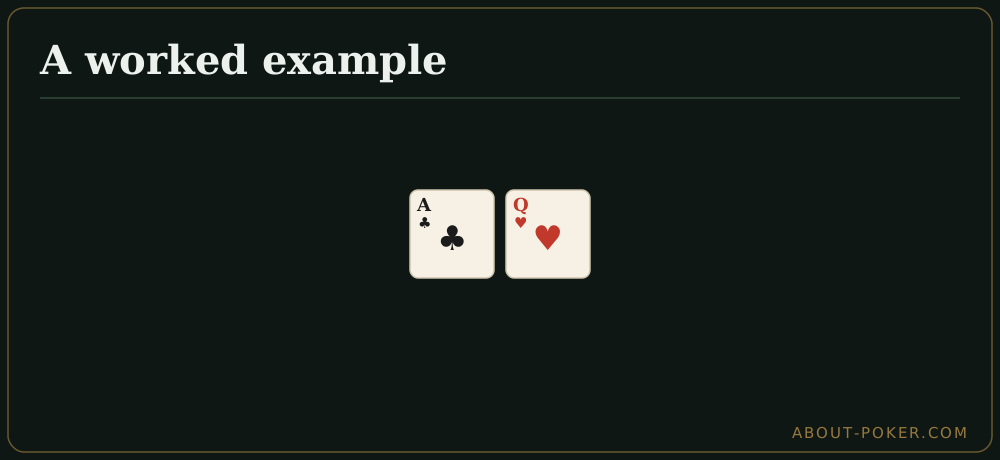
You’re in a $1/$2 game. A tight-aggressive regular opens to $6 from the cutoff. Preflop you assign them a range of strong pairs, big broadways, and some suited hands — say 66+ (pairs sixty-six and up), A-J and better, K-Q, and a few suited connectors.
The flop comes K♦ 7♠ 2♣. They bet. That dry board doesn’t change much — they’d bet their kings, overpairs, and some ace-high bluffs. Range still fairly wide.
The turn is the 4♥. They bet again — a second barrel. Now you can delete most of the pure air; few players fire two streets with nothing here. Their range is tightening toward top pair and overpairs (K-Q, A-K, A-A, Q-Q, J-J) plus a small slice of bluffs.
The river is the 5♠, and they bet big a third time. Three barrels on this runout is heavily weighted to strong made hands. You also hold two cards that matter for the blocker effect: if you hold the ace, you make A-K and A-A less likely in their range, nudging your read toward second-best value or the rare bluff. That single deduction can turn a fold into a call.
The information you use
Every clue is a filter. Position tells you how wide someone opened. Bet sizing distinguishes value from bluff for many players. Board texture determines which hands connect. Timing and physical tells add color in live games. And player tendencies matter enormously — the same 3-bet means one range from a nit and a much wider one from a maniac. You weigh all of it together, not any single tell in isolation.
Common hand-reading mistakes
- Locking onto one hand. The cardinal error. Keep a range alive until the action forces it narrow.
- Ignoring your own range. Good opponents are reading you too; think about what your line represents.
- Forgetting bluffs and blockers. A river range isn’t all value — account for the bluffs, and use your own cards to estimate what they can’t have.
- Over-narrowing. Don’t delete hands the opponent would genuinely play just because you’d play them differently.
Quick checklist
- Read ranges, never a single hand — a good player has many hands that play alike.
- Start with a preflop range by position and action, then filter each street.
- Delete hands that wouldn’t take the action you just saw; keep the ones that would.
- Use position, sizing, texture, timing, and tendencies as filters together.
- Factor in blockers and bluffs before you commit on the river.
Hand reading turns poker from guesswork into deduction. The more you practice narrowing ranges — reviewing hands afterward and drilling the street-by-street logic — the faster it becomes, until you’re doing it almost automatically while the action is still live.
Frequently asked
What is hand reading in poker?
Hand reading is the skill of narrowing down the set of hands an opponent could hold — their range — by interpreting their actions on each street. Rather than guessing one exact hand, you start with all the hands they'd play preflop and eliminate holdings that don't fit their bets, raises, and checks as the board develops.
Is hand reading about putting someone on one hand?
No — that's the beginner version and it's usually wrong. Skilled hand reading works with ranges, not single hands. You keep a whole group of plausible holdings alive and adjust the mix as new information arrives, because a good player will have several different hands that play the same way.
How do you get better at hand reading?
Practice narrowing ranges street by street: start with a preflop range for the opponent's position and action, then remove hands that wouldn't take each subsequent action. Reviewing your own hands afterward and using range-narrowing trainers builds the pattern recognition that makes it fast at the table.
What information do you use to read hands?
Position, preflop action, bet sizing, board texture, timing, and player tendencies. Each action an opponent takes is a filter that removes some hands from their range and makes others more likely, so you combine all of these clues to shape the range on every street.