What Is Gutshot in Poker?
A gutshot is an inside straight draw with just four outs. The exact odds, how to play it as a semi-bluff, and a clear worked example.
On this page · 6 sections
A gutshot — also called an inside straight draw or a belly buster — is a straight draw missing one card in the middle of the sequence. Only a single rank completes it, which means just four cards in the whole deck can help you. That makes the gutshot the weakest common straight draw, but it is far from useless: played as a semi-bluff, a gutshot wins pots that its raw equity never could.
What makes it a gutshot
A straight is five cards in a row. With a gutshot you hold four of the five, but there is a hole in the middle. Say you have 9-8 and the board shows 6-5. Your cards run 9-8, then a gap, then 6-5. Only a 7 fills that gap to make 9-8-7-6-5. Every other card leaves you with nothing.
Contrast this with an open-ended straight draw, where you have four cards in sequence and can complete on either end. Open-ended draws have eight outs; a gutshot has only four. That difference — four outs versus eight — is the whole reason gutshots are treated so much more cautiously.
The exact odds
With four outs, a gutshot hits about 8.5 percent of the time on the next single card (4 outs divided by 47 unseen cards). If you will see both the turn and the river, your chance of completing rises to roughly 16.5 percent — a little better than 1 in 6.
The quick mental shortcut is the “rule of 2 and 4.” Multiply your outs by 2 for the chance to improve on the next card, or by 4 for the chance across both remaining cards. Four outs times two is about 8 percent per street; four times four is about 16 percent by the river. Both match the true figures closely enough for table use.
Why raw equity isn’t the point
Sixteen percent by the river sounds too small to play, and if calling were your only option, it usually would be. The reason gutshots are worth having is that you can win the pot two ways: by hitting the straight, and by betting so your opponent folds. That second path — the semi-bluff — is where gutshots earn their keep.
When you bet or raise with a gutshot, you apply pressure now while keeping a backup: if you get called, you still have four outs to make the best hand. Skilled players love gutshots as bluffing candidates precisely because a “pure” bluff has zero outs, while a gutshot bluff has real equity when called.
A worked example
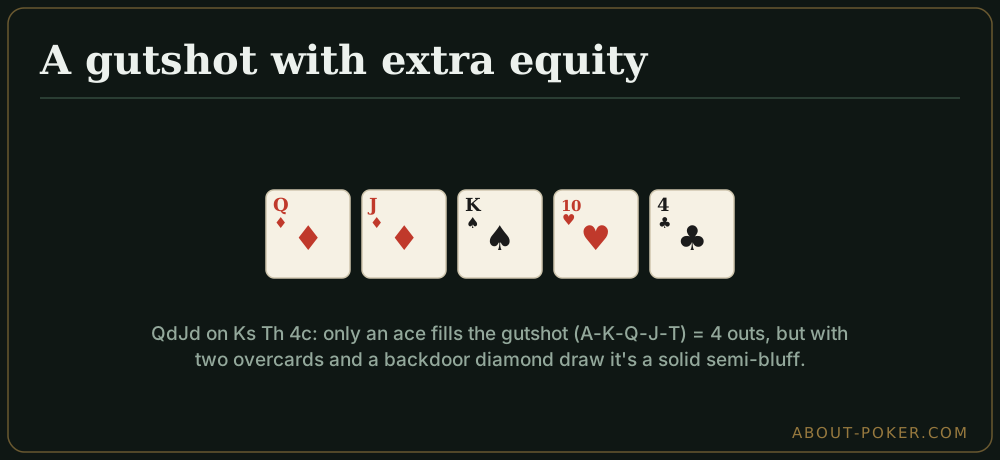
You hold Q♦ J♦ and the flop comes K♠ T♥ 4♣. You have a gutshot: an ace makes A-K-Q-J-T, and only an ace does. That is four outs. On its own, calling a big bet here would be a losing play — you are roughly a 4-to-1 underdog to hit by the turn.
But look closer. You also have two overcards to the board’s low card, a backdoor diamond flush draw, and position. Now betting makes sense. If your opponent folds, you win immediately. If they call and an ace comes, you make the nut straight and can stack them, because the straight is well disguised. And even a queen or jack on the turn may give you the best hand. The gutshot is the anchor of a hand with several ways to win — that is how you should almost always view it, not as a lone draw.
How position and opponent change it
In position, a gutshot is much more playable. You control the pot size, you can take a free card when checked to, and your semi-bluffs work better because your opponent has already shown weakness. Out of position, a bare gutshot is often a fold to real pressure — you cannot realize your equity as easily and you risk being blown off the hand.
Opponent type matters too. Against a player who folds too much, a gutshot semi-bluff is close to free money because the fold equity is high. Against a calling station who never folds, drop the bluff entirely and only continue if the price to draw is genuinely cheap, since you will have to actually hit the four-outer to win.
Common mistakes and a checklist
The classic leak is calling big bets with a naked gutshot and no extra equity, hoping to spike the one card. Over time that bleeds chips. The fix: before continuing with a gutshot, ask whether you have something extra — overcards, a backdoor flush, position, or strong fold equity. If yes, a semi-bluff or a cheap call is fine. If it is a bare four-outer facing a large bet with nothing else going for it, fold and wait for a better spot. Discipline with gutshots is a quiet mark of a winning player.
Frequently asked
How many outs does a gutshot have?
Four. Only one rank completes an inside straight, and there are four cards of that rank in the deck, so a gutshot has exactly four outs unless some are blocked.
What are the odds of hitting a gutshot?
About 8.5 percent per single card, and roughly 16.5 percent to hit by the river when you see both the turn and river. That is why the rule of thumb is four outs times two per street, times four for two cards to come.
Should I call with just a gutshot?
Usually not for a big bet, because four outs rarely gets the right price. Gutshots play best as semi-bluffs where you can win by making your opponent fold, or as cheap calls with extra equity like overcards or backdoor draws.