What Is Gutshot Draw in Poker?
A gutshot draw needs one specific rank in the middle to make a straight. Its four outs, real odds, and how to turn a weak draw into a profitable semi-bluff.
On this page · 6 sections
A gutshot draw — also called an inside straight draw or belly-buster — is a straight draw with a hole in the middle that only one rank can fill. You hold four cards toward a straight, but they are not consecutive: there is a single gap, and just one rank plugs it. That leaves you four outs, exactly half of what an open-ended draw offers, which makes the gutshot the weakest of the common straight draws.
What “gutshot” means
A straight is five cards in a row. With a gutshot you have four of the five ranks, but with a gap in the middle rather than an open run at both ends. Because only the missing middle rank helps you, and there are four cards of that rank in the deck, you have exactly four outs.
Take J-10 in your hand and a board of 8-7-2. Your sequence is J-10 _ 8-7, and only a 9 completes J-10-9-8-7. No card on either end works — a queen or a six leaves you short. That single-rank dependency is what defines a gutshot and why it is so much weaker than the open-ended straight draw, which fills at both ends for eight outs.
The odds, done correctly
With four outs, the math is clean. On the next single card you hit about 4 times 2, or roughly 8.5 percent. With two cards still to come — for instance on the flop, seeing both turn and river — you use 4 times 4, or about 16.5 percent. Those are the standard, correct figures.
That means a bare gutshot completes only about one time in six by the river. On its own that is not enough to chase with big bets, which is why a naked gutshot is rarely worth calling large sums to draw. Its value comes from other sources, as we will see.
A worked example
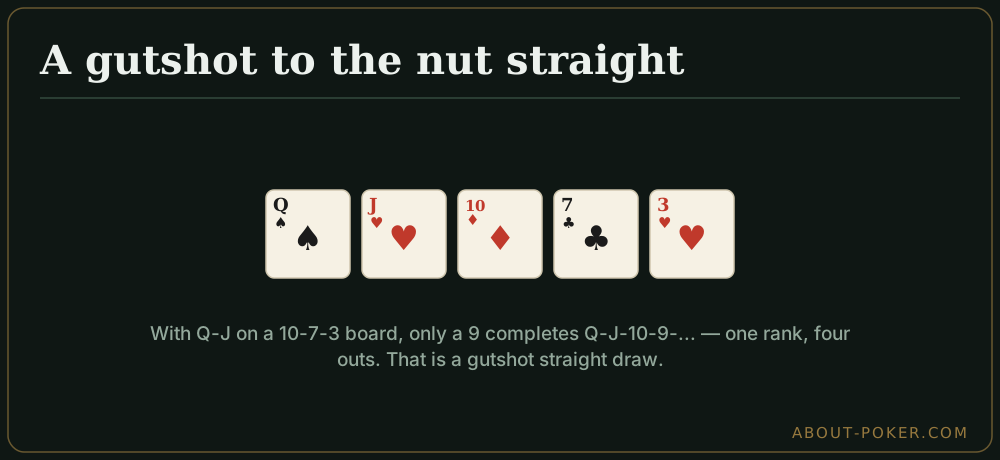
You call a raise on the button with Q-J and the flop comes 10-7-3 with two of a suit you do not hold. You have a gutshot to the nut straight: only a king or a nine completes a run for you, and here just the 9 plugs the Q-J _ 10 sequence — a classic gutshot with four outs, plus two overcards.
If your opponent bets and you are getting good immediate odds, you might call because your overcards add extra outs and your position lets you realize equity. But if the bet is large and your overcards are not clean, folding a bare gutshot is often correct. The draw alone is not strong enough; the surrounding factors decide.
Turning a gutshot into a profitable play
A gutshot is most profitable as a semi-bluff. Even with only four straight outs, you can raise or bet, because you win two ways: your opponent folds now, or you hit the straight later. This fold equity plus the four outs together can make an aggressive line more profitable than a passive call.
Gutshots also gain value when they carry extra equity. A gutshot with two overcards, a backdoor flush, or a pair adds outs that a bare gutshot lacks. When you fold out better hands and have a real chance to improve, the play prints money over time.
- Semi-bluff with fold equity. Betting a gutshot as a bluff you can back into is stronger than passively calling.
- Prefer nut gutshots. A draw to the best possible straight lets you get paid when you hit and bluff more credibly.
- Add up your real outs. Overcards, backdoor flushes, and pairs turn a four-out dog into a genuine threat — sometimes a combo draw.
- Do not chase bare gutshots for big bets. Four outs and 16 percent do not justify large calls without a payoff or extra equity.
Gutshot versus open-ended
The contrast with an open-ended straight draw is the key lesson. An open-ended draw has eight outs and completes about 31 percent of the time by the river; a gutshot has four outs and completes about 16.5 percent. The open-ender is exactly twice as likely to hit, so it can call bigger and bet more freely. A gutshot needs help — fold equity, position, or extra outs — to be worth pursuing.
Quick checklist for gutshots
- One rank fills the middle gap — four outs, half of an open-ender.
- Roughly 8.5 percent on one card, 16.5 percent to the river.
- Best used as a semi-bluff where fold equity does the heavy lifting.
- Nut gutshots and gutshots with extra equity are worth far more.
- Fold bare gutshots facing large bets without a payoff.
A gutshot is a small draw, but small draws played aggressively at the right moments add up. Respect the weak math, lean on fold equity, and only chase when the extra outs or the price make it worthwhile.
Frequently asked
What is a gutshot draw in poker?
A gutshot draw, also called an inside straight draw, needs one specific rank in the middle of your sequence to complete a straight. You hold four cards to a straight with a gap, so only one rank fills it — giving you four outs.
How many outs does a gutshot have?
Four. Only one rank completes the straight, and there are four cards of that rank in the deck. That makes a gutshot exactly half as likely to hit as an open-ended straight draw, which has eight outs.
What are the odds of hitting a gutshot?
About 8.5 percent on the next single card and roughly 16.5 percent to complete by the river when you will see both cards. The shortcut is four outs times two per street, or times four for two cards to come.