What Is Kicker in Poker?
A kicker is the side card that breaks ties in poker. Learn how kickers decide winners, why they matter preflop, and how to avoid dominated hands.
On this page · 7 sections
The kicker is one of the most misunderstood ideas for new players, and it quietly decides more pots than people realize. Once you understand it, you make sharper decisions before the flop and stop losing chips to hands that look strong but are actually dominated.
The Core Answer
A kicker is a card that is not part of your primary made hand but is still used to determine the winner when two players hold the same ranking. Every poker showdown compares exactly five cards. If your best five cards include a pair, you only “use” two cards for the pair itself, so the other three are kickers. Those kickers are compared one at a time, highest first, until the tie breaks.
The key rule to memorize: kickers only matter when the main portion of two hands is identical. If you have two pair and your opponent has one pair, the kicker never enters the discussion because two pair already wins. Kickers are a tiebreaker, not a ranking of their own.
A Worked Example
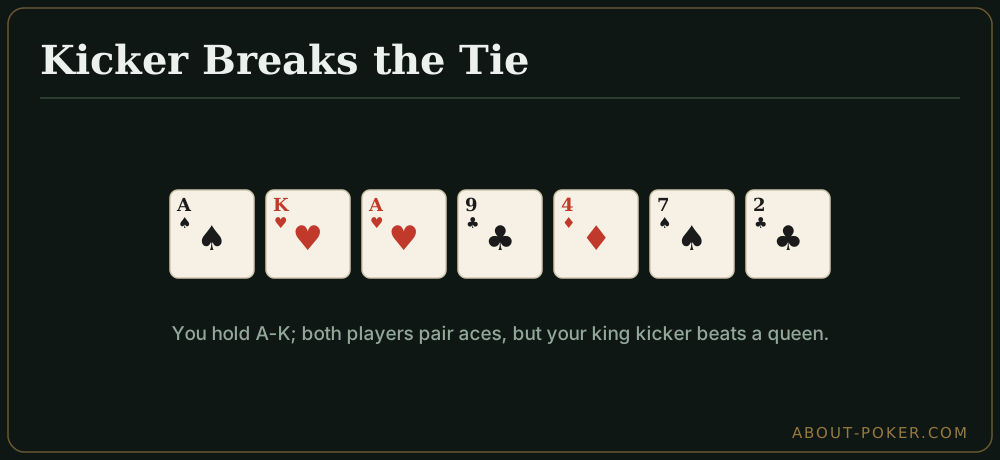
You hold A-K and your opponent holds A-Q. The board runs out A-9-4-7-2. Both of you now have a pair of aces. The pair itself is a tie, so the hand comes down to the next-best card. You play A-K-9-7 as your kickers, your opponent plays A-Q-9-7. On the second card, your king beats their queen, and you win the pot.
Now flip it. You hold A-2 against A-K on the same board. You both make aces, but your best five cards are A-K-9-7-2 versus their A-K-9-7 and a queen — wait, they hold the king, so their kicker chain is stronger and they win. This is exactly why A-2 is a trap hand: when you pair your ace, you are often out-kicked by a better ace.
Why Kickers Punish Weak Aces
The most expensive kicker mistakes happen with what players call “weak aces” — hands like A-5 or A-7 offsuit. They look tempting because an ace is the highest card, but if you pair it and someone else also holds an ace with a bigger side card, you lose a big pot. When you understand what a range is, you can see that a raiser’s range is full of stronger aces, so calling with a weak ace often means playing a dominated hand.
The practical takeaway: the value of an ace comes largely from its kicker. A-K is a premium hand; A-4 is a marginal one. The ace is the same, but the kicker changes everything.
Kickers Beyond Top Pair
Kickers apply to more than pairs. With trips, the two remaining cards are kickers. With one pair, the three remaining cards are all kickers. Only hands that use all five cards — a straight, a flush, a full house, or better — have no kicker at all, because there is no leftover card to compare.
This also explains why an overpair is so strong: a pocket pair higher than the board makes a pair whose rank alone beats everyone who paired the board, so you rarely even need the kicker. The strength lives in the pair itself.
Common Mistakes
New players make three recurring kicker errors. First, they overvalue any ace, forgetting the side card decides close spots. Second, they forget that once they make two pair or better, kickers stop mattering, and they fold winning hands out of confusion. Third, they misread the board and think a “playing the board” situation is a chop when in fact their hole cards give them a kicker edge. Slow down at showdown and count all five cards.
How Position and Stakes Change Kicker Value
Kicker value is not fixed; it shifts with the situation. Early in a hand, against a tight opener who raises from up front, the odds that your ace faces a bigger ace go way up, so a weak kicker is far more dangerous. Against a loose player who opens half their hands, your kicker plays much better because their range is full of worse aces and random cards. Stack depth matters too: deep-stacked, a dominated kicker can cost you a huge pot when you make top pair and refuse to fold, so kicker quality matters more the deeper you play. Short-stacked, all-in preflop, the kicker still matters but you rarely have the option to fold your way out of trouble.
Quick Checklist
Before you commit chips with a top-pair hand, run this mental check. Is my pair likely to be the best pair, or could a raiser hold the same pair with a better card? What is my kicker, and does it beat the typical kickers in my opponent’s range? If I only have a small kicker, am I willing to fold when facing pressure? Answering these honestly keeps you out of the classic dominated-ace disaster and turns the kicker from a mystery into an edge. For a shorter reference on the term itself, see the kicker glossary entry.
Frequently asked
What is a kicker in poker?
A kicker is a card that is not part of the made hand but is used to break ties between two players who hold the same ranking. For example, with a pair of aces, your highest remaining card decides who wins if both players hold aces.
Does the kicker always matter?
No. The kicker only comes into play when both players have the same primary hand, such as the same pair or the same trips. If one player already has a stronger hand class, kickers are irrelevant.
How many kickers does a hand use?
A five-card poker hand always uses exactly five cards. If your made portion is a pair, the remaining three cards act as kickers, compared in order from highest to lowest until the tie is broken.