What Is Ladder Up in Poker?
Laddering up means surviving to climb into higher tournament payout tiers. Here's what it means, when to fold for the ladder, and when it costs you.
On this page · 6 sections
To ladder up in a poker tournament means to survive as other players bust, climbing into higher and higher payout tiers without necessarily winning any chips yourself. Every prize structure is a staircase — each finishing position pays a little (or a lot) more than the one below it. When a rival gets eliminated before you, you step up a rung and lock in more real money. Understanding when to fight for those steps and when to ignore them is one of the most valuable skills in tournament poker.
The exact meaning
Picture a payout ladder: 9th place pays $1,000, 8th pays $1,300, 7th pays $1,700, and so on up to first. If you’re sitting in 9th chip position at the final table and the player in 8th busts, you’ve just “laddered up” — you’re now guaranteed at least $1,300 without having played a hand. The verb captures that upward movement through the pay tiers driven by other people’s eliminations.
Laddering is passive by nature. You don’t have to accumulate chips to do it; you just have to not bust before someone else does. That’s why it becomes a live strategic goal in exactly the spots where survival is worth a lot of money.
Why laddering matters: ICM
The reason laddering is more than wishful thinking comes down to ICM — the Independent Chip Model. ICM says a chip’s real-money value depends on the stack sizes and remaining payouts, not just its face count. Near big pay jumps, surviving is worth a disproportionate amount, so preserving your tournament life can be worth more than winning a coin-flip pot.
That’s the mathematical engine behind laddering. When the gaps between prizes are large and there are shorter stacks around you, folding a marginal hand to let them bust first is often the highest-EV play — even when the hand itself is a slight favorite in chips.
A worked example
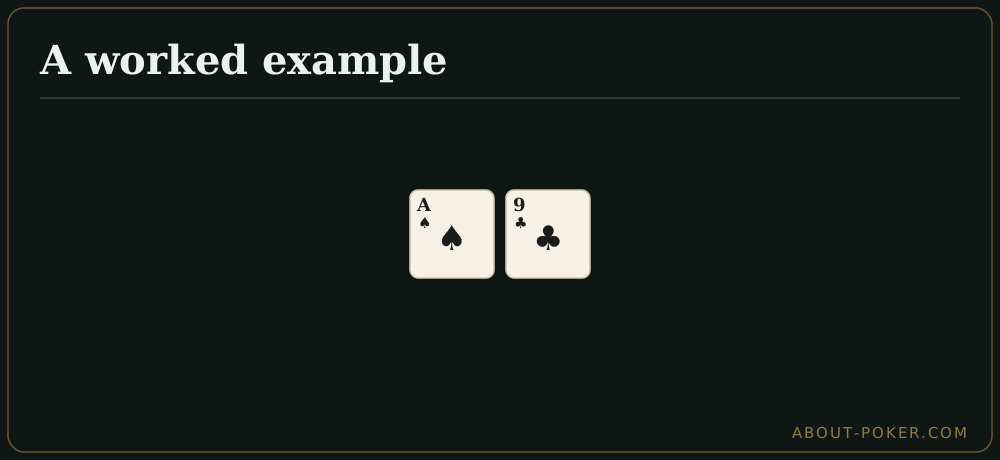
Six players remain at a final table. Payouts jump sharply: 6th pays $2,000, 5th pays $3,000, 4th pays $4,500. You have 12 big blinds — the second-shortest stack. The shortest stack has just 4 big blinds and is about to be forced all-in by the blinds next orbit.
You pick up a hand like A-9 offsuit and face an all-in from a big stack. In a normal chip world, A-9 is close to a call. But here, folding is often correct: if you fold, the 4-blind stack is likely to bust within the next orbit, laddering you from $2,000 up to $3,000 for free. Risking your tournament life on a coin flip when someone else is about to bust anyway throws away that guaranteed pay jump. You survive, they bust, you ladder up.
When laddering is a trap
Laddering only pays when the jumps are meaningful and there are genuine short stacks to outlast. It becomes a costly mistake in two situations:
- Tiny pay jumps. If the difference between spots is small — a few dollars, like in the flat lower tiers just past the min-cash — folding good hands to survive barely helps. The real money is up top, and playing scared forfeits it.
- You have a big edge. If you’re deep-stacked and clearly the best player left, chips are your friend. Accumulating to run over the table is worth far more than nervously protecting a mid-tier finish.
The classic error is a player who tightens up so hard to ladder that they blind down into a shove-or-fold stack, then bust anyway — having sacrificed all their chip-accumulation spots for a small ladder that never materialized.
How to decide in the moment
- Check the pay jumps. Are the next few steps large relative to your stack? If yes, laddering has real value.
- Scan for shorter stacks. Is there someone likely to bust before you? Laddering needs a victim ahead of you.
- Weigh your edge. Are you a favorite to run deep on skill and stack? If so, lean toward accumulating.
- Respect the clock. Don’t fold yourself into oblivion — surviving is only valuable if you still have a playable stack.
Quick checklist
- Laddering = climbing pay tiers by outlasting other players, not by winning chips.
- It’s powered by ICM: survival is worth extra money near big pay jumps.
- Fold marginal hands to ladder when jumps are large and shorter stacks are about to bust.
- Ignore laddering when jumps are tiny or you have a clear skill and chip edge.
- Never blind down to nothing chasing a small ladder — that turns survival into a slow bust.
Laddering rewards patience with precision. Know the payout structure cold, watch the stacks around you, and you’ll always know whether this is a hand to fold for a free pay jump or a hand to gamble toward the top of the ladder.
Frequently asked
What does ladder up mean in poker?
To ladder up means to survive long enough that other players bust before you, moving you into a higher payout tier. Each time a player is eliminated near you, you climb one rung of the prize ladder and lock in more money without winning a single chip yourself.
When should you play for the ladder?
Play for the ladder when the pay jumps are large relative to your stack and there are shorter stacks likely to bust before you — common at final tables and satellite bubbles. In those spots, survival can be worth more than chips, so folding marginal hands to outlast others is correct.
When is laddering a mistake?
Laddering becomes a mistake when you fold away too much equity to survive a small pay jump. If the money bumps are tiny or you're deep-stacked with a big edge, playing scared to ladder up sacrifices the far larger value of accumulating chips and reaching the top prizes.
What is the difference between laddering and min-cashing?
Min-cashing is reaching the lowest paid spot once. Laddering is the ongoing act of climbing through multiple pay tiers by outlasting other players. You min-cash first, then continue to ladder up each time someone above the bubble busts before you.