What Is Level in Poker?
Level in poker has two meanings: the tournament blind level, and the layer of thinking you and your opponent are on. Learn both, with examples.
On this page · 7 sections
“Level” is one of those poker words that means two completely different things depending on the sentence. In a tournament, a level is a chunk of time with fixed blinds. In a strategy discussion, a level is a layer of thinking in the mental chess match between you and your opponent. Both are worth knowing cold.
Meaning One: The Tournament Level
In any tournament, play is divided into levels — timed periods, often 15 to 30 minutes online or 40 to 90 minutes live, during which the blinds and antes stay fixed. When a level ends, the blinds go up according to a published structure.
For example, a tournament might open at level 1 with blinds of 25/50, move to level 2 at 50/100, then 75/150, and keep climbing. As the levels rise, the blinds eat into stacks faster, forcing action. Knowing your stack in big blinds at each level tells you how much room you have to play. A 10,000 stack is enormous at 25/50 (200 big blinds) and desperate at 1,000/2,000 (5 big blinds), even though the chip count never changed.
Deep, slow levels reward patient, skilled play; fast, turbo levels reward aggression because there is no time to wait for premium hands. Reading a structure sheet before you sit down is a basic edge many players skip.
Meaning Two: Levels of Thinking
The more interesting meaning comes from David Sklansky’s idea of “multiple levels of thinking.” Each level is a layer of what you are reasoning about:
- Level 0: Not thinking about hands at all — just playing your cards.
- Level 1: What do I have?
- Level 2: What does my opponent have? (Their range.)
- Level 3: What does my opponent think I have?
- Level 4: What does my opponent think I think they have?
Each step up tries to peek one layer deeper into the other player’s head. The whole discipline of reading these layers is covered in depth in our guide to level thinking.
A Worked Example of Leveling
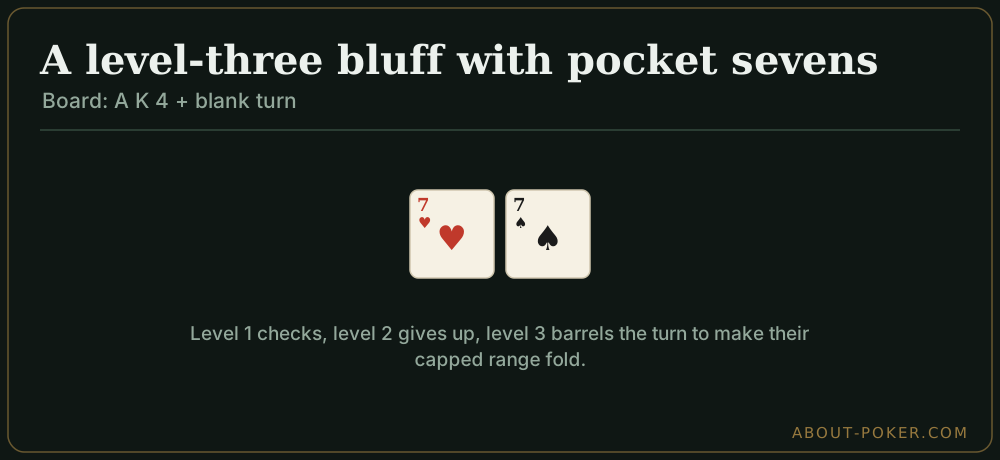
You hold 7h 7s on a board of A-K-4. You bet the flop and your opponent calls. The turn is a blank.
- A level 1 player just checks — “I only have a pair of sevens, that’s weak.”
- A level 2 player thinks, “They called an ace-high board; they probably have an ace or a king, so my sevens are behind. Check.”
- A level 3 player thinks, “They called my flop bet but they call there with a lot of weak aces and draws they will fold to more pressure. They also expect me to give up now if I have nothing. So a second barrel represents the strong hand they are worried about.” That player fires a turn bluff precisely because the opponent is thinking one level below.
The winner of the exchange is not the deepest thinker — it is the player exactly one level above the other.
Leveling Yourself
The classic trap is called “leveling yourself”: thinking so many layers deep that you outsmart yourself against an opponent who is not thinking at all. If your opponent is a level-1 player who bets when they have a hand and checks when they do not, all your level-4 reasoning about “what they think I think” is wasted. Against them, the winning move is simple: believe their bets and fold your bluff catchers.
The rule is blunt but reliable: figure out what level your opponent is on, then move exactly one step above it. No more.
How the Two Meanings Interact
The meanings connect at the poker table more than you would expect. Early tournament levels are deep-stacked, so there is room for multi-street, multi-level thinking. Late levels are short-stacked, and the game collapses toward level 1 and 2 — with 8 big blinds there is no room for a level-4 bluff, only shove-or-fold math. So the tournament level you are in shapes which thinking levels are even relevant.
Common Mistakes
Ignoring the structure. Not knowing how fast levels rise leads to passive play that gets blinded out.
Over-leveling weak opponents. The single most common leaking spot is thinking three levels deep against someone playing face-up.
Assuming everyone thinks like you. Your reads only work if you correctly identify the other player’s level first.
Quick Checklist
- In a tournament, know the current blind level and your stack in big blinds.
- Identify your opponent’s thinking level before you act.
- Aim to operate exactly one level above them.
- When in doubt against a simple player, drop back down — do not level yourself.
Frequently asked
What does level mean in poker?
Level has two meanings. In tournaments, a level is a timed period with a fixed set of blinds and antes. In strategy talk, a level is a layer of thinking — level one is your own cards, level two is what your opponent has, level three is what they think you have, and so on.
What is leveling in poker?
Leveling is the mental game of outthinking your opponent by operating one layer above them. If they are trying to read your hand, you act based on how they will read it. Overdoing it — thinking too many layers deep against a simple opponent — is called leveling yourself.
How many levels of thinking are there?
The classic model runs from level zero (not thinking about hands at all) up through level one (my cards), two (their cards), three (their read of me), and beyond. In practice you only need to be one level above your specific opponent to win the exchange.