What Is Merged Range in Poker?
A merged range is a betting range of strong and medium hands with few pure bluffs. Learn how it differs from a polarized range, with a worked example.
On this page · 6 sections
A merged range is a betting range built from strong and medium-strength value hands with very few or no pure bluffs. Rather than splitting your bets into “the nuts and air,” a merged range blends — or merges — a continuous band of good hands together. You are betting a whole tier of hands that are ahead of what your opponent will call with, aiming for thin value across the board. It is one of the two fundamental ways to construct a betting range, and knowing when to use it separates thinking players from robotic ones.
Where the term comes from
The word describes the shape of the range. Imagine ranking every hand from strongest to weakest. A polarized range bets only the very top and the very bottom, leaving a gap in the middle. A merged range fills that gap — the strong and medium hands are merged into one continuous group that all bet together. Some players call this a “linear” range for the same reason: it runs in a straight line from the top down, without the split.
Merged versus polarized
This is the key contrast, so it is worth making sharp:
- Polarized range: very strong hands plus bluffs, nothing in between. Bet large. Your opponent cannot tell the nuts from air.
- Merged range: strong and medium value hands, few or no bluffs. Bet small to medium. You get called by many weaker hands.
The two ranges solve different problems. A polarized range wants either a fold or a big call from a strong second-best hand. A merged range wants a lot of small calls from many weak hands. That is why merged ranges pair naturally with an underbet or a modest half-pot bet, while polarized ranges use overbets. To use either well, you first need to understand what a range is and how boards favor one player over another.
Worked example: betting a merged range
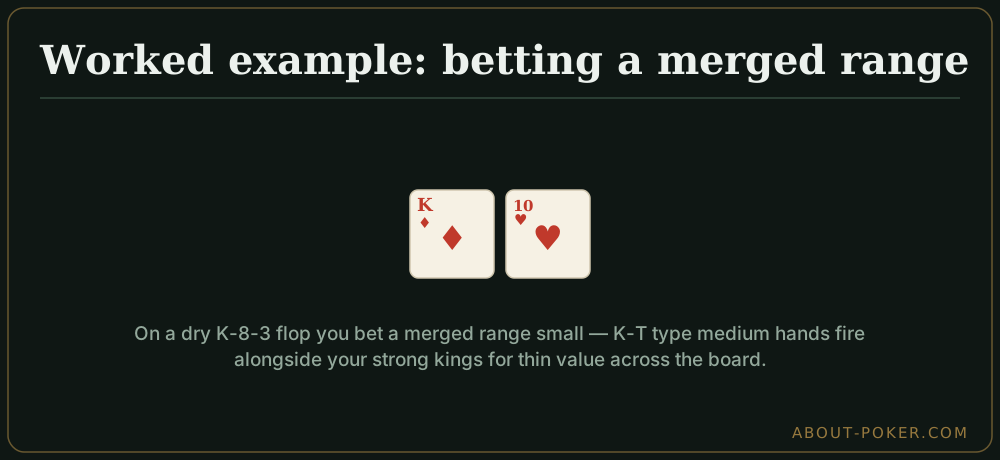
You raise preflop from the button and the big blind calls. The flop comes:
K♠ 8♦ 3♣
This dry, king-high board strongly favors your raising range — you have far more kings and overpairs than the big blind does. Here you can bet a merged range with a small size, say a third of the pot. What goes into it?
- Strong hands: K-Q, K-J, A-A, K-K — clear value.
- Medium hands: A-K, K-T, 8-8, second pair, and some ace-highs that are still ahead of much of the caller’s range.
Notice there are very few pure bluffs. You do not need them, because your medium hands are already ahead of the big blind’s weak kings, middle pairs, and floats. A small bet lets all of these hands bet and get called by the many worse hands the caller holds. That is thin value gathered across a wide, merged range — you win a little from many hands rather than a lot from a few.
Contrast that with the turn on a scary runout, where you might switch to a polarized range: only your very best hands and a few bluffs bet big, and everything in the middle checks.
When to use a merged range
Use a merged (linear) range when:
- You have a range advantage but not a nut advantage — your good and medium hands are ahead, but you rarely hold the absolute nuts.
- The board is dry and favors you, so weak hands call small bets without much risk of getting drawn out.
- You want to bet a wide range cheaply and deny equity while collecting thin value.
Switch to a polarized range on later streets, on wetter boards, and when you hold a genuine nut advantage that lets you overbet with your best hands and bluffs.
Common mistakes
- Betting merged too big. A large bet with a merged range folds out worse hands and gets called by better — the opposite of what you want. Keep it small.
- Adding too many bluffs. A merged range is value-heavy by definition. Stuffing it with bluffs turns it into a bad polarized range.
- Using it on the wrong board. On coordinated boards that hit the caller, your medium hands are no longer ahead. Tighten up.
- Ignoring later streets. A range that is merged on the flop may need to polarize by the river as the board and stacks change.
Quick checklist before you bet a merged range
- Do I have a range advantage on this board without a nut advantage?
- Are my medium hands genuinely ahead of what my opponent will call with?
- Am I using a small-to-medium size so worse hands can call?
- Is the board dry enough that cheap calls will not outdraw me often?
Match the range to the situation and the merged range becomes a quiet profit machine, grinding thin value out of spots where a big bet would win nothing. Keep building your strategic vocabulary in the poker terms glossary.
Frequently asked
What is a merged range in poker?
A merged range is a betting range made up of strong and medium-strength value hands with very few or no pure bluffs. Instead of splitting into the nuts and air, the range is 'merged' together into a band of good hands that are all ahead of what an opponent will call with, so you bet for thin value across the board.
What is the difference between a merged and a polarized range?
A polarized range is split into two groups — very strong hands and bluffs, with nothing in between. A merged range is a continuous band of strong and medium hands with few bluffs. Polarized ranges use large bets; merged ranges use small to medium bets to get thin value from weaker hands.
When should you bet a merged range?
Bet a merged range when you have a range advantage but not a nut advantage — boards where your good and medium hands are ahead of your opponent's calling range. Small sizings work best, because they let all your value hands bet and get called by the many weaker hands you beat.
Is a merged range the same as a linear range?
The terms are closely related and often used interchangeably. A linear (or merged) range bets the top of your range down through medium hands in a continuous band, as opposed to a polarized range that bets only the top and the bottom. Both describe value-heavy ranges bet with smaller sizings.