What Is Nut Advantage in Poker?
Nut advantage means holding more of the strongest possible hands than your opponent. Learn how it drives overbets, aggression, and a worked example.
On this page · 6 sections
Nut advantage describes which player holds more of the strongest possible hands on a given board. If your range contains more of the top-tier holdings — the nuts and near-nuts — than your opponent’s range does, you have the nut advantage. It is one of the most important concepts for understanding when to bet big, when to barrel, and when to back off, because the player with more nutted hands can apply pressure the other simply cannot answer.
What nut advantage means
Poker after the flop is a battle between two ranges — the full set of hands each player could hold given how the action went. Nut advantage asks a narrow, specific question: on this exact board, who has more of the very best hands?
The answer depends on the preflop story. If you raised and your opponent called, certain board textures fill your range with monsters and leave theirs without. On a board of A-K-Q, for example, the preflop raiser holds all the A-A, K-K, Q-Q sets and A-K combos, while the caller rarely has those exact hands. That is nut advantage: not that your whole range is stronger, but that you hold more of the top rung of the ladder.
Nut advantage versus range advantage
These two ideas are related but distinct.
- Range advantage means your entire range is stronger on average — more pairs, better high cards, fewer weak hands.
- Nut advantage means you specifically hold more of the best hands, regardless of the average.
You can have range advantage without nut advantage. On a board like J-9-8, the preflop raiser may have more overpairs (range advantage), but the caller who called with suited connectors holds more of the straights and two-pair combos (nut advantage). It is the nut advantage that unlocks the biggest bets, because only the nuts justify putting the most money in.
Why it matters: unlocking the overbet
Nut advantage is what makes an overbet credible. When you hold more of the strongest hands, you can bet more than the pot and your opponent has no clean answer: they can never be confident you do not have the nuts. That forces them to fold many decent hands and pay off when they do call. A player without nut advantage cannot overbet profitably, because a big bet from them is easy to snap off — everyone knows their range is capped.
This is why understanding nut advantage matters even if you never memorize a solver output. It tells you when aggression works. Bet big and barrel on boards where you own the nuts; slow down and play smaller on boards where your opponent does.
A worked example
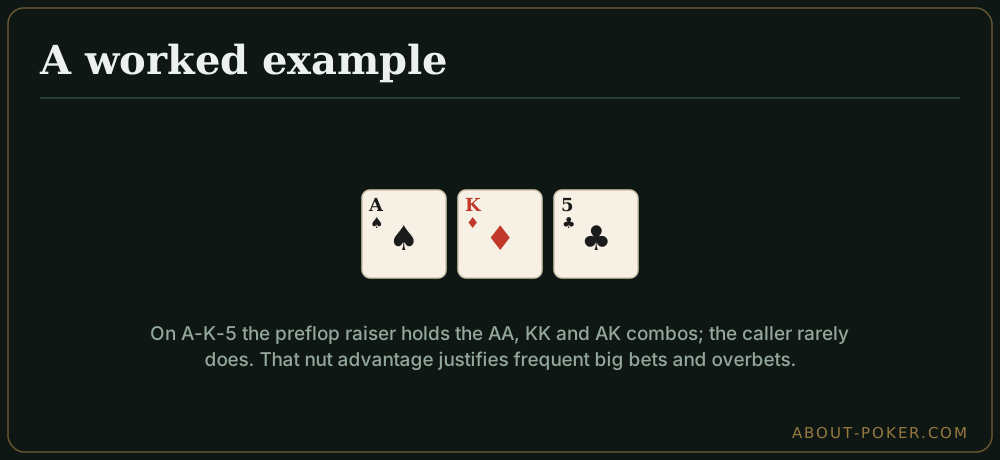
You raise preflop with a strong range and the big blind calls. The flop comes A♠ K♦ 5♣. This board is fantastic for you. Your range holds all the A-A, K-K, and A-K combinations for top sets and top two pair; the big blind’s calling range rarely contains those, since most players would 3-bet A-K and the premium pairs before the flop.
Here you have a clear nut advantage. That lets you bet often and lets you use large sizes, including overbets on later streets, because you credibly represent the top of the range. If the turn is another blank like the 8♥, you can keep barreling — the big blind still cannot have many nutted hands, so they must fold a lot of marginal made hands and give up the pot.
When you do NOT have nut advantage
The mirror image is just as important. On a low, connected board like 7♥ 6♥ 5♠, the big blind’s wide calling range is full of straights, sets, and two-pair, while your raising range holds mostly overcards and overpairs. Now they have the nut advantage. Betting big into that board is a trap — you get raised and pushed off hands, and your overpairs are not the nuts. On boards where you lack nut advantage, check more, bet smaller, and respect their aggression.
Common mistakes
The most common error is barreling big on boards that favor the caller’s range, mistaking a range advantage for a nut advantage. Overbetting a board full of straights and sets with your overpair is how stacks disappear. Another mistake is failing to use your nut advantage when you have it — betting timidly on an ace-high board wastes the leverage your range gives you. Learn to read the board through the lens of the preflop story: ask who holds more of the top hands, then bet accordingly. Own the nuts, own the pot.
Frequently asked
What is nut advantage in poker?
Nut advantage means your range contains more of the strongest possible hands on a board than your opponent's range does. The player with more nutted combinations can bet bigger and more often because they can credibly represent the top of the range.
What is the difference between nut advantage and range advantage?
Range advantage means your whole range is stronger on average. Nut advantage means you hold more of the very best hands specifically. You can have one without the other, and nut advantage is what unlocks large overbets.
Why does nut advantage matter?
It lets you apply maximum pressure. With more nutted hands you can overbet and barrel, because your opponent can never be sure you don't have the nuts, so they must fold many hands that fear the top of your range.