What Is Indifference in Poker?
Indifference is when an opponent gains the same EV whether they call or fold. Learn how balanced bet sizing creates it, with the math and a worked example.
On this page · 6 sections
Indifference is the point where a player gets the exact same expected value from two different choices — most often, where calling and folding are worth precisely the same. It sounds abstract, but it’s the engine underneath game-theory-optimal poker. When you make your opponent indifferent, they can’t beat you by favoring one action over another, because both actions pay the same.
The core idea
Exploitation works by finding a choice that’s clearly better and doing it more. If folding is more profitable than calling against your bets, a smart opponent just folds more. Indifference erases that edge: you construct your betting range so that whichever action they pick, their long-run result is identical.
That doesn’t mean the game is a wash. You still profit — from your value hands, from the dead money, from opponents who aren’t balanced against you. Indifference is specifically about neutralizing the one decision you’re offering them, so they can’t exploit that decision.
How balanced sizing creates indifference
The classic case is a river bluff-catcher. Your opponent holds a hand that beats your bluffs but loses to your value. Should they call or fold? You control the answer by choosing your ratio of value bets to bluffs.
If you have too many value bets, folding is best for them and they fold. Too many bluffs, and calling is best and they call. Hit the exact ratio dictated by the pot odds you’re laying, and their call and their fold are worth the same — they’re indifferent. Their bluff-catcher’s EV is identical either way.
This is why alpha and minimum defense frequency matter so much: they’re the exact frequencies that produce indifference. Bet the right bluff ratio and the caller is indifferent to calling; defend at exactly MDF and the bettor is indifferent to bluffing.
A worked example
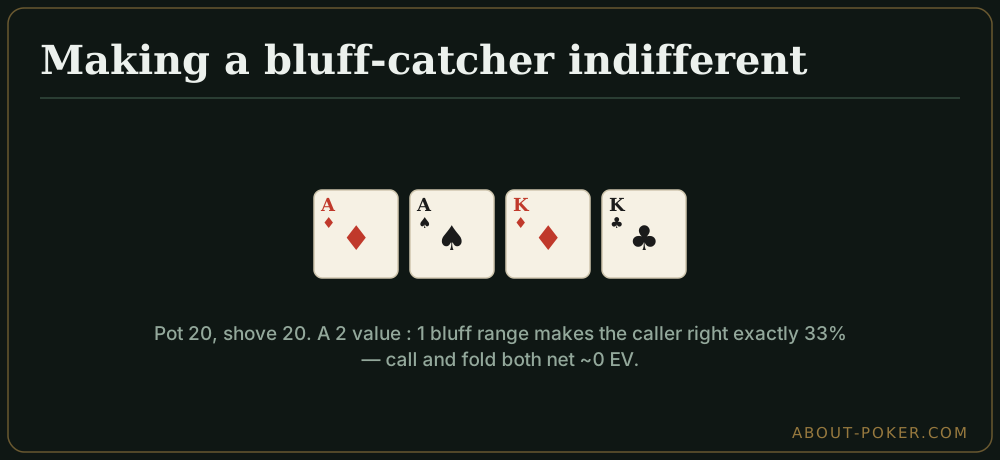
The pot is 20 on the river, and you shove for 20 more — a pot-sized bet. Your opponent has a bluff-catcher that beats every bluff but loses to every value hand.
Their pot odds: they call 20 to win 40 total, so they need to win 20 ÷ 60 ≈ 33% of the time to break even. That means your value-to-bluff ratio should make them right exactly a third of the time.
For a pot-sized bet the balanced mix is 2 value bets to 1 bluff. Say you get to the river with 6 combos: 4 value, 2 bluffs. When called, the caller beats your bluffs (2 combos) and loses to value (4 combos) — winning 2 of 6 ≈ 33%, exactly their break-even.
- If they call: they win 40 one-third of the time and lose 20 two-thirds — EV of about 0.
- If they fold: they win and lose nothing — EV of 0.
Both come out to the same number. They’re indifferent. You can’t be exploited on this river no matter how they respond.
Where indifference shows up
- Bluff-catchers vs. bets: the case above — the most common.
- Bettor’s bluffs vs. MDF: if the caller defends exactly right, the bettor is indifferent between bluffing and giving up.
- Mixed strategies: when a solver plays a hand as, say, 60% call and 40% raise, it’s because both actions are equal in EV — the hand is indifferent, so splitting is fine.
Common misunderstandings
- “Indifferent means it doesn’t matter what I do.” For the indifferent player, yes. But you, the one setting the trap, still profit from the structure. Indifference is a tool you impose, not a shrug.
- “I should always play to make opponents indifferent.” Only against strong, balanced opponents. Against exploitable players, deviate — over-bluff the folders, over-value-bet the callers.
- Confusing indifference with equal equity. It’s about equal expected value of two choices, not equal chances of winning the hand.
- Forgetting blockers. Which specific bluff combos you pick affects the caller’s range and can shift real EV even when the frequency looks balanced.
Quick takeaways
- Indifference means two choices carry identical EV.
- You create it with balanced value-to-bluff ratios tied to your bet size.
- It’s the foundation of unexploitable play — and the reason alpha and MDF exist.
- Against weak players, break indifference on purpose to exploit their leaks.
Master indifference and the rest of GTO stops feeling mysterious. It’s just the math of leaving your opponent no better move.
Frequently asked
What is indifference in poker?
Indifference is a state where a player earns the same expected value whichever option they choose — for example, calling and folding produce identical EV. Game-theory-optimal strategies deliberately create indifference so the opponent cannot exploit them by favoring one action.
Why would you want to make an opponent indifferent?
Because if their two choices are worth exactly the same, they cannot gain by picking either one. That removes their ability to exploit you. Balanced value-to-bluff ratios make a bluff-catcher indifferent between calling and folding.
How is indifference related to alpha and MDF?
Alpha and minimum defense frequency are the frequencies that produce indifference. When you bluff at exactly the alpha ratio, the caller's bluff-catchers are indifferent; when they defend at exactly MDF, your bluffs are indifferent.