What Is Second Nuts in Poker?
The second nuts is the second-best possible hand on a given board. Here's what the term means, why it's dangerous, and how to play it without going broke.
On this page · 6 sections
The second nuts is the second-best possible hand on a given board — a holding so strong that it beats everything except the single best hand, known as the nuts. It’s an enormous hand and a genuine trap. The very strength that makes the second nuts a monster is what tempts players to shovel their whole stack in, right into the one holding that beats them. Understanding the second nuts is really about understanding a specific, expensive way to lose.
Defining it precisely
To pin down the second nuts, you first identify the nuts — the unbeatable hand for that exact board — and then ask: what’s the best hand behind it?
Say the board is K♥ Q♥ 8♥ 4♠ 2♣. The best possible hand is the ace-high flush — held by any player with the A♥ plus one more heart. That’s the nuts. The K♥ is already on the board, so the next-best flush is made with the J♥, giving a jack-high flush (K-Q-J-8 of hearts). That jack-high flush is the second nuts: it beats every hand in the deck except one — the ace-high flush.
The definition is always relative to the board. As the community cards change, so does what counts as the nuts and the second nuts.
Why the second nuts is dangerous
Holding the second nuts feels identical to holding the nuts. Your hand beats virtually everything, so your instinct is to get all the chips in — and most of the time, that’s correct and profitable. The danger is the exception. When you run the second nuts into the actual nuts, you almost never fold, because your hand is simply too strong to release. That’s how one hand quietly costs you a full stack.
This is a close relative of the cooler: a situation where two big hands collide and the loser could hardly have played it any other way. The second nuts is a cooler waiting to happen.
A worked example
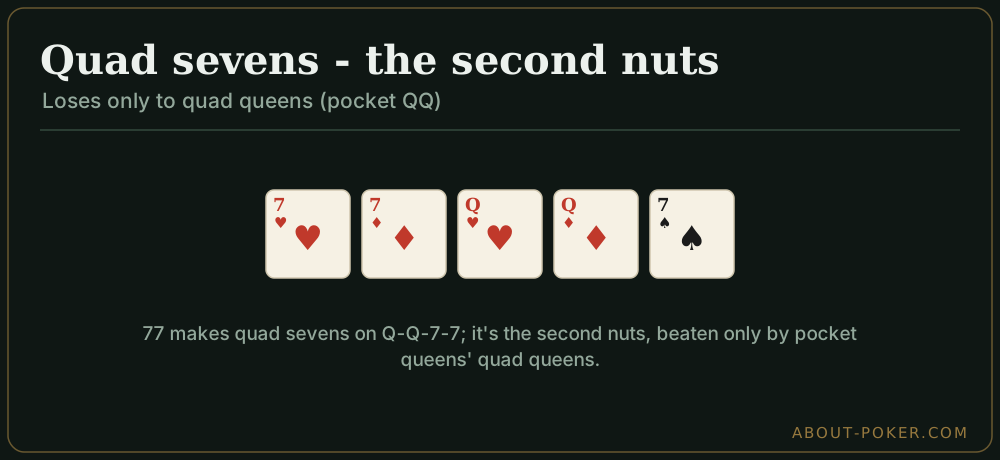
The board is Q♥ Q♦ 7♠ 7♣ 2♦ — two pair on the board, queens and sevens. Now think about the strongest hands possible.
The nuts is quad queens, held by anyone with pocket queens (Q♠ Q♣ in the hole plus the two board queens). Nothing beats four queens here. The second nuts is quad sevens, held by anyone with pocket sevens. It loses only to quad queens.
Say you’re holding 7♥ 7♦ — quad sevens, the second nuts. This is an absolute monster; you will almost never lay it down, and against nearly every hand in your opponent’s range you should get all the chips in. But there is exactly one hand that beats you: pocket queens. So when a tight, passive opponent suddenly check-raises you all-in on the river, you face the second-nuts dilemma. Your quads feel unbeatable, but the one hand that would play this way is the one that beats you. That instinct to snap-call is precisely the trap the second nuts sets.
How to play the second nuts
Play it strong, but keep your eyes open for the single hand that beats you:
- Value bet and raise by default — the second nuts is a monster and folding it routinely would be a huge leak.
- Ask if the nuts is realistic. Does your opponent’s line credibly represent the one hand that beats you? A passive player who suddenly jams often has it.
- Use blockers. If you hold a card that makes the nuts less likely — see our note on what blockers are — the nuts is less of a threat and you can commit more freely.
- Respect the pattern of the hand. A calling station raising the river, or a tight player waking up with aggression, are classic nut-holding tells.
Position and pot control
Where you sit changes how you play it. In position, you can control the pot size — betting for value while keeping the pot manageable enough that a cooler doesn’t cost your whole stack. Out of position against unknown aggression, a check-call is often wiser than a check-raise, because it caps your losses when you’re up against the nuts while still collecting value from worse hands.
The higher the stakes and the deeper the stacks, the more this matters. With 40 big blinds, getting the second nuts in is usually fine — the downside is capped. With 300 big blinds, the same all-in can be a catastrophe if it runs into the nuts.
The mindset that saves stacks
The best players treat the second nuts with respect, not reverence. They extract value aggressively while quietly reserving a fold for the clearest nut-representing lines. You won’t lay it down often — and you shouldn’t — but the discipline to fold the second nuts once in a blue moon is what separates a break-even player from a winner over the long run.
For the rest of the terms around hand strength and showdown, browse the full poker glossary.
Frequently asked
What is the second nuts in poker?
The second nuts is the second-best possible hand on a given board — everything loses to it except the single strongest holding, called the nuts. For example, on a board where a king-high flush is the nuts, a queen-high flush is the second nuts.
Is the second nuts a good hand?
It's a very strong hand, but it's dangerous precisely because it's so strong. Players holding the second nuts tend to commit their whole stack, which is exactly how they lose big when an opponent turns up with the actual nuts. Strength invites overconfidence.
How do you play the second nuts?
Bet and raise for value, but stay alert to the one hand that beats you. Consider whether your opponent's aggression could realistically represent the nuts, use blockers to gauge how likely that is, and be willing to slow down against passive players who suddenly wake up with a big raise.
What's the difference between the nuts and the second nuts?
The nuts is the single best possible hand that cannot be beaten on that board. The second nuts is the next-best hand, which loses only to the nuts. Holding the second nuts feels like holding the nuts, and that illusion is what makes it costly.