What Is Single Raised Pot in Poker?
A single raised pot forms when one player raises and gets called with no re-raise. Learn what an SRP is, its high SPR, and how to play these common pots.
On this page · 6 sections
A single raised pot, commonly shortened to SRP, is a pot in which one player raised before the flop and was simply called, with no re-raise. It is by far the most common pot you will play, so getting comfortable in single raised pots is one of the highest-value skills in the game. Because only one raise went in, the pot is smaller and the ranges are wider than in re-raised pots, which changes how each street should be approached.
How a single raised pot forms
The action is minimal. One player opens with a raise, another player calls, and everyone else folds. That is it: raise, call, flop. No one puts in a re-raise, so the pot stays relatively small. If a re-raise had occurred, you would instead have a 3-bet pot, which plays very differently.
The defining feature of an SRP is a high stack-to-pot ratio, or SPR, which is your remaining stack divided by the size of the pot. At 100 big blinds deep, a typical single raised pot leaves an SPR around 10 or more after the flop. That deep SPR means you have room to bet the flop, turn, and river without being forced all-in early, so hand values play out over a longer story.
Why the high SPR matters
A high SPR rewards a different set of hands than a low-SPR 3-bet pot does. Because you can play three streets and still have chips behind, speculative hands gain value. Small pairs looking to flop a set, suited connectors chasing straights and flushes, and suited aces all benefit, because when they hit big they can win a large pot through implied odds.
At the same time, one-pair hands become trickier. In a deep SRP, top pair is rarely worth stacking off with, because a lot of money going in usually means your opponent has you beaten. You play top pair for value across a street or two, not for your whole stack. Managing that balance, extracting value while avoiding being stacked, is the core skill of single raised pots.
Ranges in a single raised pot
Ranges in an SRP are wide. The preflop raiser opened a broad range and the caller continued with a broad range too, so on the flop both players can hold a huge variety of hands. This width is what makes the c-bet so central to SRP play: the raiser often has a range and initiative advantage and can bet a large fraction of flops to apply pressure.
Because ranges are wide and stacks are deep, single raised pots feature more manoeuvring: floating, delayed bets, turn probes, and thin value bets all appear more often than in the tighter, more committed world of a 3-bet pot.
A worked example
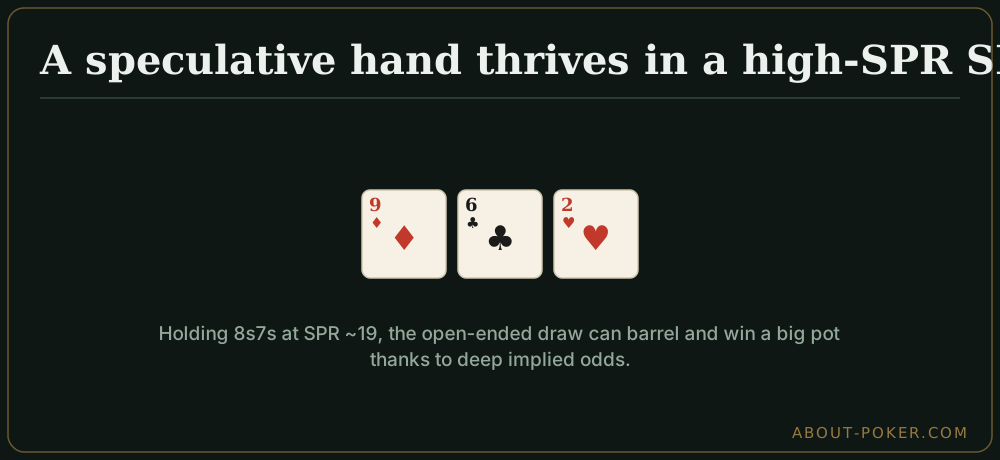
You open 8s 7s from the button at 100 big blinds and the big blind calls. The pot is about 5 big blinds and you both have around 97 behind, an SPR of roughly 19. This is a deep single raised pot.
The flop comes 9d 6c 2h, giving you an open-ended straight draw. The deep SPR is exactly why 8-7 suited was worth playing: you can barrel this draw across streets, and if you complete your straight you can win a very large pot relative to what you have invested. In a low-SPR 3-bet pot the same draw would be far less attractive, because there would not be enough chips behind to justify chasing. The high SPR of the SRP is what gives this speculative hand its value, which is the opposite of what happens after a 3-bet.
Common mistakes
- Stacking off with one pair. In a deep SRP, getting all-in with top pair usually means you are beaten. Play it for a street or two of value.
- Underusing your speculative hands. Deep SPRs are where suited connectors and small pairs earn their keep; do not play them too passively.
- Betting without a plan. With three streets available, decide early how you want the hand to develop rather than firing street by street with no roadmap.
Quick checklist
- Is there only one preflop raise? Then it is a single raised pot.
- What is the SPR? Usually high, so plan for multi-street play.
- Do my speculative hands have room to pay off? Deep SPR says yes.
- Am I overcommitting one pair? Value bet it, do not stack off blindly.
Single raised pots are the bread and butter of poker. Master the high-SPR, wide-range dynamics here and you improve the majority of the hands you will ever play.
Frequently asked
What is a single raised pot in poker?
A single raised pot, often called an SRP, is a pot where one player raised preflop and was called with no re-raise. It is the most common pot type, played with wider ranges and a high stack-to-pot ratio.
How is a single raised pot different from a 3-bet pot?
A single raised pot has only one preflop raise, so it is smaller with a higher stack-to-pot ratio. Ranges are wider and there is more room to play multiple streets. A 3-bet pot has a re-raise, a bigger pot, and a lower SPR.
What is the SPR in a single raised pot?
In a single raised pot at 100 big blinds deep, the stack-to-pot ratio after the flop is often around 10 or higher. That high SPR gives plenty of room to bet across the flop, turn, and river.