What Is VPIP in Poker?
VPIP is the percentage of hands a player voluntarily puts money into preflop. Learn what it means, how to read it, and what a good VPIP looks like.
On this page · 6 sections
VPIP stands for Voluntarily Put money In Pot. It is the percentage of hands in which a player chooses to put chips in before the flop — by calling or raising — measured against every hand dealt to them. If you play 100 hands and voluntarily enter 22 of them, your VPIP is 22 percent. It is the first statistic serious players and tracking software reach for, because in one number it captures how loose or tight someone is.
The word doing all the work is voluntarily. Forced blinds do not count. VPIP measures only the pots a player decided to join, which is exactly what reveals their style.
What VPIP Actually Measures
Every hand you are dealt has three possible preflop endings: you fold, you get a free look (checking your big blind option), or you put money in on purpose. Only that last category counts toward VPIP. Calling a raise counts. Limping counts. Raising counts. Three-betting counts. Folding does not, and neither does the free check in the big blind.
Because it lumps calling and raising together, VPIP is a width statistic — it tells you how many hands a player is willing to play, not how aggressively they play them. That aggression side is captured by a partner stat called PFR, and the two are almost always read together.
Reading the Number
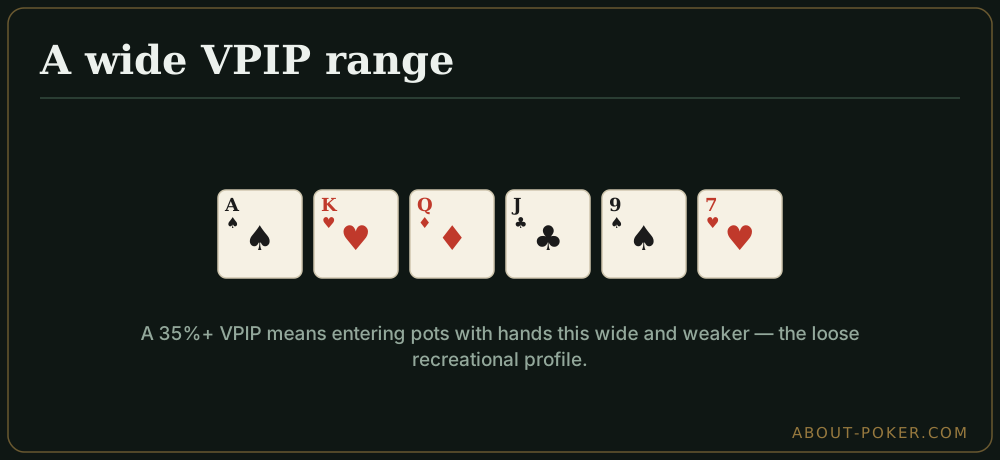
VPIP maps cleanly onto player types once you know the ranges. These are standard benchmarks for cash games:
- Under 15 percent (full ring): a tight, disciplined player, often a nit who only plays premium hands.
- 15 to 20 percent (full ring): a solid, well-balanced regular.
- 22 to 28 percent (six-max): the healthy zone for shorter tables where you must play wider.
- 35 percent and up: a loose player, frequently a recreational fish entering far too many pots.
The reason these ranges shift by table size is simple: with fewer opponents, fewer of them hold strong hands, so wider play is correct.
A Worked Example
You sit down at a six-max table and pull up your tracker on the player to your left. After 1,800 hands it reads VPIP 41 / PFR 9. What does that tell you?
VPIP of 41 percent means this player enters nearly half of all hands — enormously loose. But PFR of only 9 means they rarely raise. The gap between the two (41 minus 9 = 32) is huge, which means they are limping and calling constantly rather than raising. This is the classic calling-station profile: they see lots of flops with weak holdings and pay off good hands. Against them you tighten up, stop bluffing, and bet your strong hands relentlessly for value.
VPIP Versus PFR
The relationship between VPIP and PFR is where the real information lives:
- VPIP close to PFR (say 20/17): an aggressive, tough regular who raises almost everything they play.
- VPIP much higher than PFR (say 35/8): a passive caller who limps and calls too much.
- PFR nearly equal to VPIP but both low (14/12): a tight-aggressive player, the profile most winning players aim for.
PFR can never be higher than VPIP, because every raise is by definition a voluntary entry. If your software ever shows PFR above VPIP, the sample is broken.
Common Mistakes When Using VPIP
The biggest error is trusting a tiny sample. Over 50 hands a normally tight player might run a VPIP of 30 percent purely from being dealt good cards in a row. Wait for a few hundred hands before drawing firm conclusions, and a few thousand before treating the number as gospel.
The second mistake is ignoring position. A single blended VPIP hides the fact that everyone plays tighter early and looser late. A player who is 18 percent overall might be 12 percent under the gun and 40 percent on the button — two completely different opponents inside one number. Good trackers let you split VPIP by position, and that breakdown is far more actionable.
Quick Checklist
- VPIP counts calls and raises, never folds or free big-blind checks.
- Read it alongside PFR to separate loose-passive from loose-aggressive.
- Expect higher numbers at six-max than at full ring.
- Distrust samples under a few hundred hands.
- A big VPIP–PFR gap almost always means a callable, exploitable opponent.
Learn VPIP well and you will size up a table within a few orbits — long before you have seen anyone’s cards.
Frequently asked
What does VPIP stand for?
VPIP stands for Voluntarily Put money In Pot. It measures how often a player chooses to put chips in the pot before the flop by calling or raising, shown as a percentage of hands dealt. It is the single fastest read on how loose or tight someone plays.
What is a good VPIP percentage?
In full-ring games a solid VPIP is around 15 to 20 percent. In six-handed games it runs higher, roughly 22 to 28 percent. Numbers well above those ranges signal a loose, usually weak player, while very low numbers mark an extremely tight one.
Does posting the big blind count toward VPIP?
No. Only voluntary money counts. Posting the small or big blind is forced, and checking your big blind option for free does not raise your VPIP. Calling a raise from the blinds or raising yourself does count.
How many hands do you need before VPIP is reliable?
A rough impression forms over a couple hundred hands, but the number only stabilizes after a few thousand. Treat a small-sample VPIP as a hint, not a verdict, and lean on it more as the hand count grows.