What Is Wrap in Poker?
A wrap is a huge Omaha straight draw where your cards wrap around the board for 13 or more outs. Learn how to count wraps and play them profitably.
On this page · 6 sections
A wrap is the signature draw of Pot-Limit Omaha (PLO) and one of the most powerful hands in all of poker. It happens when three or four of your cards “wrap around” the board’s straight-relevant cards, giving you a huge number of ways to complete a straight, often far more than the eight outs a Hold’em player is used to. Understanding wraps is essential in Omaha because they turn drawing hands into monsters that can be favorites even against made hands.
What a wrap is
In Hold’em your biggest simple straight draw is an open-ended straight draw with eight outs, four on each end. Omaha gives you four hole cards instead of two, so your connected cards can attack a straight from more directions at once. When several of your cards surround the board’s connectors, you “wrap” them and pick up straight-completing cards above, below, and between the board cards.
The result is a draw counted not in eights but in teens and twenties. A big wrap can have 13, 17, or even 20 outs, numbers that would be impossible with only two hole cards. That is what makes a wrap special: raw quantity of clean straight outs.
How to count a wrap
The key is to count the ranks that give you a straight, then convert to card outs. Suppose you hold JT98 and the flop is 7-6-2. Any 5, 8, 9, or 10 completes a straight. Because you already hold two of the tens, nines, and eights, you count the remaining cards in the deck for each winning rank. That works out to roughly 20 straight outs, one of the largest wraps possible.
A smaller wrap example: you hold KQJ9 on a T-8-2 board. Cards that make a straight include the jack, queen, king, and nine ranks combining with the board, giving you a 13-out wrap. Even 13 outs is enormous, about a 54 percent chance to complete by the river using the rough rule of counting outs times four on the flop.
Why wraps win money
A wrap is not just a draw, it is often a mathematical favorite. Consider a 20-out wrap against a bare overpair like aces with no redraws. By the river the wrap completes so often that it is ahead. This is completely different from Hold’em, where a flush draw is a clear underdog to a made hand. In Omaha, the biggest wraps flip the usual made-hand-versus-draw relationship on its head.
Wraps get even scarier as combo draws, when you add a flush draw on top. A wrap plus a nut flush draw can be 60 percent or more against top set. These are the hands you build your stack with in Omaha, and they are the reason connected, suited starting hands are so prized.
A worked example
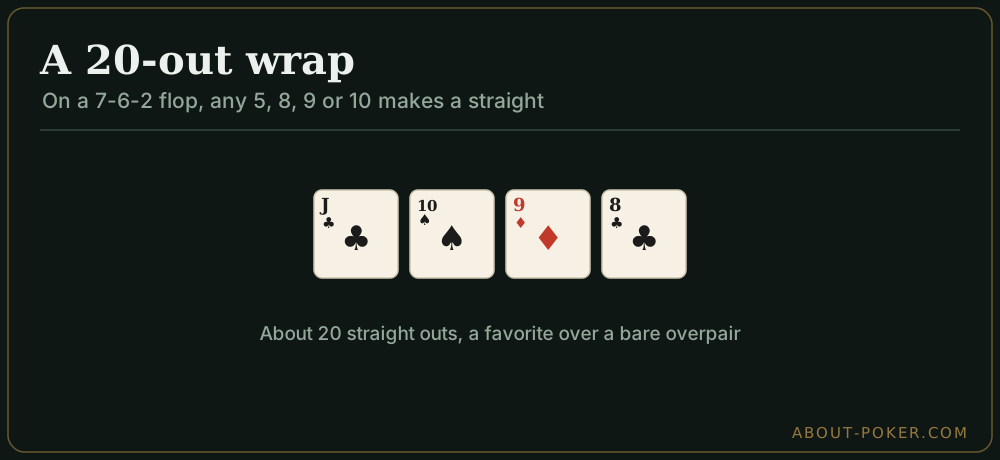
You hold Jc Ts 9d 8c and call a raise in position. The flop is 7h 6s 2d. You have flopped the biggest wrap available: any 5 makes the low straight, any 8, 9, or 10 makes a straight, and you also hold the top end so your straights are strong. Counting outs, you have about 20 cards that complete a straight.
Your opponent bets pot with what you read as an overpair. Rather than just call, this is often a spot to raise or get the stacks in. With 20 outs you are a slight favorite even before counting backdoor equity. In Omaha, a wrap this large is a stack-off, not a peel. Compare that to a weaker wrap of only 9 or 10 outs, where you would call to see a turn and reassess, since you are behind a made hand and want a better price.
Common mistakes with wraps
- Not distinguishing big wraps from small wraps. A 20-out wrap is a favorite; a 9-out wrap is not. Count your outs before deciding to commit.
- Ignoring which end is the nut end. Some wraps make non-nut straights. Making the nuts matters hugely in Omaha because non-nut straights lose stacks to bigger straights.
- Playing wraps passively. Big wraps have so much equity that flatting away their value is a leak. When you flop a huge wrap, look to build the pot and apply pressure.
- Forgetting redraws. A wrap with a flush draw or pair is far stronger than a bare wrap. Always factor in your extra outs.
Quick checklist
When you flop a straight draw in Omaha, count the winning ranks, convert to outs, and note whether you have the nut end and any flush or pair redraws. Thirteen-plus clean outs with nut potential is a wrap you can commit with. Fewer outs, or a non-nut wrap out of position, calls for caution. Learn to recognize wraps instantly and you will unlock the aggressive, high-equity style that wins at Omaha.
Frequently asked
What is a wrap in poker?
A wrap is a Pot-Limit Omaha straight draw where three or four of your cards surround the board cards, giving you far more outs than a normal straight draw. Wraps commonly have 13, 17, or even 20 outs, which is why they are so powerful in Omaha.
How many outs does a wrap have?
It depends on the exact cards, but wraps range from about 13 outs up to 20 outs. A basic Hold'em open-ender has 8 outs; a big Omaha wrap can more than double that, sometimes making it a favorite over a made hand by the river.
Is a wrap better than an open-ended straight draw?
Yes. An open-ended straight draw has 8 outs. A wrap uses the extra cards Omaha gives you to add more straight-completing ranks, so it can have 13 to 20 outs. The biggest wraps are strong enough to get all-in against overpairs and even made straights.