What Is Combo Draw in Poker?
A combo draw stacks two draws at once — like a flush plus a straight draw — for huge equity. How to count the outs and why combo draws love to get all-in.
On this page · 6 sections
A combo draw is a hand that is drawing to two things at once — most classically a flush draw and a straight draw on the same flop. Because you can complete your hand in more than one way, your outs stack up, sometimes to 15 or more. These “monster draws” are among the most powerful holdings in No-Limit Hold’em precisely because a big combo draw can be a mathematical favorite over an already-made hand.
What makes a draw a “combo”
A single draw improves in one way: a flush draw needs a suited card, a straight draw needs a rank. A combo draw layers two of these together so that many more cards help you.
The most common combo is a flush draw plus a straight draw. But the family is broad: a flush draw plus a gutshot, a pair plus a flush draw, or even a pair plus an open-ended straight draw. The theme is always the same — more than one road to a winning hand means more outs, and more outs means more equity.
Counting the outs
The strength of a combo draw comes from adding the outs of each draw, then subtracting any cards counted twice.
Take the biggest common example. A flush draw has nine outs. An open-ended straight draw has eight. If none of the straight cards are the flush suit, you would have 17 — but two of the straight-completing cards are usually your flush suit, so they are already counted. Subtract those two and you get 15 outs. Fifteen outs is the classic “monster draw” number.
A smaller combo — a flush draw plus a gutshot — gives nine plus four minus one shared card, or about 12 outs. Either way, the process is the same: add the outs, remove overlaps, and count honestly.
A worked example
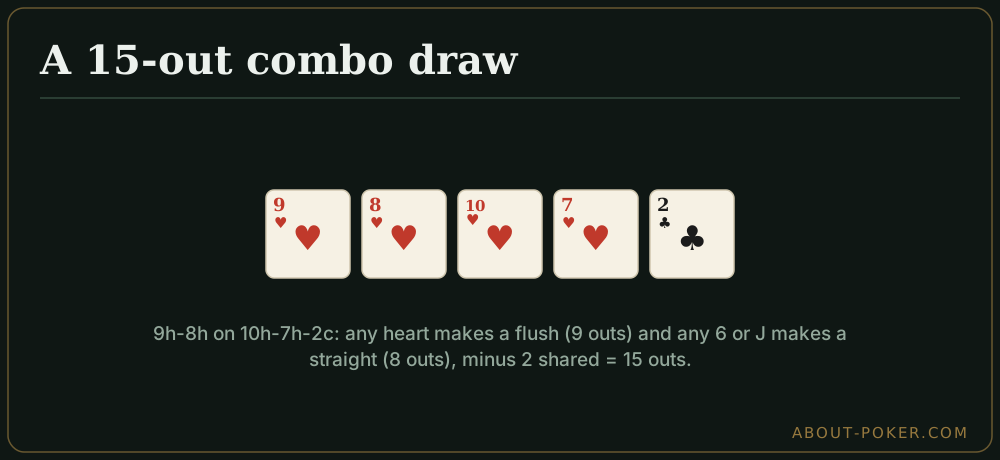
You hold 9♥ 8♥ and the flop comes 10♥ 7♥ 2♣. Look at everything you have going: any heart makes a flush (nine outs), and any 6 or J completes your straight (eight outs for the open-ender). Two of the straight cards — the 6♥ and J♥ — are also hearts, already in your flush count, so your total is 9 plus 8 minus 2, which is 15 outs.
Fifteen outs on the flop is roughly 54 percent to improve by the river using the four-times shortcut adjusted for the high count. That means against a made hand like top pair, you are actually a small favorite. This is why a hand like this is a prime candidate to raise and get all-in as a semi-bluff: even if called, you win more than half the time, and you also pick up the pot whenever your opponent folds.
Why combo draws love aggression
The reason combo draws are so profitable is that they win two ways: fold equity now and hand equity later. With 12 to 15 outs you have so much raw equity that even being called is fine — you are close to a coin flip or ahead. And because you also threaten to fold out better hands, semi-bluffing gets the best of both worlds.
- Raise and re-raise freely. A big combo draw can get all the money in on the flop and still be a favorite or near it.
- Prefer nut combo draws. Drawing to the nut flush and the nut straight avoids being dominated when you hit.
- Do not slow-play them. Combo draws want to build the pot and apply pressure, not check and see cheap cards.
- Count outs precisely. Overlapping cards must be subtracted, or you will overrate the hand.
Combo draw versus single draw
Compared with a lone draw, the combo draw is a different animal. A bare open-ended straight draw has eight outs and about 31 percent equity by the river — enough to call, but not to be a favorite. Stack a flush draw on top and you jump to 15 outs and slight-favorite status. The extra outs are what let combo draws shove where a single draw would only call, and they are the reason experienced players get so excited to see two live draws in one hand.
Quick checklist for combo draws
- Two draws in one hand — usually flush plus straight — for stacked outs.
- Add the outs, subtract cards that complete both, and count honestly.
- Fifteen outs is roughly a coin-flip-plus against a made pair.
- Play them aggressively: raise, re-raise, and be happy to get all-in.
- Favor nut combo draws so you win big when you complete.
A combo draw flips the usual logic of drawing hands. Instead of passively hoping to hit, you hold enough equity to be the aggressor — and often enough to be the favorite. Recognize a monster draw when it appears and play it like the powerhouse it is.
Frequently asked
What is a combo draw in poker?
A combo draw is a hand with two draws at once, most often a flush draw plus a straight draw. Because you can improve in more than one way, you have many more outs than a single draw and often enough equity to be a favorite against a made hand.
How many outs does a combo draw have?
It depends on the mix. A flush draw plus an open-ended straight draw is up to 15 outs — nine for the flush plus eight for the straight, minus the two cards that complete both. A flush draw plus a gutshot is about 12 outs.
Is a combo draw a favorite over top pair?
Often yes. A 15-out combo draw has roughly 54 percent equity against a single made pair on the flop, meaning it is a slight favorite. That is why big combo draws are ideal hands to get all-in with as semi-bluffs.