What Is Open-Ended Straight Draw in Poker?
An open-ended straight draw has eight outs and completes on either end. The odds, why it beats a gutshot, and how to play it as a semi-bluff.
On this page · 6 sections
An open-ended straight draw (often shortened to OESD) is one of the strongest drawing hands in poker. You hold four cards in a row, and a card at either end completes your straight. That gives you eight outs — double what a gutshot offers — and makes the open-ender a hand you can play fast and aggressively rather than passively hope with.
What “open-ended” means
A straight is five consecutive cards. With an open-ended draw you have four of them in an unbroken run, so two different ranks can finish the sequence — one on top and one on the bottom.
Take 9-8 in your hand with a board of 7-6. Your run is 9-8-7-6, and it completes with either a 10 (making 10-9-8-7-6) or a 5 (making 9-8-7-6-5). Two ranks help, and with four cards of each rank in the deck, that is eight outs total. Compare this to a gutshot, where only one rank fills a hole in the middle and you have just four outs. The open-ender is exactly twice as likely to hit.
The odds you need to know
Eight outs is a strong number. On the next single card, an open-ended draw completes about 17 percent of the time (8 outs divided by 47 unseen cards). If you will see both the turn and the river, your chance of getting there rises to roughly 31.5 percent — close to 1 in 3.
Use the rule of 2 and 4 to get this at the table. Eight outs times two is about 16 to 17 percent per street; eight times four is about 32 percent across both cards to come. That is enough equity that against a single opponent, an open-ended draw is often correct to play for stacks when you fold out equity or get the right price.
Why it plays aggressively
Because the open-ender has real equity, it is the textbook semi-bluff. When you bet or raise with it, you win two ways: your opponent folds now, or they call and you hit roughly a third of the time by the river. That combination — fold equity plus draw equity — is what makes semi-bluffing profitable, and eight outs is enough that even if you are called every time, you are not in bad shape.
This is very different from how you treat a bare gutshot. A gutshot leans almost entirely on fold equity; an open-ender can happily go to showdown as an underdog with plenty of live outs.
A worked example
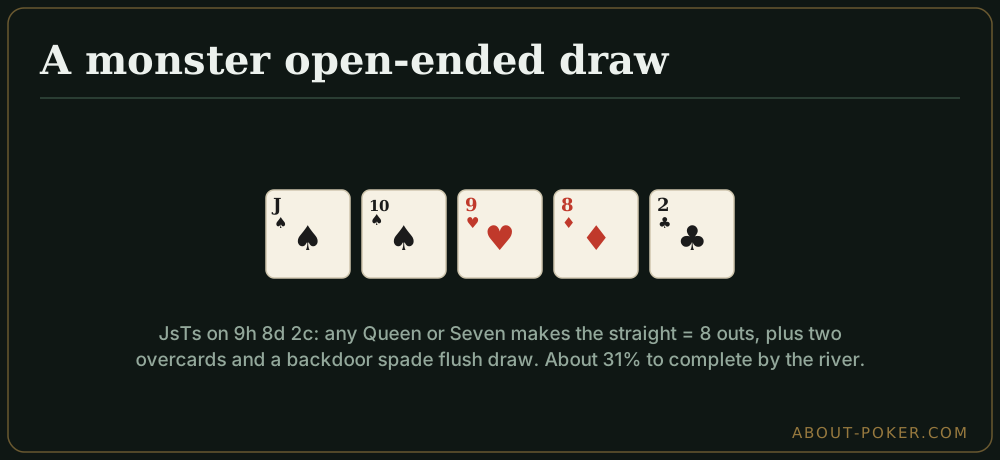
You hold J♠ T♠ and the flop comes 9♥ 8♦ 2♣. You have an open-ended straight draw: any queen makes Q-J-T-9-8 and any 7 makes J-T-9-8-7. That is eight clean outs, plus two overcards to the board and a backdoor spade flush draw. This is a monster of a draw even though you have not made a pair.
Facing a bet, raising is often better than calling. You have about 31 percent equity to complete the straight, extra equity from your overcards, and strong fold equity because many hands cannot continue against a raise. If your opponent folds, you win the pot outright. If they call and a queen or seven arrives, you have a well-hidden straight and can often win a big pot, since opponents rarely fold when the card that helped you looks harmless to them.
Position, blockers, and the tricky spots
In position, the open-ender is close to a free-rolling machine: you can take free cards, control the pot, and pick the best moments to apply pressure. Out of position it is still strong but harder to realize, so leaning on the semi-bluff to end the hand early has extra value.
Watch two traps. First, count your outs honestly — if the straight card also completes a flush for your opponent, some of your outs are “tainted” and win less than a full share. Second, on a paired board your straight can lose to a full house, so a card that makes your straight is not always the nuts. Adjust your aggression when the board is dangerous.
Checklist
When you flop an open-ended straight draw, run through this: How many opponents am I against — fewer is better for a semi-bluff. Am I in position? Are any of my eight outs tainted by a possible flush or full house? Do I have extra equity like overcards or a backdoor flush? With eight clean outs, position, and fold equity, playing the open-ender fast is usually the winning move. With tainted outs and multiple opponents out of position, slow down and take the cheaper line. Either way, respect the open-ender — it is one of the best hands to hold that has not yet made anything.
Frequently asked
How many outs does an open-ended straight draw have?
Eight. Four cards complete the straight on the high end and four on the low end, giving you eight outs unless some are already accounted for on the board or in your hand.
What are the odds of hitting an open-ended straight draw?
About 17 percent on the next single card and roughly 31.5 percent to complete by the river when you will see both the turn and river. The shortcut is eight outs times two per street, or times four for two cards to come.
Is an open-ended draw better than a flush draw?
They are close. An open-ended straight draw has eight outs and a flush draw has nine, so the flush draw is slightly stronger. Both are strong enough to play aggressively as semi-bluffs.