88 vs AQ: Preflop Odds & Equity
Pocket eights are about a 54% favorite over AQ all-in preflop — a classic coinflip. Here are the exact 88-vs-AQ equities and where each side's outs come from.
On this page · 7 sections
You shove 8♠ 8♥ and get called by A♣ Q♦, or you’re the one holding AQ staring at a pair. Either way this is the textbook race: the small pair is a slight favorite at about 54%, and AQ trails around 46%. It feels like a coin toss because it nearly is — but the pair has the edge, and understanding why keeps you calm when the flip goes the wrong way.
The headline equity
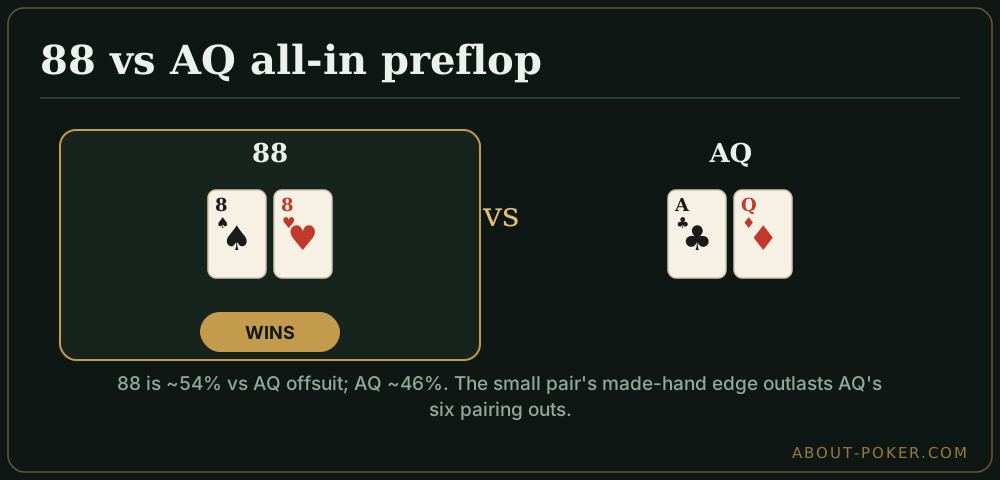
All-in preflop, pocket eights are about a 54% favorite over AQ offsuit, with AQ winning around 46%. Suited AQ picks up flush equity and climbs to roughly 48%, dropping the eights to about 52%.
| Matchup | 88 equity | AQ equity |
|---|---|---|
| 88 vs AQ offsuit | ~54% | ~46% |
| 88 vs AQ suited | ~52% | ~48% |
Carry one number to the table: pair versus two overcards is a ~54/46 race, tightening toward even when the overcards are suited.
Where AQ’s 46% comes from
AQ starts behind because it holds no pair. Its equity is built entirely from improving on the board:
- Pair the ace or queen: three aces and three queens remain, giving AQ six clean outs to top pair. Catching one of those across the five community cards is the bulk of its equity.
- Straights: AQ can complete broadway with KJT or use one card in a straight, adding a modest slice.
- Flushes: only when AQ is suited — that’s the entire source of its two-point bump in the suited version.
Together those outs reach about 46%. Being able to count them instantly is the skill covered in the poker outs guide.
Why the small pair is favored
The eights don’t need help to win — on a board like J♦ 6♣ 3♠, they’re already ahead of AQ, which has completely missed. AQ must catch one of its six outs; the eights simply have to survive. Starting ahead with five cards to come is worth a few percentage points, and that head start is exactly why an “underdog-looking” pair beats a glamorous AQ more than half the time. This is the heart of equity: current-best-hand plus cards to come.
A worked example
Effective stacks are 20 big blinds. You open 8♠ 8♥ from the cutoff, the big blind jams A♣ Q♦, and you call. You’re a 54% favorite for the pot.
If the pot is 43 big blinds, your call is clearly profitable: you win it 54% of the time and lose 46%. But the margin is thin — expect to bust this flip almost half the time. Losing it isn’t a mistake, it’s variance, and mistaking normal variance for a leak is one of the fastest ways to tilt. The preflop all-in odds framework exists to price exactly these decisions.
How the board changes the race
The 54/46 figure is the equity before any cards come. Once the flop lands, the number swings hard in one direction, and understanding that swing helps you read all-in spots that resolve street by street rather than in one shove.
- Flop misses both overcards (say J-6-3): the eights are now a big favorite, around 90%. AQ is down to catching runner-runner or two of its six outs across just two cards.
- Flop pairs the ace or queen (say A-7-2): the roles flip completely. AQ jumps to roughly 90%+ with top pair, top kicker, and the eights are drawing to two remaining eights plus thin runner-runner outs.
- Flop brings a coordinated board (say Q-J-T with AQ suited): AQ can hold a pair plus a gutshot or open-ender plus a flush draw, spiking its equity well past the eights.
The lesson is that “coinflip” describes the average across every possible board, not any single flop. Almost every flop is lopsided one way or the other; the near-even number simply reflects how often each type of flop appears.
The 54/46 race in context
It helps to place 88 vs AQ next to its neighbors so the pattern sticks. A pair versus two undercards (say 88 vs 65) is a much bigger favorite, around 80%, because the undercards must pair to beat the pair rather than merely pairing to win. A pair versus two overcards — this spot — is the classic near-flip at 54/46. And a pair versus one overcard and one undercard (say 88 vs A5) is in between, roughly 70/30 for the pair, because A5 has only three clean overcard outs plus its low pair and straight/flush chances.
Two overcards is the strongest the “underdog” side of a pair-vs-unpaired confrontation ever gets without being suited-connected, which is exactly why AQ, KQ, and AK against a middle or small pair all cluster near that 54/46 to 55/45 line. Learn the one anchor and you’ve learned the whole family: pocket pair over two overcards is a coinflip that the pair wins a hair more than half the time. For the broader framework of turning these percentages into correct calls and shoves, the preflop all-in odds guide ties equity to pot odds directly.
The takeaway on races
Pocket eights over AQ is a marginal favorite, not a dominating one. Whether to take the flip comes down to pot odds and stack depth, never to any false sense that the pair “should” win. Lock in the anchor — 88 is ~54% over AQ offsuit — and treat suited AQ as a near-even flip. Sharpen the surrounding skills through equity, counting outs, and the poker odds & math hub.
Frequently asked
What are the odds of 88 vs AQ preflop?
Pocket eights are roughly a 54% favorite over AQ all-in preflop when the AQ is offsuit, with AQ winning about 46%. Against suited AQ it's closer to 52/48. It's the classic pair-versus-overcards coinflip.
Why is 88 favored over AQ if AQ is the 'bigger' hand?
AQ looks stronger but it has no pair yet — it must improve to win. The eights are already ahead and only need the board to miss the ace and queen, which is why the small pair holds a slim edge.
How many outs does AQ have against 88?
Six clean outs to pair up — three aces and three queens — plus extra equity from straights and, if suited, flushes. Those chances add up to about 46% but not quite enough to overtake the pair.
Does it matter if AQ is suited against 88?
Slightly. Suited AQ gains flush equity, moving from about 46% to roughly 48%, which drops the eights from 54% to about 52%. It stays a coinflip either way.