A5s vs KK: Preflop Odds & Equity
Ace-five suited against pocket kings holds up better than you expect — A5s wins about 33% preflop. Here are the exact equities and why the suit and wheel matter.
On this page · 7 sections
Ace-five suited gets in against K♠ K♥ and looks like a big underdog. It is — but not as badly as the raw pair-versus-ace matchup suggests. A♦ 5♦ wins about 33% of the time, one full third, because three separate features stack up in its favor: an ace, a wheel straight, and a flush draw.
The headline equity
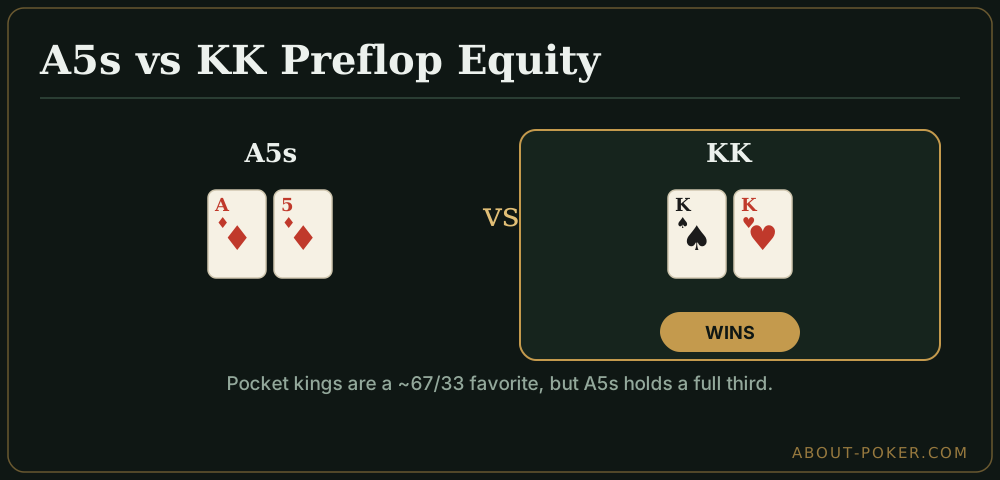
Every figure below comes from a full board enumeration cross-checked with a Monte Carlo run:
| Matchup | A5s equity | KK equity |
|---|---|---|
| A5s vs KK | ~33% | ~67% |
| A5o vs KK | ~30% | ~70% |
Ace-five suited holds about a third of the pot. Strip away the suit and it drops a few points — proof of how much the flush draw is worth. See it resolve card by card in the equity calculator.
Why a small suited ace holds a third
Against a pair, an unpaired hand normally wins by pairing up. A5s wins by pairing up and two other ways, and none of them are blocked by the kings.
- The ace: three aces remain, and pairing the ace beats the kings outright. Live and clean.
- The wheel: A-2-3-4-5 is a real straight for this hand, so cards like 2, 3, and 4 add straight equity most hands lack.
- The flush: two of a suit means five- and four-card flush chances the kings can never share.
Layer those together and A5s realizes far more of its raw equity than a blank hand would. This is exactly why small suited aces are premium bluff-shoving hands: solid equity when called, plus the ace blocks a caller holding AA.
A worked example
Say 100 big blinds go in for a 200 big blind pot. Preflop, the kings own about 134 blinds of equity, ace-five suited about 66. Now watch a flop.
Flop 9♦ 6♦ 2♣: A5s picks up a flush draw plus its overcard and wheel outs — well over a dozen combined outs — and its equity climbs toward 45% even though the kings still have the made overpair. Change the flop to Q♣ 8♥ 3♠, a total miss, and A5s falls to just its ace and backdoor chances, around 18%. The 33% preflop number is the average across those swings, and the suited boards are what pull it up.
Why A5s beats a hand like K5s here
The instructive contrast is a hand that shares a card with the kings. K5s against KK is nearly drawing dead when it pairs its king — that king is dominated, so those outs are worthless, and it wins barely 15%. A5s shares nothing with the kings: its ace, its straights, and its flush are all fully live. That gap — roughly 33% versus 15% — is the entire lesson of blockers and live outs, and it is pure combinatorics.
From equity to a decision
At 33/67 A5s is a clear underdog, but a live one, which is exactly why it earns a spot in aggressive ranges.
| Situation | Read | Line |
|---|---|---|
| Short-stack shove, called by KK | ~33% | Underdog but fine as a jam; you rarely knew |
| You hold KK vs an A5s shove | ~67% | Strong favorite; call it off |
| A5s as a 3-bet bluff | — | Ace blocker plus equity make it a top choice |
How the matchup shifts by suit and by pair
Two details move the A5s-versus-KK number in ways worth internalizing. First, the shared suit. If one of your diamonds matches a king — say the kings are K♦ K♥ and you hold A♦ 5♦ — some of your flush outs are dead, and your equity slips a point or two below the clean ~33%. When your suit is completely unshared with the kings, you keep the full flush value. Second, which overpair you face. A5s does slightly better against QQ or JJ than against KK, because with kings out there, an opponent holding KK removes one of the cards that would otherwise pair the board against you less often — but more importantly, against lower pairs your ace overcard is worth the same while none of your straight or flush outs are ever blocked. The general rule: a small suited ace holds right around a third against any single big pair, drifting up as the pair gets smaller and down when you share its suit.
Turning the 33% into pot odds
Knowing you have ~33% equity tells you exactly how much you can call. Against KK all in, you need pot odds better than 33-to-67 — that is, you need to be risking less than about one third of the final pot. Concretely, if you must call 50 big blinds to win a pot that will total 150 (your 50 plus 100 already out there), you are getting 100-to-50, or 2-to-1, and 2-to-1 means you only need 33% to break even. That is precisely your equity, so it is a break-even call in a vacuum — and any fold equity or dead money in the pot tips it to a clear call. Flip it around: if you are the kings and someone jams A5s into you, you are a 67% favorite getting to call off almost any price. This is why the anchor number matters — it converts a vague “am I ahead” feeling into an exact threshold.
Lock in the anchor — A5s wins about 33% against KK — and every small-suited-ace-versus-overpair spot becomes a read on live outs and blockers, not a hopeless punt. Sharpen your counting with combinatorics, build the full line with preflop all-in odds, and explore the poker odds & math hub.
Frequently asked
What are the odds of A5s vs KK preflop?
Ace-five suited wins about 33% of the time against pocket kings, with the kings around 67%. That is better than most players guess for a small suited ace against a big pair.
Why does A5s do so well against KK?
Ace-five suited has three clean things going for it: an ace overcard, wheel straight potential (A-2-3-4-5), and a flush draw from being suited. Together those push its equity to about a third against an overpair.
Is A5s a good hand to shove against a pair?
As a short-stack shove or 3-bet bluff-jam, A5s is a common choice precisely because it blocks aces and holds solid equity when called. Against exactly KK it is a 33% underdog but rarely dominated.
How does A5s compare to a hand like K5s against KK?
Much better. K5s shares a king with the kings and is nearly drawing dead when it pairs, while A5s has a live ace, wheel straights, and a flush draw — none of which the kings block.