AA vs AKs: Preflop Odds & Equity
AA is about an 87% favorite over suited ace-king all-in preflop. Here are the exact aces-vs-AKs equities and why the ace in your hand crushes AK's outs.
On this page · 7 sections
You get A♠ K♠ all-in preflop and villain shows A♣ A♦. It’s not a race — it’s a rout. Your suited big slick wins only about 13% of the time, drawing to a thin set of outs, because two of the aces you’d want to pair are sitting in villain’s hand. From the aces’ seat, this is one of the best get-it-in spots there is: ~87% to win, close to a 6.7-to-1 favorite.
The headline equity
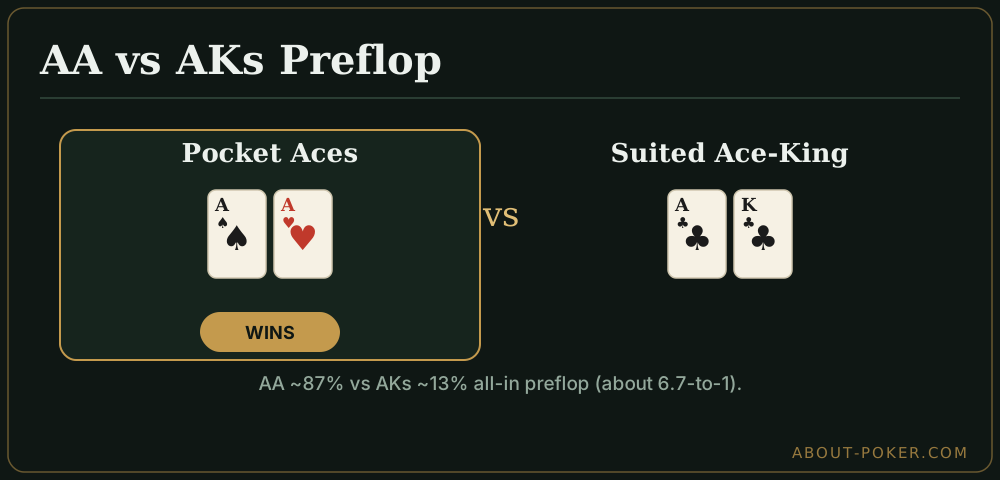
All-in preflop, pocket aces are roughly an 87% favorite over suited ace-king, and AKs wins about 13%. As odds, that’s close to 6.7-to-1 for the aces.
| Matchup | AA equity | AKs equity |
|---|---|---|
| AA vs AKs (all-in preflop) | ~87% | ~13% |
Swap to offsuit ace-king and the picture gets even bleaker for AK — it wins only about 8%, because it loses the runner-runner flush outs that suited AK keeps. The five-point gap between AKs and AKo is entirely those flush run-outs.
Why the aces dominate ace-king
Ace-king is a premium hand, but preflop it’s unpaired — it has to improve to win. Against aces, its most natural improvement is nearly dead:
- Pair the ace: almost impossible. The aces hold two aces and AK holds one, so only a single ace remains in the deck. And catching it makes trip aces for nobody useful, since villain already has a pair of aces.
- Pair the king: three kings remain, so this is AK’s realistic main out — but a pair of kings still loses to a pair of aces unless AK improves further.
- Runner-runner straights and flushes fill in the rest, and the flush outs are the only reason suited beats offsuit here.
Because the aces block AK’s ace outs so completely, big slick is left drawing thin. That’s the whole story behind the 13%.
To put numbers on the outs: on the flop, AKs is typically looking at three kings, plus flush and straight completions, and even those rarely arrive by the river in time. A rough way to feel the gap is to compare it to AKs against a random lower pair like 88, where the two overcards are fully live and the hand is close to 46-54. Against aces, one of those two overcards (the ace) is worth almost nothing, and the whole hand sags to 13%. Losing half your overcard equity is what turns a coin flip into a rout.
Don’t confuse it with a race
The trap is remembering that “AK is a coin flip” and applying it here. AK is roughly a coin flip — but against a lower pair like QQ or JJ, where the two overcards give it real live outs. Against aces, both of AK’s overcards are half-dead (the ace especially), so it collapses to a 13% underdog. Same hand, completely different matchup. Keeping those two scenarios separate is exactly what solid equity intuition is for.
A worked example
Effective stacks are 100 big blinds. You open A♠ A♥, a player three-bets, you four-bet, and they five-bet jam with A♣ K♣. You call. You’re an 87% favorite for a 200-big-blind pot.
Compare that to a common misread: your opponent shoves thinking their suited big slick is “flipping.” It isn’t — they’re a 6.7-to-1 dog. The lesson runs both ways. When you hold AKs and get snapped off by a range that’s heavy in aces and kings, you’re often in far worse shape than a flip. When you hold the aces, you welcome AK jamming all day. This is the exact input the preflop all-in odds method turns into a call.
The range angle
You’ll almost never know villain holds AKs, and that’s the practical point. With aces you never need to — nothing beats you preflop. With ace-king, the question is how often villain’s range contains the aces and kings that dominate you versus the lower pairs you flip against. Ace-king is 16 combinations (4 suited + 12 offsuit), and counting those against villain’s aces and pairs is standard combinatorics work — it’s how you tell a genuine flip from a spot where your big slick is crushed.
How the matchup shifts by stack depth
The equity never changes — AA is always ~87% over AKs once the money is in — but what you do with it depends on stacks. Deep (150bb+), holding aces you rarely want to blast the money in preflop against a single raiser, because most of villain’s continuing range is worse and you’d fold out the very hands you dominate; you make far more by keeping AKs and worse in the pot postflop. From the AKs seat the same depth argues for caution: stacking off 150bb into a four-bet that’s heavy in aces and kings is how you lose a buy-in to a hand you’re 13% against.
Shallow, the logic flips. At 20-30bb the pot is often already committed after a three-bet, and getting aces in preflop is trivially correct because you can’t be dominated. With AKs at that depth you’re happy to jam because your equity against villain’s whole jamming or calling range — which is loaded with worse aces, KQ, and pairs you flip — is far above 13%. The single AA combo you fear is a rounding error in that range.
The lesson: the 87/13 number tells you the worst case for AKs, but it should almost never scare you off a shove, because you’re up against a range, not a specific pair of aces.
A quick decision checklist
- Holding AA: get it in every time preflop. Nothing beats you; there is no bad spot.
- Holding AKs facing a small raise: continue freely — you’re crushing most of the range.
- Holding AKs facing a big four-bet or five-bet jam from a tight player: slow down, because now the aces and kings that dominate you make up a real share of the range.
- Never assume AK is “flipping” against an all-in — check whether the range is pairs (flip) or big aces and kings (crushed).
Carry one number to the table: AA is ~87% over AKs (and ~92% over AKo). It’s not a race — it’s domination, because the aces block the very cards big slick needs. Build the surrounding skills through equity, combinatorics, and the poker odds & math hub.
Frequently asked
What are the odds of AA vs AKs preflop?
Pocket aces are about an 87% favorite over suited ace-king all-in preflop, with AKs winning roughly 13% of the time. That's close to a 6.7-to-1 edge for the aces.
Why does AA crush ace-king so badly?
The aces hold two of the four aces in the deck, so AK can almost never pair its ace. That kills its most natural way to improve and leaves it drawing mostly to a king or runner-runner help.
Is AA vs AKs a coin flip?
No. People confuse it with a race because AK plays like a coin flip against a lower pair such as QQ or JJ. Against aces specifically, AK is a big underdog at about 13% because the aces block its ace outs.
Does suited vs offsuit change the AA vs AK odds?
Yes, a little. Suited ace-king has runner-runner flush outs that offsuit AK doesn't, so AKs wins about 13% versus roughly 8% for offsuit AK. Aces are a favorite over both.