AA vs 72o: Preflop Odds & Equity
Pocket aces beat 7-2 offsuit — the worst hand in Hold'em — about 88% of the time. Here are the exact preflop equities of the best vs worst matchup.
On this page · 6 sections
The best hand in Hold’em against the worst. You hold A♠ A♥; villain, for reasons known only to villain, has 7♣ 2♦. This is as lopsided as a preflop all-in gets — but not as lopsided as most people guess. Pocket aces win about 88% of the time, meaning even 7-2 offsuit backs in roughly once every eight tries. That surviving 12% is a lesson in how much equity any two cards keep when five board cards are still to come.
The headline equities
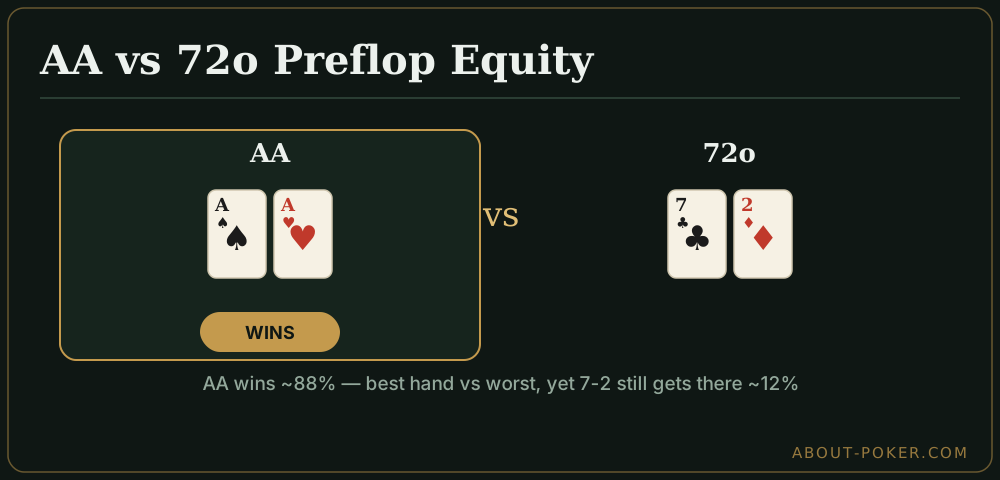
Every figure below comes from an exhaustive board run cross-checked with a Monte Carlo sim:
| Matchup | AA equity | 72o equity |
|---|---|---|
| AA vs 72o (offsuit) | ~88% | ~12% |
| (for reference) AA vs KK | ~82% | ~18% |
| (for reference) AA vs AKs | ~87% | ~13% |
Here’s the surprise buried in that table: aces beat 7-2 offsuit (~88%) by barely more than they beat pocket kings (~82%), and about the same as they beat suited ace-king (~87%). The worst hand in poker is only a few points worse against aces than a premium holding. That’s not because 7-2 is secretly good — it’s because nothing is drawing dead preflop.
Why even the worst hand keeps 12%
Five board cards is a lot of runway. Count 7-2’s paths to a win against aces:
- Two pair: pair both the 7 and the 2 — ugly, but it beats one pair of aces.
- Trips: three 7s or three 2s.
- Straight: possible but hard — 7 and 2 are five ranks apart, so a straight needs a very specific run of cards.
- Flush: impossible with offsuit cards (the “o” in 72o), which is exactly why 72o is worse than 72s.
Two pair and trips do most of the heavy lifting. When 7-2 bricks — which is most of the time — the aces cruise. But “most of the time” isn’t “always,” and one flop in eight, the junk connects. The same principle explains why a pair is never a huge favorite over live overcards, as in KK vs AK: board cards keep the underdog alive.
A worked example: how big an edge 88% really is
Getting the money in as an 88% favorite is enormous. Say you get aces all in against 7-2 for 50bb each, 100 times, at the clean 88% figure with no dead money.
- You win 88 pots of 100bb (your 50 plus villain’s 50) = 88 × 50bb net = +4,400bb.
- You lose 12 pots of 50bb = −600bb.
- Net over 100 all-ins: +3,800bb, or about +38bb per all-in.
Compare that to the AKs vs QQ style race, which barely breaks even. The lesson isn’t “hope for 7-2 to call” — it’s how much each point of equity is worth. Going from 46% to 88% turns a break-even flip into one of the most profitable spots in poker. That conversion from equity to expected value is the whole point of what is equity.
What this teaches about the rest of the deck
The AA-vs-72o result reframes every other matchup. If the worst hand in the game keeps 12% against the best, then:
- A “big underdog” pair like QQ vs KK (18%) isn’t hopeless — it’s actually better off than 7-2 vs aces.
- A “coinflip” like AKs vs QQ (46%) is a near-even race, wildly better than 88/12.
- No preflop all-in is ever truly a lock; even 88% loses one time in eight.
That’s why disciplined players never slow-play aces into a family pot and never assume a big edge is a guarantee — variance is real, and even 7-2 gets there sometimes. Turn these anchors into actual call-or-fold lines on preflop all-in odds.
How the edge shifts multiway
The 88% figure is a heads-up number: aces against exactly one 7-2. The moment more players see the flop, the picture changes fast, and this is the part beginners misjudge most. Equity has to be split among every live hand, and each extra opponent brings fresh two-pair, trips, and straight combinations to the table.
Rough all-in equities for aces against random junk hands:
- Aces vs one random hand: about 85% (against a truly random holding, slightly higher than the 88% specific to 7-2 because 7-2 has a hair more disconnected potential than the average junk hand — the numbers are close).
- Aces vs two opponents: roughly 73%.
- Aces vs three opponents: roughly 64%.
- Aces vs eight opponents: aces are still the single most likely winner, but their share drops toward the low-to-mid 30s — they win less than half the time.
The takeaway is practical. Aces are far more valuable in a heads-up pot than a family pot, which is exactly why you raise and re-raise to thin the field rather than limp along and let five players in cheap. You would rather win a medium pot 85% of the time than a huge pot 35% of the time — the first is worth more in the long run and swings far less. Getting the field down to one caller is how you convert the theoretical strength of aces into real, low-variance profit.
Suited versus offsuit, and why 72o is the floor
It is worth being precise about why offsuit 7-2 specifically holds the title of worst hand. Compare it to its suited cousin, 7-2 suited:
- 72o cannot make a flush at all, so it loses every scrap of flush equity. Against aces it holds about 12%.
- 72s can back into a flush, which adds a couple of points; it climbs to roughly 14% against aces.
That flush difference is the entire gap, and it is the same reason every suited hand outranks its offsuit twin. Once you strip flushes away, what makes 7-2 the floor rather than, say, 8-3 or 9-4, is the combination of two things: the ranks are far enough apart that straights are extremely hard (you can never use both cards in the same five-card straight), and both cards are low, so any pair you make is beaten by a huge fraction of the deck. A hand like 7-2 has the worst of both worlds — no straight glue and no high-card equity. That is the anchor at the very bottom of the starting-hand rankings that every other hand is measured against.
Lock in the anchor — aces beat 7-2 offsuit about 88%, and even the worst hand keeps ~12% — and you’ll respect both the size of a big edge and the stubborn reality that no preflop hand is ever drawing dead. Keep building through equity, preflop all-in odds, and the poker odds & math hub.
Frequently asked
What are the odds of AA vs 72o preflop?
Pocket aces beat 7-2 offsuit about 88% of the time, with 7-2 winning roughly 12%. It's the biggest edge one non-paired-versus-pair matchup produces short of a pair versus its own dominated kicker.
Is 7-2 offsuit really the worst hand in poker?
Yes, 7-2 offsuit is generally rated the worst starting hand in Texas Hold'em. The cards are too far apart to make a straight easily, can't make a flush together, and even when they pair, the pair is tiny.
How does 7-2 win 12% of the time against aces?
Mostly by making two pair or trips, plus rare straights and flushes. Even the worst hand connects with the board sometimes across five cards, which is why aces are 'only' about 88% rather than 95%+.
Why aren't aces a bigger favorite than 88%?
Because any two cards run out five board cards, and random hands catch two pair, trips, or straights more often than intuition suggests. No single unpaired hand is drawing dead preflop, so even 7-2 keeps about 12%.