AA vs AK: Preflop Odds & Equity
Pocket aces are about an 87% favorite over AK all-in preflop — one of the most dominant spots in poker, because AK shares one of its own outs. Here are the.
On this page · 7 sections
You hold A♠ K♦, get it in preflop, and villain shows A♣ A♥. This is worse than a normal cooler. Against most pairs AK is a live coinflip, but against aces it’s crushed — about 87% for the aces, only 13% for AK. The reason is subtle and worth knowing: your own ace is working against you.
The headline equity
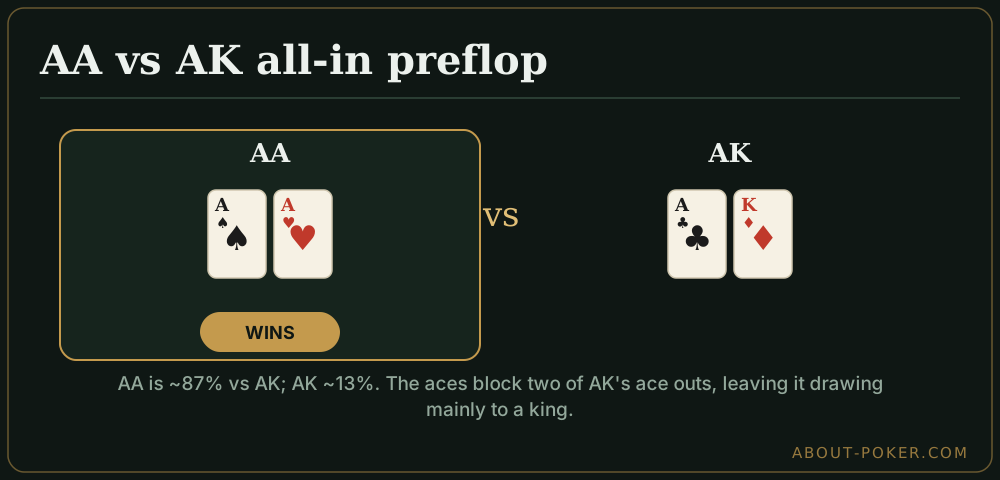
All-in preflop, pocket aces are about an 87% favorite over AK offsuit, with AK winning around 13%. Suited AK claws back a fraction of a point from added flush equity, but the matchup stays near 87/13.
| Matchup | AA equity | AK equity |
|---|---|---|
| AA vs AK offsuit | ~87% | ~13% |
| AA vs AK suited | ~86% | ~14% |
The number to remember: aces over AK is a near 87/13 blowout — far more lopsided than aces over a pair like kings (~82/18) and nowhere near a race.
Why AK is drawing so thin
Normally AK against a pair has six outs — three aces and three kings — to make top pair. Against aces, that math collapses:
- The ace outs are dead: two of the three remaining aces are in the aces’ hand. AK can only pair its ace by catching the single last one, and even then it loses to the set of aces it just helped make.
- Kings are the real outs: with three kings left, pairing the king is AK’s main path — but that only wins if the aces don’t improve.
- Backdoor straights and flushes: the rest of the 13% comes from runner-runner outs and the occasional straight.
So AK effectively has about three clean outs instead of six. Half of its usual equity is quietly removed by the aces holding matching cards — a “blocker” effect that combinatorics makes precise.
The blocker principle in one spot
This matchup is the cleanest illustration of blockers in poker. Holding an ace is normally great, but here it means the aces have removed your best outs before the flop is even dealt. The same idea runs through range analysis: the specific cards you and your opponent hold change how many combinations of draws and made hands are actually available. That’s why AK versus AA (~87/13) is so much worse than AK versus QQ (~46/54), even though both opponents are “just a pair.” Understanding removal is a pillar of equity.
A worked example
Effective stacks are 100 big blinds. You open A♠ K♦, an opponent three-bets, you four-bet, and they jam. You call and see A♣ A♥. You’re a 13% underdog in a 200-big-blind pot.
Getting AK all-in against a known pair of aces is a disaster — you’ll win barely one time in eight. But in real games you rarely know it’s exactly aces; a four-bet jam can be AK, KK, QQ, or a bluff, against which AK is fine. The 87/13 figure only kicks in once the cards are face up. Pricing “how often is it actually aces” is exactly what the preflop all-in odds framework and combinatorics handle together.
How the flop changes everything
The 87/13 number is a preflop, all-five-cards-to-come figure. Once the flop lands, the equity swings hard in one direction and rarely comes back. If the flop misses AK entirely — say Q-7-2 rainbow — AK’s equity actually drops from 13% to around 8-9%, because there are now only two cards to come and still only three live kings. The window to catch up is shrinking, so a clean miss is close to drawing dead.
The flip side is dramatic. If AK flops a king, it leaps from a 13% underdog to roughly a 91-92% favorite, because top pair top kicker now beats an unimproved pair of aces, and the aces are left drawing to two outs (the case ace) or running cards. That single-card swing — from 13% to over 90% — is the whole reason AK is willing to see a flop cheaply against a range that contains aces: the times it hits pay for all the times it misses. A king flops for AK about 12-13% of the time, so it is not rare, just streaky.
Turn and river cards matter too. On a blank turn after a blank flop, AK is down to a single card and about 4-5% equity — essentially the three kings out of 46 unseen cards, plus a sliver of backdoor-to-frontdoor straight or flush completion that the turn happened to open up.
Comparing AK against a full range
The 87/13 figure is a trap if you treat it as the equity of “getting AK in preflop.” You almost never face exactly aces. Against a realistic 4-bet-jam range of, say, QQ+ and AK, AK’s equity is far healthier:
- vs AA: ~13% — the disaster case.
- vs KK: ~34% — AK is blocking two of the kings, so it fares much better than against aces.
- vs QQ: ~46% — nearly a coinflip; AK is two live overcards.
- vs AK (chop or kicker): ~50% if it is the same combo, a near-split.
Blend those together weighted by how many combinations of each hand the opponent actually holds — there are more non-AA combos than AA combos in most ranges — and AK’s pooled equity against the whole 4-bet-jam range typically lands somewhere in the low-to-mid 40s. That is why committing AK preflop is routinely correct even though the AA-specific number looks terrifying. Working out those combination weights is exactly the job of combinatorics.
The takeaway
AA versus AK is the matchup that teaches blockers: your own ace kills the outs you most want. Lock in the anchor — AA is ~87% over AK — and remember it’s far more dominant than aces over another pair, precisely because of card removal. But also remember the number describes one specific, fully-known matchup; against a real range AK is a fine hand to get in. Build the surrounding skills through equity, combinatorics, and the poker odds & math hub.
Frequently asked
What are the odds of AA vs AK preflop?
Pocket aces are about an 87% favorite over AK all-in preflop when AK is offsuit, with AK winning around 13%. Suited AK improves to roughly 12%–13% depending on the exact cards. It's one of the most lopsided common matchups.
Why is AA vs AK worse for AK than a normal race?
Because the aces hold two of the three aces AK would need to pair. AK is left drawing mainly to a king, so it has far fewer clean outs than a hand like AK versus a random pair. That's why it's 87/13, not a coinflip.
How many outs does AK have against AA?
Essentially the three remaining kings, plus thin straight and flush chances. The two aces AK could pair are sitting in the aces' hand, so half of AK's usual pairing outs are dead.
Is AK ever a good spot to get all-in against aces?
No — at 13% you're a huge underdog. But you often can't know villain has exactly aces, and against a full raising range AK is fine to commit. The 87/13 figure only applies once you know it's specifically aces.