99 vs AK: Preflop Odds & Equity
Pocket nines are about a 54% favorite over AK all-in preflop — the classic coinflip. Here are the exact 99-vs-AK equities and where each side's outs come from.
On this page · 7 sections
You get pocket nines all-in against A♣ K♦ and you’re in the single most common all-in situation in tournament poker: the race. Your 9♠ 9♥ is a small favorite — about 54% — while AK wins roughly 46%. It’s close enough that players call it a coinflip, but the edge is real, and knowing exactly where it comes from changes how you feel about getting it in.
The headline equity
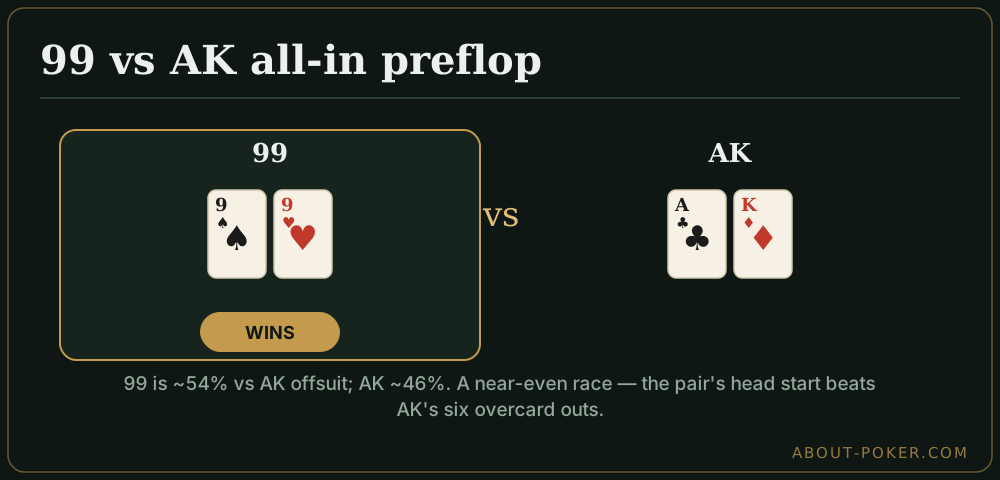
All-in preflop, pocket nines are about a 54% favorite over AK offsuit, with AK winning around 46%. If the AK is suited, its flush outs bump it up to roughly 48%, dropping the nines to about 52%.
| Matchup | 99 equity | AK equity |
|---|---|---|
| 99 vs AK offsuit | ~54% | ~46% |
| 99 vs AK suited | ~52% | ~48% |
The number to carry to the table: pair over two overcards is a ~54/46 race, nudging toward even money when the overcards are suited.
Where AK’s 46% comes from
AK is behind the moment the cards are dealt — it has no pair. So it’s drawing to hit the board:
- Pair an ace or a king: there are three aces and three kings left, giving AK six clean outs to make top pair. Over five community cards, catching at least one of those six is what powers most of its equity.
- Straights: AK can make a broadway straight (with QJT) or use one card in a straight, adding a slice of equity.
- Flushes: only when the AK is suited — that’s the entire reason suited AK gains about two points over its offsuit version.
Add the pairing chances to the straight and flush backups and you land at AK’s ~46%. Learn to spot these draws fast with the poker outs framework.
It helps to break the 46% into parts. Pairing an ace or a king by the river accounts for the large majority of AK’s equity — six outs over five cards connect a little under half the time. The straight and runner-runner chances add only a few points on top. That is why an offsuit AK with no flush help is stuck near 46 rather than closer to 50: almost all of its winning boards require it to simply pair up, and six outs, while a lot, is not quite enough to catch a hand that is already ahead.
Why the pair stays ahead
Pocket nines don’t need to improve to win — they just need the board to miss AK. On a blank board like 7♦ 3♣ 2♠ ... , the nines are already the best hand. AK has to actively catch up, and six outs across five cards isn’t quite enough to overcome starting behind. That structural head start is why the pair holds a slim but consistent edge, and it’s a core idea in equity: being ahead now with cards left to come is worth real percentage points.
A worked example
Effective stacks are 25 big blinds late in a tournament. You open 9♠ 9♥, an opponent jams A♣ K♦, and you call. You’re a 54% favorite for the pot.
Say the pot is 52 big blinds after blinds and antes. Your expected value is positive: 54% of the time you win it, 46% of the time you don’t. Over many repetitions, taking this flip when you’re getting good pot odds is correct — but notice how thin the edge is. You’ll lose this race nearly half the time, and that’s normal, not a leak. This is exactly the kind of spot the preflop all-in odds framework is built to price.
How the flip changes with the pair’s rank
Not every pair-versus-AK race is identical. The size of the pair matters in two ways. First, a bigger pair removes overcard outs: if you hold TT instead of 99, and the villain has AK, nothing changes about AK’s six outs — but if you held a pair like QQ, you would be blocking one of the ranks AK wants to hit and holding cards above part of AK’s straight material. Second, a pair below the overcards can be counterfeited more easily. With 99 against AK, a board that brings running cards for AK’s straight or a higher pair on the board plays out the same regardless, but the general rule holds: pairs from 22 up through JJ are all roughly 54/46 favorites over two live overcards, because in every case AK is chasing the same six-out, five-card draw.
The pair only pulls meaningfully ahead of the coinflip zone when it dominates one of the overcards — for example, 99 versus A9 is no longer a race, because the villain’s nine is nearly dead. Against AK, where both of your opponent’s cards are live and above your pair, you are locked into the classic ~54/46 shape. That is worth remembering at the table: “pair versus two bigger live cards” is always a coinflip, and no amount of the pair being 99 instead of 55 changes that.
A quick decision checklist
Before you commit chips in a 99-versus-AK spot, run through this short list:
- Are both overcards live? If yes, you are in a true ~54/46 race. If one of them is dominated (you hold a nine against A9, say), the math tips much further your way.
- Is the AK suited? Subtract about two points from your edge — you are now closer to 52/48.
- What price are you getting? As a 54% favorite you need the pot to be laying you better than roughly even money to call profitably on raw equity, which it almost always is when you have already invested chips.
- What is the tournament context? Raw equity says take the flip, but survival can matter. Weigh your stack and payout situation, not just the percentage.
The takeaway on races
Pocket nines over AK is the definition of a marginal favorite. You’re ahead, but only barely, so the decision to take the flip depends on the pot odds and the tournament situation, not on any illusion of dominance. Lock in the anchor — 99 is ~54% over AK offsuit — and treat suited AK as a near-even flip. Build the surrounding skills through equity, counting outs, and the poker odds & math hub.
Frequently asked
What are the odds of 99 vs AK preflop?
Pocket nines are roughly a 54% favorite over AK all-in preflop when the AK is offsuit, with AK winning about 46%. Against suited AK the gap narrows to about 52/48. This is the classic 'coinflip' or 'race.'
Is a pair always favored over two overcards?
Yes, but only slightly. A pair like 99 is about a 54/46 favorite over two live overcards such as AK offsuit. The pair is ahead now and the overcards must improve, but there are enough ace or king outs to keep it close to a coinflip.
Does AK being suited change the 99 vs AK odds?
A little. Suited AK adds flush equity, pushing it from about 46% up to roughly 48%, so pocket nines fall from 54% to about 52%. It's still a coinflip, just a touch closer.
Why is 99 vs AK called a race?
Because neither side is a big favorite. The pair is ahead but fragile, and the two overcards have six outs to pair up plus straight and flush chances. The equity lands near 50/50, so the outcome feels like a coin toss.