Odds of Being Dealt Aces
You are dealt pocket aces about 0.45% of the time — once every 221 hands. Here is the exact math, how it compares to other pairs, and what it means at the table.
On this page · 7 sections
You are dealt pocket aces about 0.45% of the time — once every 221 hands on average. It is the best starting hand in Texas hold’em and the rarest of the premium pairs to actually receive. Here is exactly where the number comes from and what it means for how you play and how often you can expect the dream hand.
The exact math
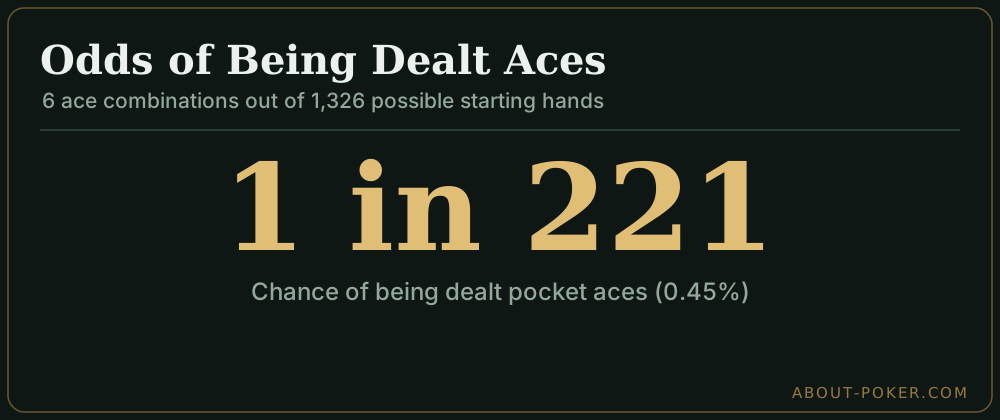
There are four aces in the deck. The number of two-card combinations you can make from them is C(4,2) = 6. The total number of two-card starting hands from a 52-card deck is C(52,2) = 1,326. So:
P(AA) = 6 ÷ 1,326 = 0.4525% = 1 in 221
That is the whole story for aces specifically. The same six-combination count applies to every individual pocket pair — kings, queens, deuces — because each rank also has four cards. For the broader family of pair probabilities, see pocket pair probability, and for the counting method behind C(4,2) and C(52,2), see poker combinatorics.
How aces compare to other hands
Because every pair is 1 in 221, you get any specific pair equally rarely. But you get some pocket pair much more often: with thirteen ranks, the chance of being dealt any pair is 13 × 6 ÷ 1,326 = 5.88%, or about 1 in 17. Put differently, roughly one deal in seventeen gives you a pocket pair of some kind, but only one deal in 221 gives you aces. That scarcity is why aces are so valuable — and why patient players do not throw them away with fancy slow-plays that let opponents draw out cheaply.
A worked example
Imagine a live 30-hands-per-hour game. At 1 in 221, you expect aces roughly once every 221 ÷ 30 ≈ 7.4 hours of play — so a full-day session might bring them two or three times. Online, four tables at 80 hands an hour each is 320 hands per hour, so you would average aces about once every 40 minutes. Now the flip side: when you do get aces, you are around 80% to win against a single random hand and about 82% against kings — see AA vs KK preflop odds and equity. The hand is a huge favorite, but it is only a two-card favorite; it wins about four times in five heads-up and much less often multiway, which is why you generally want to play it in a raised, ideally heads-up pot.
Multiple aces at the table
Players often ask how often two people both wake up with aces. The short answer is: rarely. Once you hold aces, only two aces remain among the 50 unseen cards, so any single opponent has just one combination of aces available out of C(50,2) = 1,225 hands — about 0.08%. Across a full table the chances rise slightly, but “aces versus aces” remains a genuine cooler you might see a handful of times a year, not a hand to fear on every deal. If it does happen heads-up and you both get the money in preflop, you are simply splitting most of the time unless a flush comes in.
Common mistakes
The classic error is over-slow-playing aces to “trap,” which invites multiway pots where their equity plummets — aces that win 80% heads-up can drop below 50% against several opponents. Raise and reraise to thin the field. A second mistake is refusing to fold aces postflop when the board and action clearly beat you; one pair, even the best one, is still one pair, and stubbornness on a Q♥ J♥ 10♥ board can be expensive. Finally, do not tilt when aces lose: at roughly 20% to lose heads-up, they will get cracked regularly, and that is variance working as designed, not a reason to change a correct preflop plan.
Why the 1-in-221 number matters at the table
The scarcity figure has a practical use beyond trivia: it calibrates your expectations and your reads. Because you personally see aces only once every 221 hands, an opponent who claims aces at the showdown twice in an hour is either very lucky or misremembering — the base rate is your reality check. It also underpins bankroll psychology. Aces feel like a guaranteed win, but the hand loses roughly one time in five heads-up and much more often multiway, so a run of cracked aces is normal variance across a few hundred deals, not a broken game. Internalizing the base rate keeps you patient when the cards run cold and grounded when they run hot: the premium hand is powerful precisely because it is rare, and rarity means you must extract maximum value on the few occasions it arrives.
Quick checklist
- Odds of being dealt aces: 0.45%, or 1 in 221.
- Every specific pocket pair is equally rare at 1 in 221; any pair at all is about 1 in 17.
- Aces win roughly 80% heads-up but far less multiway — raise to thin the field.
- Aces versus aces is a rare cooler, not a common event to plan around.
- Be willing to fold aces postflop when the board and action clearly say you are beaten.
Frequently asked
What are the odds of being dealt pocket aces?
About 0.45%, or 1 in 221. There are six ways to make pocket aces from four aces, out of 1,326 possible two-card hands, which works out to 6 in 1,326, or roughly once every 221 deals.
How often should I get aces in a session?
On average once every 221 hands, so in a typical live session of 30 hands an hour you would expect aces a little less than once every seven-and-a-half hours. Online, at 60 to 100 hands an hour per table, you will see them far more frequently.
What are the odds two players both have aces?
Very small. At a full nine-handed table the chance that two specific players are both dealt aces is remote, and even the chance that any two players hold aces on the same deal is only a fraction of a percent. It happens, but rarely.