Odds of Flopping a Straight
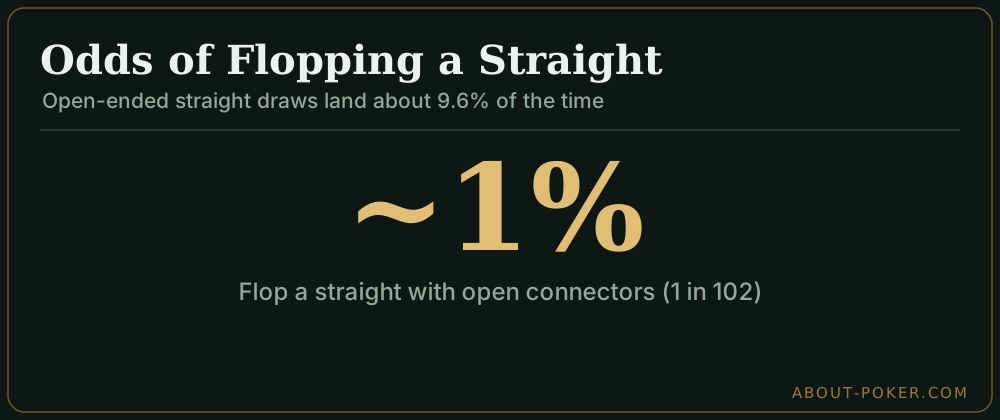
You flop a straight about 1% of the time (1 in 102) with open connectors. Here is the exact count, why draws matter far more, and how to play them.
On this page · 7 sections
Hold two connected cards and you will flop a made straight only about 1% of the time — roughly 1 in 102 with the best open connectors. Like the flush, the straight is a rare flop; the money in connected hands comes from the straight draws you make and realize on later streets. Here is the math and how to apply it.
The exact count
Take open-ended connectors such as 8♥ 7♠. To flop a straight you need three specific ranks that, combined with both your cards, form a five-card run. There are three qualifying runs that use both the 8 and the 7:
- 4-5-6-7-8 → flop must bring 4, 5, 6
- 5-6-7-8-9 → flop must bring 5, 6, 9
- 6-7-8-9-10 → flop must bring 6, 9, 10
Each run needs three specific ranks, and each rank can arrive in any of 4 suits, so each gives 4 × 4 × 4 = 64 flop combinations. Three runs give 192 combinations:
P(straight) = 192 ÷ C(50,3) = 192 ÷ 19,600 = 0.98%
That is 1 in 102 — even rarer than flopping a set. Connectors are not about the made straight; they are about the draw.
Straight draws are the real edge
An open-ended straight draw (OESD) gives you eight outs and is far more common than the made straight. With 8♥ 7♠ you flop an OESD roughly 9.6% of the time and a four-out gutshot around 17%. An OESD is worth about 32% equity by the river against a made hand — genuine firepower. This is why suited connectors and connectors are prized: they flop strong, disguised draws that let you apply pressure and stack opponents when you hit. Track those outs precisely using poker outs.
A worked example
You call a raise with 9♦ 8♦ and the flop comes 7♣ 6♠ 2♥. You have flopped an open-ended straight draw — any 10 or any 5 completes your straight, eight outs. Using the rule of 4 and 2, eight outs times four is about 32% to hit by the river. That is a strong semi-bluffing spot: you can raise or barrel, because when called you still have a third of the pot in equity plus the chance to win immediately. Now compare the rarer version: the same hand flops 10♣ 6♠ 5♥, giving you a made straight, roughly a 1-in-102 gift — play it fast on a wet board and slower on a dry one.
How straight odds change with card connection
The 1% figure applies to zero-gap open connectors (43 through JT). One-gap hands like 9♠ 7♠ flop fewer straights because fewer runs use both cards, and double-gappers fewer still. Broadway-adjacent hands also lose one open end: K♥ Q♥ cannot make a straight below the ten, so it plays more like a one-way hand. The takeaway is that the tightest connectors carry the most straight equity, which is exactly why they climb the preflop ranking charts. When choosing between a straight chase and a flush chase, see straight vs flush odds — the straight is easier to hide but the flush usually wins at showdown.
Common mistakes
Players routinely overrate the made straight and underrate the draw, then get the play backward. They slow-play a rare flopped straight into a dry board where nobody can pay, and they under-bet strong draws that want to build the pot. A second error is chasing gutshots at bad prices: four outs is only about 16–17% by the river, so a gutshot needs cheap cards or strong implied odds to continue. Finally, do not forget straight blockers — when your straight is on a paired board, your opponent may already have a full house, and your near-nuts can quietly become second best.
Why straights get paid more than flushes
The straight has one big edge over the flush at the payout window: it hides better. A completed straight often sits on a board that does not obviously threaten one, so opponents keep betting into you with top pair or an overpair. A flush, by contrast, needs three matching suits on the board, which is a visible warning. This means a made straight frequently wins a larger pot than a made flush of equal rarity, even though the flush beats the straight when they clash. Keep that asymmetry in mind: when you complete a straight on an innocent-looking board, lean toward value-betting thin, because your opponent has fewer reasons to fold.
Quick checklist
- Flopping a made straight with open connectors: about 1%, or 1 in 102.
- Flopping an open-ended straight draw: about 9.6% — nine to ten times more common.
- An OESD is worth roughly 32% equity by the river; a gutshot about 16–17%.
- Zero-gap connectors flop the most straights; gaps reduce your straight potential.
- Semi-bluff strong draws; do not slow-play them into dry, unpayable boards.
Frequently asked
What are the odds of flopping a straight with connectors?
About 1%, or roughly 1 in 102, with open-ended connectors like 8-7 or J-10. All three flop cards must combine with both your hole cards to complete a five-card run, which is a demanding requirement.
How often do you flop a straight draw?
With open-ended connectors you flop an open-ended straight draw about 9.6% of the time and a gutshot roughly 17%. Draws, not made straights, are what give connected hands their real value on the flop.
Are gapped connectors worse for flopping straights?
Yes. One-gap hands like 9-7 flop fewer straights because fewer five-card runs use both cards, and double-gappers are worse still. Tighter connection means more straight potential, which is why the closest connectors are the most playable.