Odds of Flopping a Gutshot
You flop a gutshot straight draw about 11% of the time with connected cards. Here is the count, the four outs it gives you, and when to continue.
On this page · 7 sections
You flop a gutshot straight draw about 11% of the time when you hold two cards that can form a straight. A gutshot — also called an inside straight draw — gives you four outs, the four cards that fill the single gap in your run of five. It is the weakest straight draw, but it flops often, and its real value comes from the extra equity it usually travels with. Here is the exact math and how to play it.
What counts as a gutshot
A gutshot is a four-card straight missing one middle rank. If you hold 8-7 and the flop is J-9-5, you need a ten to make 7-8-9-10-J. Only tens complete it, and there are four of them, so you have four outs. Contrast that with an open-ended draw, which is missing a card on either end and has eight outs. The gutshot is exactly half as strong on raw outs.
The core count
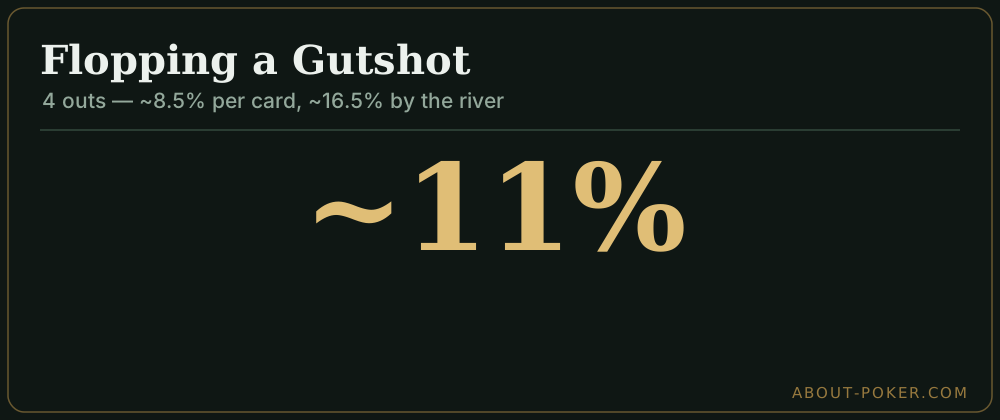
With two connected cards like 8-7, roughly 11% of flops give you a gutshot. The exact figure moves a little depending on how connected your cards are and whether the flop also brings a pair or overcards, but 11% is the working number. It is more common than flopping an open-ender (about 9.6% with connectors and about 8% with one-gappers) because there are more board layouts that leave a single gap than layouts that open both ends.
What a gutshot is worth: the four outs
Four outs is thin. Using the rule of 4 and 2, four outs is about 16% to complete by the river from the flop, and about 8.5% on the next card alone. That is why a bare gutshot is rarely a call against a big bet: you are getting under 4-to-1 to hit on the next card, and most bets do not lay you those odds.
The count itself is straightforward. Of the 47 unseen cards after the flop, 4 fill your straight. On the turn that is 4 in 47, about 8.5%. Miss the turn and the river gives you 4 in 46, again about 8.7%. Combine them and you complete by the river about 16.5% of the time.
A worked example
You hold T♠9♠ and the flop is Q♥8♦2♣. You have a gutshot to the straight: any jack makes Q-J-T-9-8. That is four outs, about 16% by the river. On its own, weak. But notice the extras. You hold two spades, giving a backdoor flush draw, and your ten and nine can pair for extra outs. Add a backdoor flush (roughly 4% by the river) and a couple of pair outs, and your total equity climbs toward 25%. That is the difference between a fold and a profitable continue.
Counting all of that accurately is the same skill as any poker outs exercise: start with the clean four, then add the realistic backdoors and overcards.
When to continue with a gutshot
Continue when the gutshot has help. A gutshot plus two overcards, or a gutshot plus a backdoor flush draw, is a real hand with enough equity to call or even semi-bluff. A naked gutshot with no overcards and no backdoors is usually a fold against real aggression.
Position matters too. In position you can call a gutshot with plans to bluff turns and realize your equity cheaply. Out of position, the same draw is worth less because you cannot control the price on later streets.
Implied odds are the other lever. A well-hidden gutshot that will get paid off when it completes — because the straight is not obvious — is worth chasing more than an obvious one that shuts down the action the moment it hits.
Common mistakes
The first mistake is treating a gutshot like an open-ender. Four outs is half of eight; do not call the same prices you would with a bigger draw.
The second is ignoring the extras. Most profitable gutshot continues are really “gutshot plus something.” Learn to see the backdoor flush, the overcards, and the pair outs.
The third is chasing gutshots out of position with no implied odds. Without the price or the payoff, a naked inside draw bleeds chips.
Quick reference
- Flop a gutshot with connected cards: about 11%.
- Gutshot outs: 4.
- Complete on the next card: about 8.5%.
- Complete by the river from the flop: about 16.5%.
A gutshot is a small piece of equity that becomes a good hand when it stacks with overcards, backdoors, or strong implied odds. Judge it by the whole package, not the four outs alone.
Frequently asked
What are the odds of flopping a gutshot?
With two connected or gapped cards, you flop a gutshot straight draw about 11% of the time. A gutshot has four outs, so it is a weak draw on its own, but it flops often enough to matter and gains a lot of value when it comes with overcards or backdoor equity.
How many outs does a gutshot have?
A gutshot, or inside straight draw, has exactly four outs — the four cards of the one rank that fills the hole in your straight. Using the rule of 4 and 2, that is roughly 16% to complete by the river from the flop, or about 8.5% on the very next card.
Should I call with a gutshot?
By itself a gutshot is usually too weak to call big bets, since four outs is only about 8.5% per card. It becomes callable when it carries extra equity — two overcards, a backdoor flush draw, or strong implied odds against a deep stack that will pay you off when you hit.