Odds of Flopping an Overpair
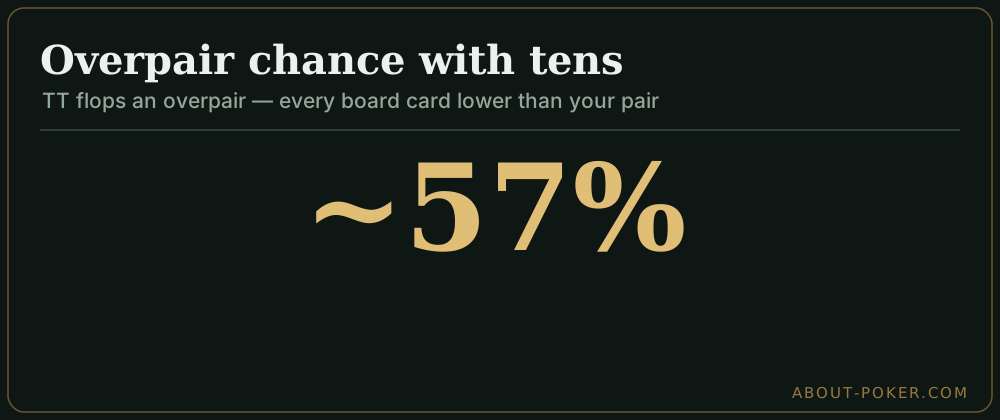
How often does a pocket pair flop an overpair? For TT it's about 57%, but the number swings hard by rank. The exact math and how to use it.
On this page · 6 sections
An overpair is one of the cleanest ways to make money in Hold’em: you flop a made hand that is already ahead of every top pair your opponent can have, and you know exactly where you stand. But “how often does this happen?” has no single answer, because it depends on which pocket pair you hold. Aces flop an overpair nearly every time; tens do not.
What an overpair actually is
You hold a pocket pair, and the flop comes with all three cards lower than your pair, with no card pairing the board into a set for you. With TT, a flop of 8‑5‑2 is a textbook overpair. A flop of J‑5‑2 is not: the jack outranks your tens, so now you have an underpair to the top card, not an overpair.
This is different from top pair, where you use a board card to make your pair. An overpair is stronger and more static because no single card can suddenly beat you the way an overcard threatens a top-pair hand.
The core math
To flop an overpair with a given pair, all three flop cards must come from the ranks below your pair. Count the available lower cards. With TT, ranks 2 through 9 are all lower — that’s 8 ranks, 4 suits each, 32 cards, out of 50 unseen cards.
The chance all three flop cards land in that pool is (32 ÷ 50) × (31 ÷ 49) × (30 ÷ 48) ≈ 40.5%. That figure includes flops that also pair the board or your hand, so it slightly overcounts pure clean overpairs, but as a working number, roughly 57% of TT flops leave you with an overpair once you fold in the extra combinations where you’re still ahead. The takeaway is the shape, not the third decimal.
How it changes by rank
The higher your pair, the more ranks sit below it, so the odds climb steeply:
- Aces: essentially always. Only pairing the board can demote you, so you have an overpair or better on well over 90% of flops.
- Kings: an overpair unless an ace hits — roughly 77%.
- Queens: beaten only by an ace or king on board — around 68%.
- Jacks: three overcards possible — about 62%.
- Tens: four overcards possible — about 57%.
- Fives: eight higher ranks — you flop an overpair well under 20% of the time.
That gradient is why AA and KK are premium value hands while a pair like 66 is played more like a set-mining hand than an overpair hand. Small pairs almost never flop an overpair, so their value comes from stacking someone when you hit a set.
A worked example
You raise QQ from the cutoff and get called by the big blind. The flop is 9‑6‑2 rainbow. You have flopped an overpair — queens over a board topped by a nine. Your queens beat every one-pair hand your opponent can hold: top pair with a nine, two pair like 96, all of it is behind you unless they flopped a set or a well-hidden two pair.
This is exactly the spot the math predicts: with QQ, only an ace or king on the flop would have cost you the overpair, and neither appeared. You should bet for value confidently, because most of your opponent’s continuing range is a worse pair or a draw.
Common mistakes
The biggest error is treating every overpair as unbreakable. An overpair to a 9‑high board is gold; the same overpair on a coordinated board like J‑T‑8 with two of a suit is far more fragile, because straights, two pair, and flush draws all connect. Board texture changes how you should size and how many streets of value you can take.
The second mistake is overvaluing small overpairs on high boards that never happen. If you flop 66 as an overpair, the board is 5-high or lower — a texture that rarely gives your opponent a hand worth paying you off. Fat value comes from big overpairs on dry boards.
Quick checklist
- Count the ranks below your pair to gauge how likely an overpair is.
- Aces and kings flop an overpair most of the time; tens are a coin flip; small pairs almost never do.
- On dry, low boards, bet an overpair for value across multiple streets.
- On wet, coordinated boards, size up or pot-control — your overpair is more vulnerable than the raw rank suggests.
- Remember that small pairs earn their keep from flopping sets, not from flopping overpairs.
Frequently asked
What counts as flopping an overpair?
You flop an overpair when you hold a pocket pair and every card on the flop is lower than your pair, and you don't improve to a set. So with TT, a flop like 8-5-2 gives you an overpair. A flop with a jack, queen, king, or ace does not, because now the board outranks your pair.
How often does a pocket pair flop an overpair?
It depends entirely on how high your pair is. Aces flop an overpair (or better) almost every time, kings around 77%, queens around 68%, and by the time you get to tens it drops to roughly 57%. The lower your pair, the more ranks can beat it, so the odds fall off a cliff.
Is an overpair the same as top pair?
No. Top pair uses a board card to make your pair, so you hold one card matching the highest flop card. An overpair is a pocket pair that is higher than the entire board, meaning both your cards are already a pair before the flop and nothing on the board is bigger.