Odds of Hitting a Backdoor Flush
A backdoor flush draw completes about 4.2% of the time — you need running cards on turn and river. The exact runner-runner math and how to value it.
On this page · 7 sections
A backdoor flush draw — sometimes called a runner-runner flush — is the quiet workhorse of good flop decisions. On its own it almost never gets there, but as an equity add-on it tips dozens of close spots toward a call or a continuation bet. Here’s the exact math and how to actually use it.
The core math
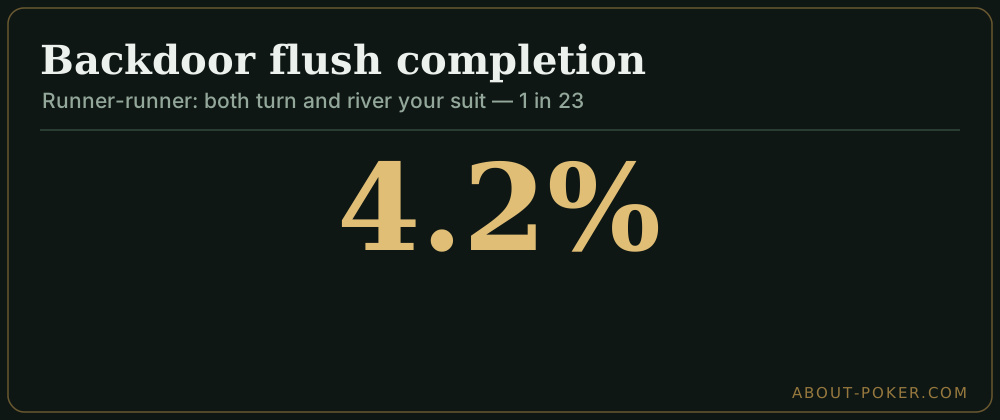
You have a backdoor flush draw when you hold two of your suit and exactly one more appears on the flop, so you have three of the suit with two cards to come. To complete, you need both the turn and the river to be your suit.
After the flop, 10 of your suit remain among 47 unseen cards. So the turn is your suit with probability 10 ÷ 47 ≈ 21.3%. If it hits, 9 remain among 46, so the river follows with probability 9 ÷ 46 ≈ 19.6%.
Multiply: 0.213 × 0.196 ≈ 4.2%, or about 1 in 23. That’s the standard runner-runner figure, and it’s why any single backdoor draw is a long shot by itself.
Why 4% still matters
Four percent sounds like a rounding error, but poker is a game of small edges stacked together. A backdoor flush draw is worth roughly 4 percentage points of equity on the flop — and the useful part is how it combines:
- Backdoor flush + two overcards turns a hand you might fold into a comfortable float or continuation bet.
- Backdoor flush + gutshot adds a real second way to improve on top of your 4 straight outs.
- Backdoor flush alone gives you a credible bluffing story: you can barrel the turn when a third suit card lands and represent a completed flush your opponent can’t discount.
This “combining equity” idea is why solvers continue with hands that look weak at a glance — the backdoors add up. See how often do you hit your draw for the broader picture.
A worked example
You hold A♠J♠ and the flop is Q♠7♥3♦. You have a backdoor flush draw (two spades plus the Q♠), a backdoor Broadway straight draw, and two overcards. No single one of these is strong, but together they justify a continuation bet.
Now the turn is the 9♠. You’ve picked up a real flush draw — 9 outs, about 19% to complete on the river, or 9 ÷ 46. Your backdoor draw has “graduated” into a live flush draw. This is the payoff of continuing with backdoors: roughly a fifth of the time the turn upgrades you into a genuine draw, and now you can barrel with real equity behind the bluff.
How to value it at the table
Do not call big bets purely because you have a backdoor flush draw — 4% is not enough on its own. Instead, treat it as the deciding factor in already-close spots. If you’re 50-50 on whether to continue with a hand, a backdoor flush draw is often the tiebreaker that says “yes.”
The other practical use is turn barreling. When a third card of your suit arrives and completes your backdoor equity, or even threatens to, you can bet with a hand that now has both showdown value and a credible representation of the flush.
Backdoor flush versus a live flush draw
It’s worth contrasting the two so you never confuse them at the table. A live flush draw has four cards of the suit already in play (two in hand, two on board) and needs just one more of three-plus streets — about 35% by the river. A backdoor flush has only three of the suit and needs two more, running perfectly — about 4.2%.
That’s an eight-fold difference in likelihood. The practical rule: pay real money only for the 35% draw. For the 4.2% backdoor, pay nothing extra on its own; let it ride as a free upgrade that occasionally, around 21% of the time on the turn, promotes itself into the genuine 35% draw. Treating a backdoor like a real draw is one of the more expensive misreads a developing player makes.
Common mistakes
The classic error is drawing to a backdoor flush as if it were a real draw and paying flop bets accordingly. It isn’t — you need two perfect cards. Only continue when the backdoor is stacked on top of other equity or a strong bluffing plan.
The reverse mistake is ignoring backdoors entirely and folding hands that should continue. Two backdoor draws plus overcards is a genuinely fine flop continue; folding it every time is far too tight and leaves easy money behind.
Quick checklist
- A backdoor flush needs runner-runner: both turn and river your suit.
- The math: (10 ÷ 47) × (9 ÷ 46) ≈ 4.2%, about 1 in 23.
- Worth roughly 4 equity points — meaningful only as an add-on.
- Use it to break ties on flop continues and to justify turn barrels.
- Never pay big bets for a backdoor draw alone; it’s a bonus, not a draw.
Frequently asked
What are the odds of hitting a backdoor flush?
About 4.2%, or roughly 1 in 23. A backdoor flush needs both the turn and the river to be your suit, so it's a runner-runner draw. The turn brings your suit about 23% of the time, and then the river must follow suit, which multiplies out to just over 4%.
How much equity is a backdoor flush draw worth?
Roughly 4 percentage points of raw equity on the flop. That doesn't sound like much, but it's meaningful when added to other equity — a backdoor flush combined with two overcards or a gutshot can turn a marginal hand into a clear continue.
Is a backdoor flush draw worth a lot?
On its own, not really — 4% is thin. Its true value is as a tiebreaker and an equity add-on. It gives you extra barreling and bluffing credibility because you can represent the completed flush, and it improves the hands you continue with on the flop.