Odds of Flopping the Nuts
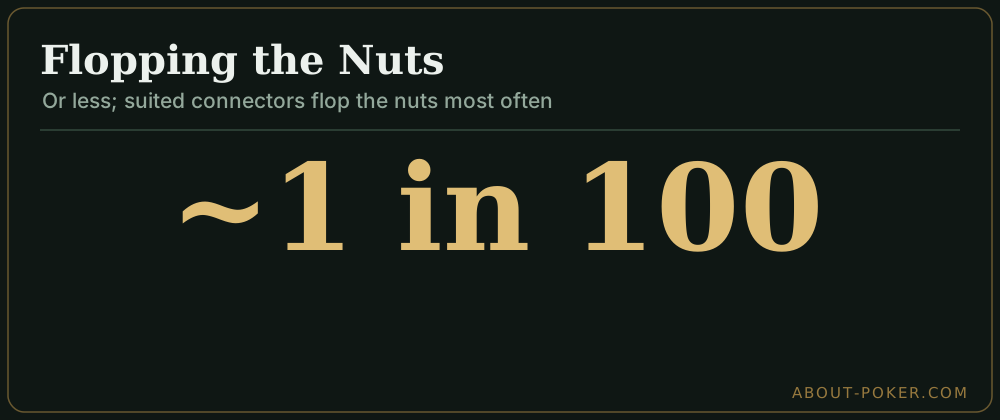
Flopping the nuts is rare — roughly 1 in 100 flops or less, depending on your hand. Here is what the nuts means, the real odds, and how to maximize it.
On this page · 7 sections
Flopping the nuts is one of poker’s best feelings and one of its rarest events. Across all hands, you flop the true nuts on the order of 1 in 100 flops or less, and the exact figure swings enormously with your starting cards. Suited connectors flop nut straights and flushes far more often than big pairs, which almost never flop the literal nuts. Here is what “the nuts” really means, the real odds, and how to get paid when you get there.
What the nuts means
The nuts is the single best hand possible given the board. On a flop of J♥T♥9♥ the nuts is the ace-high flush; on 8♦7♣2♠ the nuts is a set of eights. Flopping the nuts means your two cards plus the flop make a hand nothing can currently beat. The key word is currently — the nuts can change on the turn and river as new cards open up bigger possibilities.
This matters because many hands people think of as monsters are not the nuts. Top set on a coordinated board is huge, but if a straight or flush is possible, your set is not the nuts.
Why big pairs rarely flop the nuts
Pocket aces flop a set about 11.8% of the time, the number covered at odds of flopping a set. But a set of aces is only the nuts on boards where no straight or flush beats it — for example an ace-high board with no two suited, no connected cards. On many flops, top set is the second nuts behind a straight or flush possibility. So even the best pair flops the literal nuts only a fraction of the time it flops a set.
That is the counterintuitive part: the hands that make the strongest single-pair-based holdings are not the best nut-flopping hands.
Which hands flop the nuts most often
Suited connectors and small suited aces are the champions here. They can flop nut straights and nut flushes, which are unbeatable holdings. A hand like 8♠7♠ flops some kind of straight around 1.3% of the time — see odds of flopping a straight — and when that straight is the top end, it is the nuts. Add the rare flopped nut flush and these hands reach the nuts more often than any big pair.
The reason is that nut straights and nut flushes cannot be out-drawn on the flop the way a set can be beaten by a bigger set or a completed draw. When suited connectors hit big, they often hit the ceiling.
A worked example
You hold 6♠5♠ and the flop comes 7♦8♣9♥. You have flopped the nut straight — 5-6-7-8-9, and nothing beats it right now. How rare was that? For your specific connectors to flop exactly the top straight, the board must bring the three ranks that complete your highest possible run, in this case 7-8-9. Working the combinatorics, a specific flopped nut straight for a given suited connector is well under 1%. This is why it is a moment to remember and, more importantly, to maximize.
Be careful even here: the board 7-8-9 is coordinated. A ten on the turn gives anyone with a jack a higher straight, and two of a suit could bring a flush. Your flopped nuts can lose its crown, which shapes how you bet.
How to play a flopped nut hand
When you flop the nuts on a dry board where the nuts cannot change, you can afford to slow-play a little and let opponents catch up or bluff. When you flop the nuts on a wet board where the turn can demote you, bet and build the pot immediately. The 6-5 example above is a bet-now situation: charge the draws and the worse straights before a scare card arrives.
Sizing should match the board. On a dry, unchanging nut board, smaller bets keep worse hands in. On a dynamic board, larger bets protect your equity and grow the pot while you are still on top.
Common mistakes
The first mistake is thinking top set is always the nuts. On coordinated boards it often is not. Know the difference before you commit your stack.
The second mistake is slow-playing on wet boards. If the turn can beat you, betting now is almost always right.
The third mistake is misjudging which starting hands flop the nuts. Chasing “the nuts” with big offsuit cards is a poor plan; suited connectors and suited aces are the true nut-flopping hands. The full counting logic is laid out at poker combinatorics.
Quick reference
- Flop the true nuts across all hands: on the order of 1 in 100 or less.
- Flop some straight with a suited connector: about 1.3%.
- Flop a set with a pocket pair: about 11.8% — but rarely the literal nuts on wet boards.
- Best nut-flopping hands: suited connectors and small suited aces.
Flopping the nuts is rare and precious. Know when your nuts is durable and when it is fragile, and size your bets to squeeze the maximum from the moment.
Frequently asked
What are the odds of flopping the nuts?
It depends on your hand and the board, but flopping the true nuts is rare — on the order of 1 in 100 flops or less across all hands. Suited connectors flop a nut straight or nut flush more often than most hands, while big pairs almost never flop the literal nuts because sets can be beaten by straights and flushes.
What does flopping the nuts mean?
The nuts is the best possible hand given the community cards. Flopping the nuts means your two hole cards combine with the three flop cards to make a hand that nothing else can beat at that moment — like the nut straight, a top set on a dry board that cannot be beaten yet, or a made nut flush.
Which hands flop the nuts most often?
Suited connectors and small suited aces are the best nut-flopping hands because they can make nut straights and nut flushes. Big offsuit cards rarely flop the nuts. Even pocket aces usually only flop top set, which is not the nuts on boards where a straight or flush is possible.