Odds of Hitting a Gutshot
A gutshot has 4 outs — about 16.5% to hit by the river, or 8.5% on a single street (about 11 to 1). Here is the math and when a gutshot is worth a call.
On this page · 8 sections
A gutshot — also called an inside straight draw or “belly buster” — is the weakest common straight draw, and it comes with a sobering number: four outs. By the river you complete it only about 16.5% of the time, roughly 5 to 1 against. On a single street it is worse still, about 8.5%, or 11 to 1. Knowing exactly how thin that is keeps you from calling too wide.
Where four outs comes from
A gutshot needs one specific rank to fill a hole in the middle of your would-be straight. Say you hold Jc-Th on a board of 8s-7d-2c: only a nine completes the straight (making J-T-9-8-7). One rank, four suits, so 1 × 4 = 4 outs. Compare that to an open-ender, which has two completing ranks and therefore eight outs — twice the strength for the same shape of hand.
Turning four outs into odds
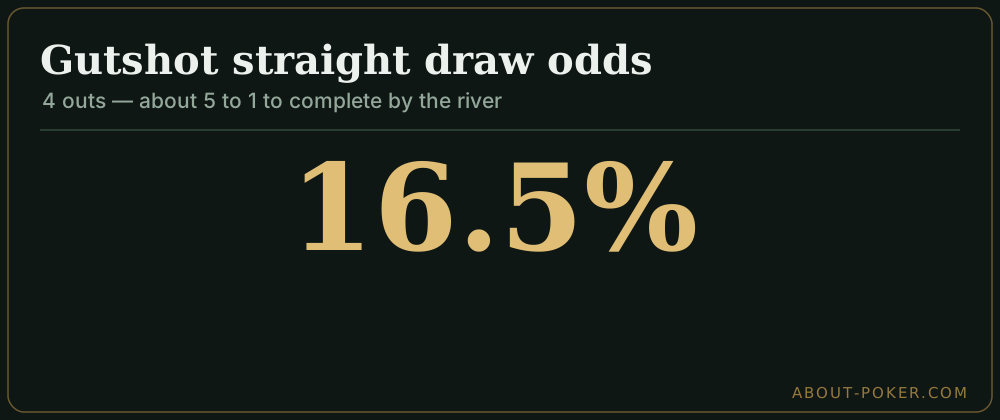
After the flop there are 47 unseen cards. On the turn alone your chance is 4 ÷ 47 = 8.5%. Miss, and 46 cards remain, so the river adds 4 ÷ 46 = 8.7%. Combining both streets:
P(hit by river) = 1 − (43/47 × 42/46) = 16.5%
That is 5.07 to 1 against with two cards to come. The rule of 4 and 2 approximates it neatly: 4 outs × 4 = 16% for both streets, 4 outs × 2 = 8% for one. Both are close to the exact figures.
A worked example
You hold Qh-Jh on 9s-8c-2d — a gutshot to the ten, four outs. The pot is $100 and your opponent bets $80, so you must call $80 to win $180, getting 2.25 to 1. Your one-street equity is 8.5%, which requires roughly 11 to 1. On direct odds this is a clear fold. But two things can rescue it: you also have two overcards that may be live (adding outs), and if a ten hits you will likely stack a made hand, giving strong implied odds. Against a smaller flop bet, and with deep stacks behind, the same gutshot becomes a routine call — the price and the future payoff are what decide it, never the four outs alone.
Why implied odds matter so much
Because the direct price is almost never good enough, gutshots live and die on implied odds — the extra money you win when you hit. A disguised gutshot that completes to the nut straight can win a full stack, and that back-end payoff is what makes the call profitable. The rule of thumb: you need roughly 11 times the current bet in eventual winnings to justify a naked gutshot on the turn. Deep stacks, hidden draws, and opponents who pay off supply that; short stacks and obvious boards do not.
When a gutshot gains value
- Double gutshot: two separate inside draws total eight outs and play like an open-ender.
- Gutshot plus flush draw: 4 + 9 − overlap, often about 12 outs, near 45% by the river — a strong semi-bluff.
- Gutshot with overcards: add up to 6 clean overcard outs, roughly doubling your equity.
- As a bluff: with fold equity you do not always need to hit; the four outs are your backup when called.
Common mistakes
- Chasing naked gutshots for value. Four outs is not enough at typical bet sizes; fold unless odds or implied odds justify it.
- Overcounting outs. If the straight card completes a flush or pairs the board, it may make your opponent a bigger hand — discount those outs.
- Forgetting position. A gutshot is far more playable in position, where you control the price and realize your equity more often.
Quick checklist
- Outs: 4.
- By the river (flop): 16.5% (5 to 1).
- Single street: 8.5% (11 to 1).
- Minimum pot odds on the turn: better than 11 to 1, or strong implied odds.
- Upgrade the hand with overcards, a flush draw, or fold equity before committing.
Position turns a gutshot profitable
The single biggest lever on a gutshot is position. In position you see your opponent act first, you can check behind for a free card when the price is wrong, and you get paid the full stack when the belly-buster fills. Out of position you often face a bet you cannot profitably call and lose your equity by folding. The same four outs are worth far more when you control the pot: you realize more of your 16.5% by seeing both cards cheaply, and you capture more implied value on the streets you do hit. If you are choosing whether to continue with a naked gutshot, position should tip a close spot toward a call and an out-of-position version toward a fold.
Half the outs of an open-ender means half the equity — treat gutshots with respect and lean on implied odds. For the full outs-counting method, see our poker outs guide.
Frequently asked
What are the odds of hitting a gutshot straight draw?
With two cards to come you complete about 16.5% of the time (roughly 5 to 1 against). On a single street it is about 8.5%, or about 11 to 1 against.
How many outs does a gutshot have?
Four. Only one rank completes the straight, and that rank has four suits in the deck, so 1 × 4 = 4 outs.
Is a gutshot worth calling?
Rarely on direct pot odds alone — you need better than 11 to 1 on a single street. Gutshots become profitable mainly through implied odds, extra outs, or fold equity when you can bluff.