Odds of Hitting a Runner-Runner Straight
The odds of hitting a runner-runner straight, worked out exactly: why a backdoor straight completes about 4-5%, how many outs it really has, and when it matters.
On this page · 6 sections
A runner-runner straight, also called a backdoor straight, is one you make by catching both the turn and the river when your flop holding is not yet an eight-out or four-out draw. It is the straight version of the backdoor flush, and like its cousin it feels like a miracle when it lands. But the probability is precise and small, and knowing it keeps you from overvaluing hands that only look connected.
What counts as a backdoor straight
To have a genuine runner-runner straight draw, you need three cards to a straight after the flop that are close enough for two more cards to fill the gap. The strongest configuration is three consecutive or near-consecutive ranks that can complete in more than one way. Compare this to a made draw on the flop, which is covered in odds of flopping a straight; the backdoor case is one step earlier, needing help on both remaining streets.
If your flop holding already has an open-ended straight draw or a gutshot, you are past the backdoor stage. The runner-runner label applies specifically when you need the turn to first create a real draw and then the river to complete it.
The exact math on the strongest case
Take a clean example. You hold Jh Th and the flop comes 8c 2d 5s, so you have no straight draw yet. That is not a backdoor straight because the cards are too spread out. Now consider holding Jh Th on a flop of 9c 4d 2s. You have J-T-9, three to a straight. To make a straight you need two of the missing ranks.
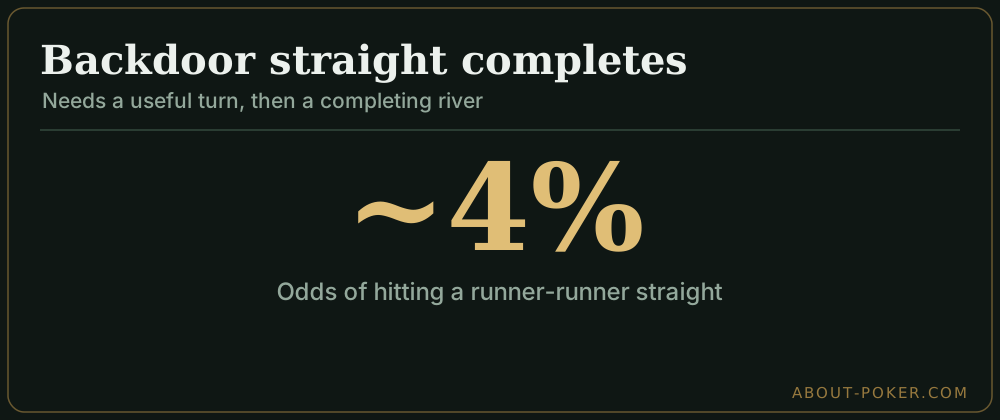
The best backdoor configurations are open on both ends, meaning several turn cards keep the draw alive. Roughly, about 6 to 8 turn cards advance you to a real straight draw, and then about 4 river cards complete it. The combined probability lands near 10/47 times 4/46, which is about 1.8% for the tightest version and climbs toward 4-5% for the most open holdings once you account for multiple completing routes. The reliable planning number is about 4% of equity, the same order of magnitude as the runner-runner odds for a backdoor flush.
Why solvers still care about 4%
Four percent sounds like nothing, and on its own it is. You should never call a real bet purely hoping to catch a runner-runner straight. But solvers fold this small equity into decisions constantly, because it stacks with everything else a hand has going for it. A hand with two overcards, a backdoor straight, and a backdoor flush can add its small pieces into a total of 15% or more raw equity, which is often enough to continue or to fire a bluff with real backup.
The backdoor straight also improves your realization. A hand that can turn a strong draw has more ways to keep barreling profitably, which increases fold equity even on the flop. That combination of small made-hand equity plus improved future playability is why continuation-betting ranges lean on backdoor potential when choosing which weak hands to keep firing.
Worked example at the table
You raise with Kd Qd and get one caller. The flop is Jc 7d 4d. You do not have a straight draw yet, but K-Q-J is three to a straight, so a Ten on the turn gives you an open-ended draw, and an Ace on the turn gives you a gutshot with Broadway. You also hold two overcards and a backdoor flush.
If you bet and get called, your backdoor straight adds roughly 3-4% to a hand that already has overcard outs and a backdoor flush. Alone it is a tiebreaker, but combined it pushes this into a clear continuation-bet and often a double-barrel when the turn helps. If the turn is the Ten of a non-diamond, you now hold an eight-out open-ended draw worth about 17% on the river, and the backdoor has become a live semi-bluff.
Common mistakes
The biggest error is treating a backdoor straight like a made draw and calling turns and rivers to chase it. At 4%, that is a fast way to burn chips. The second mistake is the opposite: ignoring backdoor equity entirely and giving up hands that actually had enough combined value to keep betting. Learn to see the small pieces without overweighting any one of them, and use the poker outs framework to keep your counting honest.
A subtler mistake is counting tainted routes. If completing your straight also completes an obvious flush for your opponent, some of your backdoor routes are worth less than they look. Discount those the same way you would discount tainted outs on a single-card draw.
Quick reference
- A backdoor straight needs help on both the turn and the river.
- Plan around roughly 4% of equity on the flop; the tightest versions are closer to 1.5%.
- It is a tiebreaker, not a reason to call a real bet on its own.
- Once the turn completes the first leg, an open-ended draw is worth about 17% on the river.
- Combine it with overcards and backdoor flushes to justify continuation bets and bluffs.
Understood this way, the runner-runner straight is not a long-shot gamble but a small, quantifiable edge that nudges close decisions. Add it to hands that already want to continue, never lean on it alone, and it will quietly improve your flop play.
Frequently asked
What are the odds of hitting a runner-runner straight?
A backdoor open-ended straight draw needs two specific ranks on the turn and river. With about 8 useful cards for the turn and 4 to complete on the river, the probability works out to roughly 4-5%, or about one in twenty-two. A weaker three-card configuration that needs an exact pair of ranks is lower, closer to 1.5%.
How many outs does a backdoor straight have?
A backdoor straight is not a normal outs situation because it needs two cards, not one. The cleanest way to count it is as roughly 4% of equity on the flop. Once the turn brings the first useful card and turns it into an open-ended draw, it becomes a standard 8-out draw worth about 17% on the river.
Should you chase a runner-runner straight?
You should almost never call purely to hit a backdoor straight, because at 4-5% you would need enormous implied odds. Treat it as a small bonus that tips close decisions, such as whether to continuation bet or to continue with a hand that already has overcards or a gutshot. It becomes a real draw only after the turn completes the first leg.