Odds of Hitting an Open-Ender
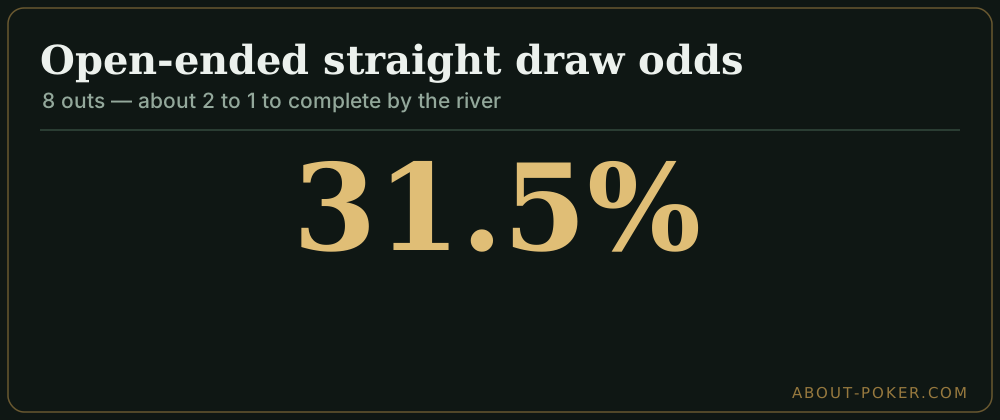
An open-ended straight draw has 8 outs — about 31.5% to hit by the river, or 17% on any single street. Here is the full math and how to play it.
On this page · 8 sections
An open-ended straight draw (an “open-ender”) is one of the most common draws in Hold’em, and it comes with a clean, memorable number: eight outs. From the flop with two cards to come you complete it about 31.5% of the time — roughly 2 to 1 against. On any single street the number is about 17%, or 4.75 to 1. Those two figures drive almost every decision you make with the hand.
Where eight outs comes from
An open-ender is a four-card run missing one card on either end — for example holding 8-7 on a 9-6-2 board, where any ten or any five makes the straight. Two ranks complete you, and each rank has four suits still live in the deck, so 2 × 4 = 8 outs. That is the defining feature: eight is double the four outs of a gutshot, which is exactly why open-enders are worth so much more.
Turning outs into percentages
There are 47 unseen cards after the flop (52 minus your two and the three on board). On the turn alone, 8 ÷ 47 = 17.0%. If you miss, 46 cards remain, so the river adds 8 ÷ 46 = 17.4%. Combining both streets:
P(hit by river) = 1 − (39/47 × 38/46) = 31.5%
That is 2.17 to 1 against — close enough to call “2 to 1.” The rule of 4 and 2 gets you there fast: multiply 8 outs by 4 for both streets (32%, near the true 31.5%) or by 2 for one street (16%, near 17%).
A worked example
You hold Ts-9s on a board of 8h-7c-2d. Any jack or any six completes your straight — eight outs. The pot is $100 and your opponent bets $50 on the flop, so you are calling $50 to win $150, getting 3 to 1. Your one-street equity is 17%, which needs 4.75 to 1. Purely on turn odds you are priced out. But you have two cards to come and position, plus a flush backdoor and overcard outs; those raise your realized equity and add implied value when a jack or six pays you off. In practice this is a routine call, and often a raise, because of everything beyond the raw eight outs.
How stack depth changes the call
Deep stacks reward draws. When effective stacks are large, the times you complete the straight can win a big pot, so pot odds that look marginal become clear calls once implied odds are counted. Shallow, the opposite is true — there is no future money to win, so you must hit your direct price or fold. A useful shortcut: if the bet is more than about a third of the remaining stacks, lean toward the strict pot-odds read; if stacks are 100 big blinds or deeper, give the draw more credit.
Open-ender versus other draws
- Gutshot: 4 outs, about 16.5% by the river. Half the strength.
- Open-ender: 8 outs, about 31.5%.
- Flush draw: 9 outs, about 35%.
- Combo (open-ender + flush): up to 15 outs, over 50% — you are a favorite.
Recognizing which bucket you are in at a glance is the whole skill. Miscount by four outs and your equity estimate is off by roughly 15%, enough to turn a profitable call into a losing one.
Common mistakes
- Counting tainted outs. If a straight card also pairs the board or completes a flush for your opponent, some of your eight outs are dirty. Discount them.
- Ignoring the second street. People quote 31.5% then face a turn bet where only 17% applies. Once the turn is dealt and you miss, you are back to one-street math.
- Calling too small a stack too deep in the hand. Implied odds require money left to win; do not pay river prices hoping for a stack that is not there.
Quick checklist
- Outs: 8.
- By the river (flop): 31.5% (2 to 1).
- Single street: 17% (4.75 to 1).
- Minimum pot odds on the turn: better than 4.75 to 1.
- Add outs only if they are clean (no flush or pairing danger).
Semi-bluffing the draw
An open-ender is the textbook semi-bluff: you can win the pot two ways — by making your opponent fold now, or by hitting one of your eight outs later. Betting or raising with the draw folds out better hands immediately, and when you get called you still have 31.5% equity going forward. That combination is why raising an open-ender on the flop often shows more profit than a passive call. The fold equity is free upside layered on top of the 2-to-1 draw, and it lets you play the hand aggressively rather than waiting to be right only a third of the time.
Keep the 8-outs, 2-to-1 pair in your head and you will read open-enders correctly every time. For the counting method behind every draw, review our guide to poker outs.
Frequently asked
What are the odds of hitting an open-ended straight draw?
With two cards to come you complete about 31.5% of the time (roughly 2 to 1 against). On a single street it is about 17%, or 4.75 to 1 against.
How many outs does an open-ender have?
Eight. Two ranks complete the straight and each rank has four suits available, so 2 × 4 = 8 clean outs.
What pot odds do I need to call with an open-ender?
On the turn you are 17% to hit on the river, so you need pot odds better than about 4.75 to 1. Facing a half-pot bet you are getting 3 to 1, so you need implied odds to continue.