Odds of Hitting a Set on the Turn
Missed the flop with a pocket pair? You hit your set on the turn just 4.3% of the time — about 1 in 23.5. The exact math and why it kills most turn calls.
On this page · 7 sections
Set-mining is built on flopping your set on the flop, not catching it later. The reason is stark: once the flop misses you, hitting your set on the turn is one of the thinnest live draws in the game. Knowing the exact number keeps you from throwing chips at a two-outer.
The core number
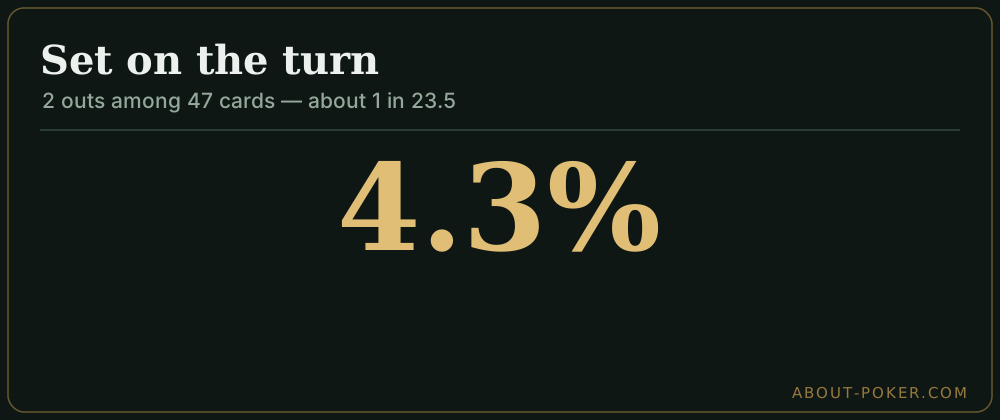
You hold a pocket pair — say 77 — and the flop bricks. There are only four sevens in the deck, you hold two of them, so exactly 2 outs remain. After the flop, 47 cards are unseen (52 minus your 2 minus the 3 on the flop).
So the chance the turn is one of your two remaining sevens is 2 ÷ 47 = 4.26%, or about 1 in 23.5. That is a genuine long shot. Compare it to flopping a set directly, which happens 11.8% of the time — nearly three times more often — because on the flop you get three cards, not one.
Why 2 outs is so unforgiving
Most draws you chase on the turn have far more outs. A flush draw has 9, an open-ended straight draw has 8, even a gutshot has 4. A set draw has only 2, which puts it at the very bottom of the outs table. Using the rule of 4 and 2, 2 outs times 2 gives about a 4% chance per street — matching the exact math.
To call profitably on raw equity alone at 4.3%, you need pot odds of roughly 22-to-1. No standard turn bet is that cheap. This is why “I’ll just call to see if I spike my set” is a losing line by itself.
A worked example
You call a raise with 55 hoping to flop a set. The flop comes K‑9‑2 and misses you. Your opponent bets 6 into a pot of 9. Your pot odds are 6 to call to win 15, which is 2.5-to-1, requiring about 29% equity to continue. Your set draw is worth 4.3%. That is nowhere close — folding is clearly correct unless you have a compelling read or a backdoor kicker to the pot.
Now flip it: same 55, but you already flopped the set on K‑5‑2. You don’t need the turn at all. That is the entire point of set-mining — you win big when you hit on the flop, and you fold cheaply the ~88% of the time you don’t.
Turn set odds versus other single-card draws
It helps to see where a 2-out set draw sits among the draws you actually chase on the turn. Per single card, using the exact one-card math (outs ÷ 47):
- Flush draw, 9 outs: about 19% — roughly 4-to-1 against.
- Open-ended straight, 8 outs: about 17%.
- Gutshot, 4 outs: about 8.5%.
- Set draw, 2 outs: about 4.3% — dead last.
A set draw is less than half as likely to hit as even a gutshot. That ranking is the reason experienced players never treat “I might spike my set” as a real reason to peel a turn. The two-outer is the weakest live draw at the table, and paying anything meaningful for it is a losing proposition over time.
When a turn set draw can continue
You do not chase 2 outs in isolation, but the set draw stacks on top of other equity:
- Combo draws. If you hold 55 on a 6‑4‑3 board, you have the set draw plus an open-ended straight draw. Now your total live outs jump and the call is easy.
- Massive implied odds. Deep-stacked, against an opponent who will stack off, the rare set can win a full buy-in. Even then, the price has to be small relative to the stack behind.
- Overpair backup. With TT on a 9‑high flop you have an overpair already, so the set draw is a bonus, not the reason you continue.
Common mistakes
Do not confuse the flop odds with the turn odds. Beginners hear “you flop a set 1 in 8.5” and then keep calling turn bets as if the same odds apply — but a single card is far less likely to complete you than three cards were. The turn is a 1-in-23.5 shot, roughly a third as likely.
The other trap is ignoring implied odds in both directions. Even when you hit your rare set, you only get paid if your opponent has a hand. Chasing 2 outs into a dry board where nobody can pay you off is the worst of both worlds.
Quick checklist
- A pocket pair has exactly 2 outs to a set after the flop.
- Turn set odds: 2 ÷ 47 = 4.3%, about 1 in 23.5.
- You need roughly 22-to-1 to call on raw equity — almost never available.
- Continue only with combo-draw backup or genuinely large implied odds.
- Remember the real profit in set-mining comes from the flop, not from chasing later streets.
Frequently asked
What are the odds of hitting a set on the turn?
About 4.3%, or roughly 1 in 23.5. After the flop you have 2 outs (the other two cards of your pair's rank) among 47 unseen cards, so 2 ÷ 47 = 4.26%. It's one of the longest live draws in Hold'em.
How many outs do you have to hit a set?
Two. You already hold two of the four cards of that rank, so only two remain in the deck. That is why set-mining relies on flopping the set immediately: catching it on a single later street is a genuine long shot.
Should I chase a set on the turn?
Almost never as your only plan. With 2 outs you need roughly 22-to-1 pot odds to call profitably on raw equity, which no normal bet offers. You continue only when huge implied odds or other equity, like a straight or flush draw, back up the call.