Odds of Improving on the Turn
The odds of improving on the turn, explained out by out: how the rule of 2 gives fast one-card estimates, worked examples, and the mistakes that cost you.
On this page · 6 sections
The odds of improving on the turn measure one thing: the chance that the single next card completes or strengthens your hand. Because only one card is coming, the math is simpler than the two-card calculations people usually memorize. Once you can count your outs, turning that count into a percentage takes a second, and it drives almost every flop decision you make with a drawing hand.
The core formula for one card
After the flop you have seen five cards: your two hole cards and the three on the board. That leaves 47 unseen cards. Any card that improves your hand is an out, and each out is worth exactly 1 out of 47, which is about 2.1%. So the odds of improving on the turn are simply your number of outs divided by 47.
The fast shortcut is the rule of 4 and 2: for one card to come, multiply your outs by 2. Nine outs times 2 gives 18%, and the true figure is 9/47 = 19.1%. The estimate runs a touch low, which is fine because it keeps you from overpaying. If you want a sharper number, multiply outs by 2 and then add roughly one more point for every seven or eight outs.
Worked example: the flush draw
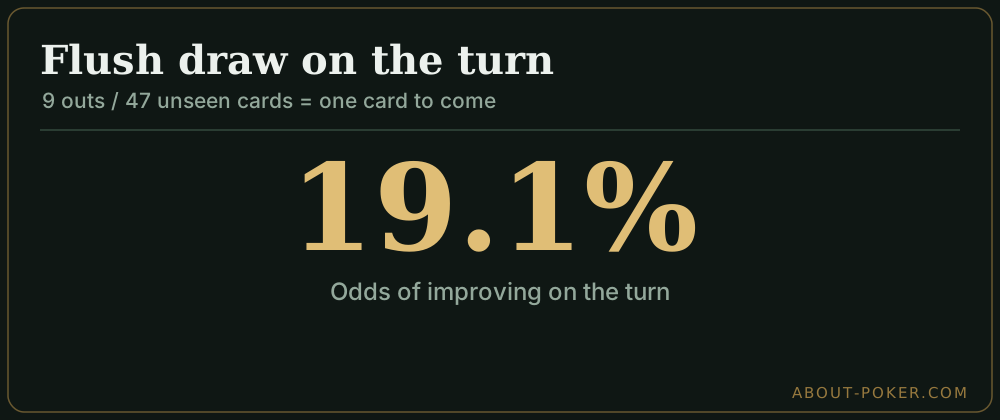
You hold Ah Ks on a board of Qh 7h 2c. Any heart makes your flush. There are 13 hearts; you can see four of them (two in your hand, two on the board), so 9 hearts remain. That is 9 outs.
Odds of improving on the turn: 9 divided by 47 equals 19.1%, about one in five. Expressed as odds against, that is roughly 4 to 1. This is the single most important number for a flush draw, because it tells you what pot odds you need to call a bet when only the turn is guaranteed to come. For the full picture of flush equity across both streets, see flush draw odds.
A quick out-to-turn reference
Learning a handful of anchor numbers means you rarely have to calculate from scratch. Here are the common draws and their true one-card odds:
- Gutshot straight (4 outs): 4/47 = 8.5%, about 11 to 1 against.
- Two overcards (6 outs): 6/47 = 12.8%, about 6.8 to 1 against.
- Open-ended straight (8 outs): 8/47 = 17.0%, about 4.9 to 1 against.
- Flush draw (9 outs): 9/47 = 19.1%, about 4.2 to 1 against.
- Flush plus gutshot (12 outs): 12/47 = 25.5%, about 2.9 to 1 against.
- Straight flush combo (15 outs): 15/47 = 31.9%, about 2.1 to 1 against.
Notice how the odds-against ratio matters more than the percentage when you face a bet. A flush draw at roughly 4 to 1 needs the pot to lay you better than 4 to 1 to call profitably on that street alone. This is where turn odds connect directly to pot odds.
Counting outs accurately
Turn odds are only as good as your out count, and the most common leak is counting outs that do not actually win. If you hold two overcards but a straight or flush is possible, some of your pairing cards may complete your opponent. If you have an open-ended straight draw on a two-tone board, a couple of your straight cards may bring a flush that beats you. Discount those cards. Solid players talk about “clean outs” versus “tainted outs” for exactly this reason.
The reverse mistake is undercounting. A combo draw that hits a straight or a flush can have 12 to 15 outs, which turns a marginal hand into a near coin flip on one card. If you fold those hands as though they were single draws, you leave a lot of value behind. Practice counting with the poker outs guide until it becomes automatic.
How the situation changes the number
The raw 47-card denominator assumes you can only see the five community and hole cards, but the decision around those odds shifts with context. When you are the one betting, your chance to improve is not the whole story, because fold equity adds to your winning chances even when the turn bricks. A flush draw that is 19% to hit is often the correct semi-bluff precisely because your opponent folds some of the time.
Stack depth matters too. With deep stacks, hitting a well-disguised straight or flush on the turn can win a large pot, so implied odds justify calls that pure turn odds would reject. With short stacks, there is no future money to win, so you should lean on the raw one-card percentage and fold draws that do not have the price.
Turn-odds checklist
Before you commit chips with a draw on the flop, run through this quickly:
- Count your clean outs, discounting cards that also help your opponent.
- Multiply by 2 for a fast turn estimate, or divide by 47 for precision.
- Convert to odds against and compare to the pot odds you are being offered.
- Add fold equity if you are betting, and implied odds if stacks are deep.
- Remember that turn odds cover one card only; the river is a separate roll.
Master these five steps and the odds of improving on the turn stop being a memorized table and become an instinct. Every drawing decision on the flop reduces to a comparison between one number, your chance to improve, and the price the pot is offering you.
Frequently asked
What are the odds of improving on the turn with a flush draw?
A flush draw has nine outs. After the flop, 47 cards are unseen, so the chance of hitting on the turn alone is 9 divided by 47, about 19.1%, or roughly one in five. The rule of 2 estimates this quickly as 9 times 2, which gives 18% and is close enough for the table.
Why do you multiply outs by 2 for the turn?
There are 47 unseen cards after the flop and one card to come. Each out is worth 1/47, which is about 2.1%. Multiplying your out count by 2 approximates that per-out value, so outs times 2 gives a fast, slightly conservative estimate of your chance to improve on the turn.
How is turn odds different from odds by the river?
Turn odds cover only the next single card, while odds by the river count both the turn and river together. That is why the rule of 4 (outs times 4) is used when you will see both cards, and the rule of 2 (outs times 2) is used for one card at a time. A flush draw is about 19% to hit on the turn but about 35% by the river.