Odds of Making a Full House
You make a full house about 3% of the time by the river as your best five-card hand. Here are the exact odds, from flopping a boat to filling up from a set.
On this page · 7 sections
Across all seven cards, you make a full house about 3% of the time as your best hand — and most of those come not from flopping the boat but from a flopped set filling up by the river, which happens roughly a third of the time. The full house is where sets earn their reputation as stack-getters. Here is the math, broken down by how the boat actually arrives.
Flopping a full house directly
The rarest path is flopping the full house outright. Start with a pocket pair like 9♥ 9♦. The flop must bring the third nine and pair one of the other two cards:
P(flop full house) = (2 × 72) ÷ C(50,3) = 144 ÷ 19,600 = 0.73%
That is about 1 in 136. Here the 2 counts the remaining nines and the 72 counts the ways the other two flop cards form a pair of a different rank. Flopping a boat with two unpaired cards is rarer still, which is why “flopped full house” is a once-in-a-session thrill, not a plan.
The real source: filling up from a set
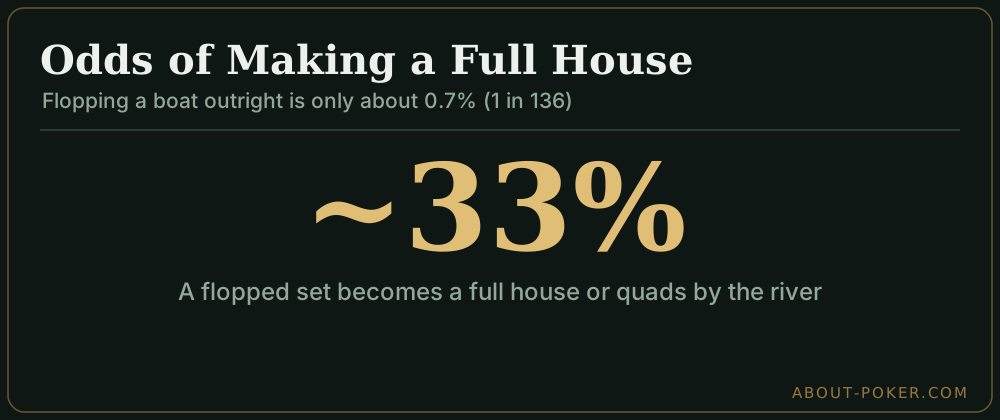
The everyday full house comes from a flopped set improving. When you flop a set, you hold three of a kind and the board shows two other cards. To fill up, you either pair one of those board cards or catch the fourth card of your rank for quads. That is roughly ten outs across two streets, and it works out to about 33% by the river. In other words, one flopped set in three becomes a full house or better. This is the engine behind set-mining’s profit — see odds of flopping a set for how often you get there in the first place, and use poker outs to count your filling-up outs correctly.
A worked example
You call with 7♣ 7♠ and the flop comes 7♥ K♦ 4♠. You have flopped a set of sevens. Your outs to a full house or quads are: the case seven (1 out for quads), any king (3 outs, pairing the board), and any four (3 outs, pairing the board) — plus new pairing chances on the turn card. Using the rule of 4 and 2 as a rough guide on the flop, roughly ten effective outs times four is around 40% — a touch high because the rule overshoots with many outs, so the true figure lands near 33%. Either way, you are a real threat to make the near-nuts, which is why you can play a flopped set fast and deep.
How full house odds shift with the board
Paired boards change everything. If the board itself is paired — say Q♥ Q♠ 6♦ — then anyone holding a six now has a full house, and even a lone pair in the hole can fill up. On such textures, full houses are common and top pair or trips can be dangerously behind. Conversely, on rainbow, unpaired, disconnected boards, full houses are scarce and a set is much closer to the effective nuts. Always read the board first: the same set is a monster on 7-K-4 and a merely-good hand on K-K-4, where an opponent’s king already outkicks or out-boats you.
Common mistakes
The biggest error is treating a flopped set as guaranteed to become a boat and over-committing on dangerous runouts before it improves — a set is strong on the flop, but it is not yet a full house. A second mistake is missing the paired-board warning: when the board pairs, reassess whether your two pair or trips is now behind a full house. Third, players overvalue small full houses on paired boards; a boat can still lose to a bigger boat, so “the underfull” — a full house made with the lower rank — is a classic stack-losing trap when the action gets heavy.
Turning a set into a boat: the outs by street
It pays to know your filling-up outs precisely rather than leaning on a rough rule. From a flopped set on an unpaired board, you have six outs on the turn to pair either board card, plus one out for quads — seven outs, or about 15% to improve on the turn alone. If the turn is a blank, the river gives you more pairing chances because the turn card itself can now pair. Stacked across both streets, the flopped set reaches a full house or quads about 33% of the time. That figure is what makes deep set-mining profitable: not only is the set often the best hand on the flop, it also carries a one-in-three chance of morphing into the near-nuts by the river, letting you commit stacks with confidence against a strong opponent range.
Quick checklist
- Full house as your best seven-card hand: about 3%.
- Flopping a full house with a pocket pair: about 0.7%, or 1 in 136 — rare.
- A flopped set fills up to a full house or quads about 33% of the time by the river.
- Paired boards make full houses common; unpaired boards make them scarce.
- Beware the underfull — a small full house can still lose a stack to a bigger one.
Frequently asked
What are the odds of making a full house?
About 3% as your best five-card hand across all seven cards. Flopping a full house directly is much rarer, but if you flop a set you fill up to a full house or quads by the river roughly a third of the time, which is where most boats come from.
What are the odds of flopping a full house?
With a pocket pair, flopping a full house is about 0.7%, or 1 in 136 — the flop must bring the third card of your rank and a pair of another rank. With two unpaired cards it is far rarer still.
How often does a set become a full house?
About 33% by the river. From a flopped set you have roughly ten outs to fill up or make quads over two streets — six to pair each board card, plus improvements on the turn — so flopped sets are strong precisely because they so often become boats.