Assigning a Preflop Range
Learn to assign a preflop range from position, action, and player type — the first step of hand reading, with a worked example and a practical checklist.
On this page · 5 sections
Every hand read starts before the flop. If you cannot picture the group of hands an opponent is likely holding after the preflop action, you have nothing to narrow on later streets — you are just guessing. Assigning a preflop range means replacing the question “what does he have?” with the far more useful “what could he have, and in what proportions?” That shift from a single hand to a distribution is the core skill of hand reading.
Why a range, not a hand
Beginners fixate on one holding: “I think he has aces.” That mindset falls apart the moment the board changes, because a real opponent arrives at the flop with dozens of possible combinations. A player who raises under the gun might have any strong pair, big broadway hand, or a few suited connectors. Treating that as a single guess throws away information; treating it as a range lets you update sensibly as cards come.
A range is a set of specific hand combinations, each with a rough weight. When you later factor in board texture and range advantage, you are measuring how that whole set of hands connects with the flop — not how one imaginary hand did.
The three inputs: position, action, player type
Three signals do most of the work.
- Position. Ranges widen as you move around the table. A disciplined player opens roughly 15% under the gun, about 25% from the cutoff, and 40%+ from the button. The blinds defend wide but weakly. Position alone reshapes the range dramatically.
- Action. An open-raise, a flat call, a 3-bet, and a cold 4-bet all tell different stories. A 3-bet from a tight player is weighted toward premium pairs and A-K; a flat call is weighted toward medium pairs and suited hands that want to see a cheap flop.
- Player type. A tight-passive regular who limps and calls has a capped, face-up range. A loose-aggressive player 3-bets with a merge of value and bluffs, so their range is wider and harder to pin down. Never apply a chart to a player it does not fit.
A worked example
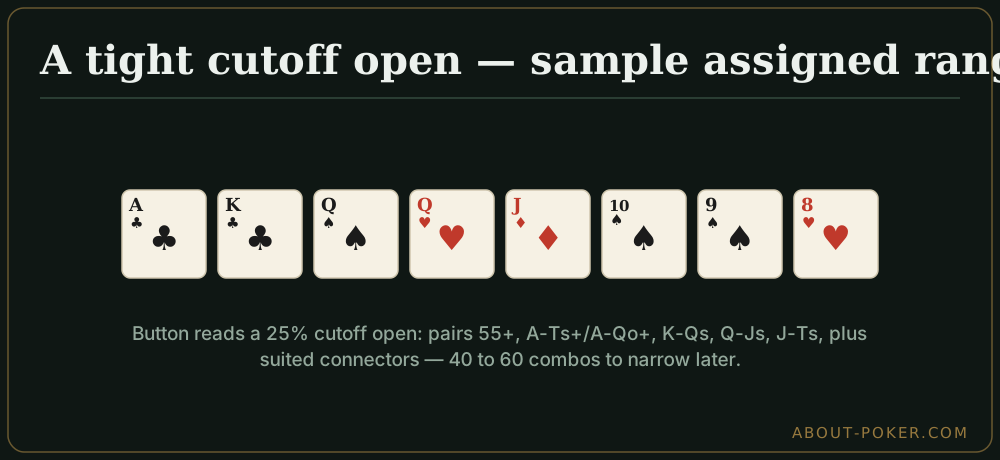
You are on the button. A solid, tight cutoff opens to 2.5bb and you are deciding how to read them. Their cutoff opening range is roughly 25% of hands. Because they are tight and unlikely to be spewing, you weight the strong end normally and trim the marginal offsuit junk.
A practical assigned range looks like: all pairs 55+ (with the biggest pairs most likely), A-Ts through A-Ks and A-Qo+, K-Qs, K-Js, Q-Js, J-Ts, T-9s, and a handful of suited connectors and suited aces. That is your starting picture — maybe 40 to 60 combinations. You have not narrowed anything yet, but now every flop card gives you something concrete to work with. On a Q-7-2 flop, you immediately know their range is full of top pairs and overpairs; on a 6-5-4 flop, you know most of their range missed. That is why the preflop read matters so much: it sets the board texture read up for you.
Common mistakes when assigning ranges
The most frequent leak is being too specific too early — locking onto a single hand and refusing to update. The second is ignoring player type and applying a “textbook” range to a recreational player who plays 60% of hands. The third is forgetting your own image: if you have been raising every pot, a 3-bet you face is weighted more toward light re-raises. Finally, do not forget removal — if you hold two aces, there are far fewer combos of A-K and A-A left for your opponent.
Once you have a solid preflop range, the rest of hand reading is subtraction. Each bet, check, and card removes hands that would have played differently, which is exactly how a continuation bet or a check-raise lets you carve the range down. And when the range gets polarized on later streets, you handle it the way you would any polarized range.
A quick checklist
- Start from a position-based opening range, then adjust for the specific action taken.
- Weight the range by player type — tight, loose, passive, or aggressive.
- Account for card removal from your own hand and the board.
- Factor in your own image and how it shapes their decision to enter the pot.
- Hold the range loosely: it is a starting distribution you will narrow every street, not a final answer.
Get the preflop range right and everything downstream — flop, turn, and river reads — becomes a process of elimination rather than a shot in the dark.
Frequently asked
What does assigning a preflop range mean?
It means estimating the full set of hands an opponent could hold based on their position, the preflop action, and their tendencies — instead of guessing a single hand. This starting range becomes the foundation you narrow street by street as the hand plays out.
What information do I use to assign a preflop range?
The three biggest inputs are position (early positions are tighter, the button and blinds are wider), the action (open, call, 3-bet, or cold-call each imply different strength), and player type (a tight-passive player has a narrower range than a loose-aggressive one).
How wide is a typical opening range?
A solid player opens roughly 15% of hands under the gun, around 25% from the cutoff, and 40% or more from the button. These are baselines — you must adjust for the specific player, since recreational players often play far more hands than a chart suggests.