Board Texture and Range Advantage
Range advantage decides who bets and how big. Learn to read board texture, tell range from nut advantage, and pick c-bet sizing with a worked example.
On this page · 6 sections
Every postflop decision starts with one question: whose range does this board favor? The answer — your range advantage, or lack of it — dictates whether you should bet, how often, and how large. Skilled players do not look at a flop and think only about their own two cards; they think about how the entire texture interacts with both players’ likely holdings. Get this read right and your continuation betting, barreling, and check-raising all fall into place. Get it wrong and you fire bets into ranges that crush you.
What range advantage means
Range advantage means your full set of possible hands has more total equity on a board than your opponent’s set of hands. It is not about the specific cards you hold — it is about the aggregate. When you raise preflop from early position and get called by the big blind, your range is skewed toward high cards and premium pairs, while their range is wider and weaker. On many flops, that preflop story hands you the advantage before a single postflop chip goes in.
The player with range advantage gets to be the aggressor. They can bet frequently, deny equity, and force the disadvantaged player into tough spots. This is the engine behind continuation betting — the preflop raiser bets because their range genuinely connects better with most flops.
Range advantage versus nut advantage
These two concepts are related but distinct, and confusing them is a common leak.
- Range advantage is about the whole distribution — whose hands have more equity on average.
- Nut advantage is about the extreme top — who holds more of the absolute strongest hands (sets, straights, top two, nut flushes).
You can hold range advantage without nut advantage. On a K-Q-3 flop, a preflop raiser has more strong top pairs and overpairs, giving them range advantage. But the big blind can hold all the straights and two pairs from hands like K-Q, J-T, and Q-3 that the raiser rarely has — so nut advantage may tilt toward the caller. This matters because nut advantage is what unlocks large sizings and overbets. A polarized range built on genuine nut hands can bet huge; a merged range with only medium strength should bet small.
Reading board texture
Texture is the map. A few reliable patterns for a preflop raiser against a big-blind caller:
- Dry, high-card boards (K-7-2, A-8-3 rainbow): strongly favor the raiser. High cards hit the raising range, and few draws exist. Bet often and small.
- Low, connected boards (7-6-5, 6-5-4 two-tone): favor the caller. These middling connected cards live in the calling range far more than in a range full of big cards. The raiser should c-bet less and check more.
- Middling paired boards (8-8-4): usually favor the raiser slightly, because the caller has fewer trips than intuition suggests and the raiser keeps their overpairs.
- Ace-high boards: heavily favor the raiser, who holds most of the aces.
Our guide to wet versus dry textures goes deeper on how connectivity and suits change these reads.
A worked example
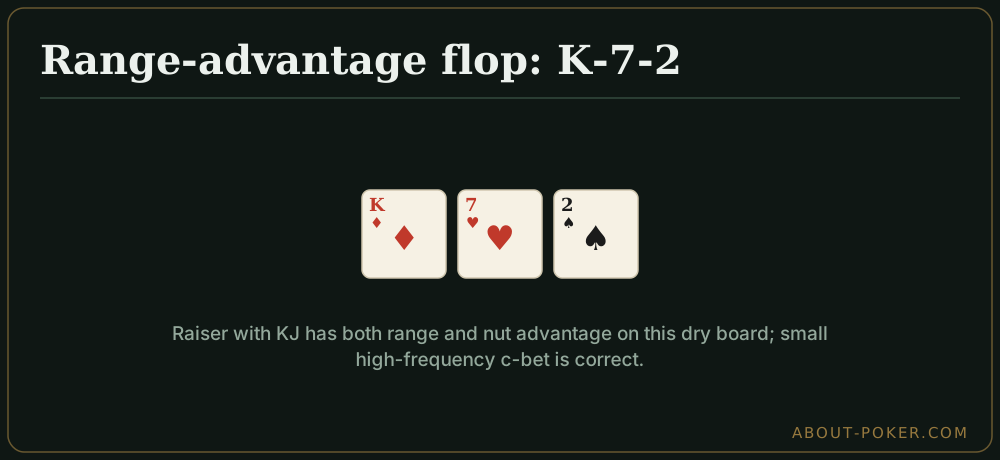
You raise K-J suited from the cutoff and the big blind calls. Flop comes K-7-2 rainbow.
Walk the ranges. Your cutoff raising range is full of kings, aces, and overpairs. The big blind’s defending range is wide — plenty of suited connectors, small pairs, and weak aces that mostly missed this dry, disconnected flop. You hold clear range advantage (your range has more top pairs and overpairs) and also nut advantage (you have all the sets of kings from K-K, and top-two combos the caller rarely has). There are no flush draws and only backdoor straight draws.
The correct play is a high-frequency, small c-bet — around a third of the pot. You are not trying to blast anyone off their hand; you are betting your whole range cheaply because the texture is so lopsided that even your weak hands profit from the fold equity and equity denial. If instead the flop had been 7-6-5 two-tone, that same K-J is now in a range that whiffed a caller-favoring board, and you would check far more often.
How advantage drives sizing and frequency
Put the pieces together into a simple framework:
- Range advantage, no nut advantage: bet often, but keep sizing small. You want to deny equity across your wide range without over-committing a merged holding.
- Range advantage plus nut advantage: you can add large sizes and overbets with your polarized hands, because you credibly rep the nuts.
- No range advantage: check more, defend by check-calling and check-raising, and let the other player make mistakes betting into a range that has caught up to theirs.
Common mistakes and a checklist
- C-betting every flop out of habit, ignoring that low connected boards favor the caller.
- Using one bet size for everything, instead of matching sizing to nut advantage.
- Confusing your hand’s strength with your range’s strength. A specific strong hand does not mean your range wants to bet big here.
- Forgetting position, which amplifies range advantage when you are the in-position aggressor.
Before you act postflop, run the checklist: Does the texture favor the preflop raiser or the caller? Do I have range advantage, nut advantage, both, or neither? Given that, should I bet often and small, or polarize and bet big — or check and defend? Answer those three questions and you will bet the right flops, size correctly, and stop firing into ranges that quietly have you beat.
Frequently asked
What is range advantage in poker?
Range advantage means your entire range of possible hands has more equity on a given board than your opponent's range. The player with range advantage can bet more often and apply pressure, since their overall holdings are stronger on that texture.
What is the difference between range advantage and nut advantage?
Range advantage is about overall equity — whose range is stronger on average. Nut advantage is about the top of the range — who holds more of the very strongest hands. You can have one without the other, and nut advantage is what unlocks large bet sizes and overbets.
How does board texture affect who bets?
Dry, high-card boards like K-7-2 favor the preflop raiser's range, allowing frequent small c-bets. Low, connected boards like 7-6-5 favor the caller's range, so the raiser should bet less often. Reading texture tells you whose range the flop helped.