River Bet Sizing
River bet sizing decides how much you win or lose in the biggest pots. Learn value vs bluff sizing, thin value, overbets, and how to build a balanced river range.
On this page · 5 sections
River bet sizing is the most consequential number you choose in a hand. There are no more cards to come, so the money you put in is decided purely by your hand’s showdown value against your opponent’s range. Size well and you extract maximum value and steal pots you could never win at showdown. Size poorly and you either leave money on the table or turn a made hand into a bluff-catcher for your opponent.
Size to the calling range, not to your hand
The core principle: your river bet size should be set by how many worse hands will call, not by how strong your hand feels. A monster is worth nothing extra if your size folds out everything you beat. Ask two questions — what does my opponent’s range look like here, and what is the largest bet that still gets called by worse?
When your opponent’s range is wide and full of medium-strength bluff-catchers, a large bet gets those hands to fold, so a medium size may actually win more. When their range is capped and they have shown willingness to call down, a large bet or overbet prints. Match the size to the target, then place your bluffs into that same size so you cannot be read. Our value betting guide covers this hand-reading step in more detail.
Thin value: bet small
Thin value bets are among the most profitable and most neglected plays in poker. When you hold a hand like second pair or a weak top pair that still beats a meaningful chunk of your opponent’s range, a small river bet — around 25-40% of the pot — gets called by hands that would never pay a big bet.
The math is simple: if you bet small and get called by worse more than half the time you get called, the bet is profitable even though your hand is not strong. Checking those hands back wins nothing extra. See thin value on the river for how to identify these spots without overdoing it.
Overbets: bet big with a polarized range
At the other extreme, the river overbet leverages a polarized range against a capped or bluff-catcher-heavy opponent. When you hold the nuts and some bluffs, and your opponent’s range is full of hands that beat nothing but a bluff, an overbet of 1.5x to 2x pot maximizes value and pressure. The larger the bet, the more bluffs you are allowed to include while staying balanced. Our overbetting the river guide walks through the board and range conditions that unlock this size.
A worked example with the math
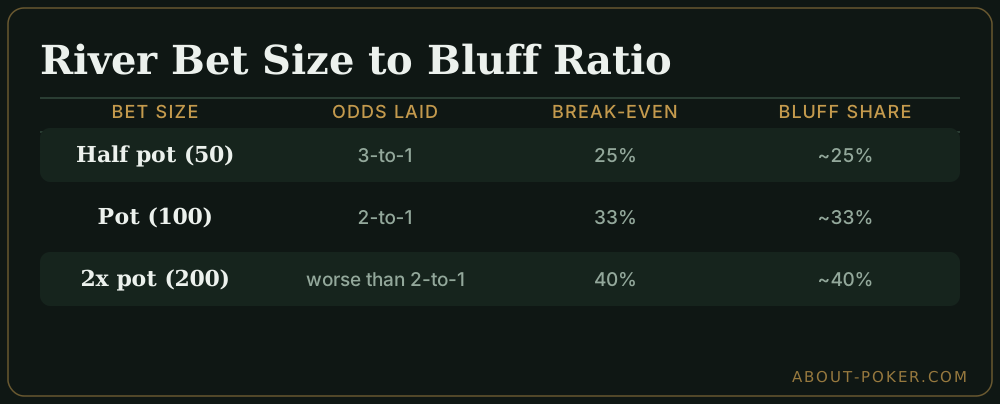
The pot on the river is 100. You hold the nuts and want to size for maximum value, but you also want to be balanced so your bluffs get through.
If you bet 50 (half pot), you are laying your opponent 3-to-1 to call: they risk 50 to win 150, so they need to be good 25% of the time. To stay unexploitable, roughly 25% of your betting range in this spot should be bluffs. If you bet 100 (pot), they get 2-to-1 and need to be good 33% of the time, so you can run about 33% bluffs. If you overbet 200 (2x pot), they get 2-to-1 on a bigger number — they risk 200 to win 300 — needing to be good 40% of the time, supporting about 40% bluffs. The pattern: bigger bets let you bluff more because they give the opponent worse odds to call.
For a concrete hand: on a Q♦J♦8♣5♠2♥ river you hold K♥T♥ for the nut straight. Against a range of top pair and two pair that will call a large bet, a pot-sized or slightly larger bet extracts far more than a half-pot bet. Pair it with your busted diamond draws as bluffs at the same size and the strategy is both maximally profitable and balanced.
Common mistakes and a checklist
The most expensive river leak is sizing by hand strength — big with the nuts, small when bluffing — which lets opponents fold to your big bets and call your small ones. The second is under-betting the nuts against a range that would have called more. The third is bluffing at a size your value hands would never use, which makes your bluffs stick out.
Before you size a river bet, run this checklist:
- What worse hands can call, and what is the biggest bet they still call with?
- Am I value betting, bluffing, or making a thin value bet?
- Does my size match the value hands I would also bet here?
- Does my bluff-to-value ratio fit the size I chose (about 25% at half pot, 33% at pot, 40% at 2x pot)?
- If I am checking, is that because betting folds out everything I beat and only gets called by better?
Get these right and your river sizing will quietly become one of the biggest edges in your game.
Frequently asked
How big should I bet the river?
Size your river bet based on how many worse hands will call. For thin value, bet small so marginal hands pay you off. With the nuts against a strong or capped opponent, bet large or overbet. Your bluffs should mirror whatever size your value hands use.
Should my river bluff and value bets be the same size?
Yes, to stay unexploitable. If you only bet big with the nuts and small when bluffing, opponents fold to big and call small. Choosing one size for both value and bluffs in a given spot keeps you balanced and hard to read.
What is a good bluff-to-value ratio on the river?
It depends on your bet size. Roughly, a half-pot bet supports about 25% bluffs, a pot-sized bet about 33%, and a 2x pot overbet about 40%. Larger bets can carry more bluffs because they give the opponent worse pot odds to call.