Sizing on Dry Boards
Dry, disconnected boards call for small bets across a wide range. Learn why the range-bet works, the efficiency of a one-third-pot stab, and a worked example.
On this page · 6 sections
Dry boards are the mirror image of wet ones, and so is the correct approach: where wet textures demand big bets, dry textures reward small ones. On a disconnected, uncoordinated flop your opponent has almost nothing to draw to, and that single fact reshapes your entire sizing strategy. The move on dry boards is to bet small — and to bet small with a very wide range.
What Makes a Board Dry
A dry board is disconnected and uncoordinated: ranks that don’t form straight draws, no flush draw, often a paired or high-low-low structure. Classic examples are K-7-2 rainbow, A-8-3 rainbow, or Q-6-2 with no two suits matching. The defining feature is the absence of draws — there is very little live equity in your opponent’s non-made hands. Nothing to deny means nothing to overcharge.
Why Small Bets Are Optimal Here
The purpose of a bet is either to deny equity or to extract value. On a dry board, there’s minimal equity to deny — an opponent with two overcards has only 6 outs, and most of their range is simply air with almost no outs. Because you don’t need to charge draws, you don’t need a big bet. A small bet accomplishes everything a large one would: it folds out the air, gets called by weaker made hands, and does it all for a fraction of the risk. This efficiency is the heart of the argument in c-betting dry flops.
The efficiency is why a small, one-third-pot bet is so profitable that you can fire it with nearly your entire range. It’s the polar opposite of sizing on wet boards, where the abundance of draws forces you to size up and polarize.
The Power of Range Betting
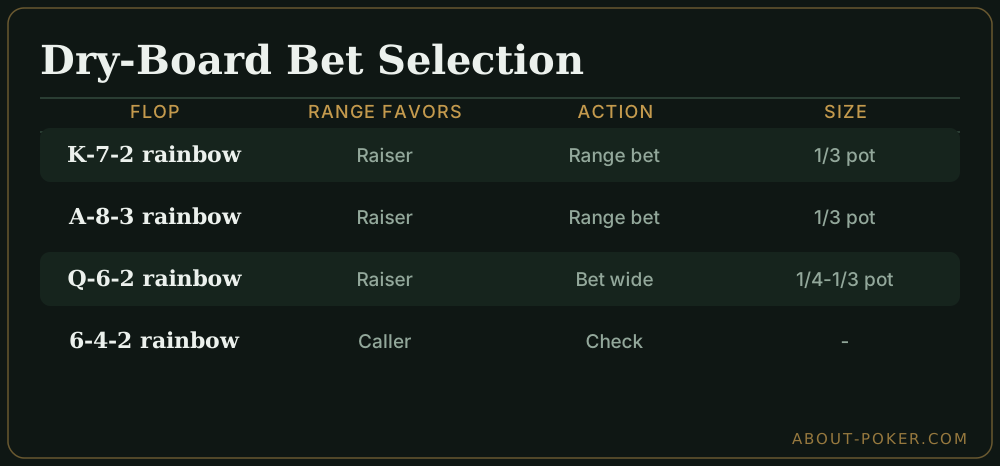
On the driest boards that favor your range — high-card flops after you raised preflop — you can employ the range bet: a small bet with 100% of your hands. This works because your range is uniformly ahead. When you raise and the flop comes K-7-2, you hold far more kings, aces, and strong pairs than a caller does, and your air still has decent equity. Betting small across the whole range means your opponent can never comfortably raise or float, because they can’t tell your monsters from your air. The small size keeps your risk trivial while the range-wide pressure grinds out value.
A Worked Example
You open A-Q from the cutoff and the big blind calls. The flop comes K-7-2 rainbow. The pot is $22. You’ve missed — you have ace-high — but this is a perfect range-bet spot.
You bet $7, about one-third pot. The big blind’s range is mostly air that missed this board; they fold the majority of the time, and your ace-high wins uncontested. When they do call, it’s usually with a weak king, a small pair, or a hand you can barrel off on later streets. Crucially, your A-Q is betting the same size your actual kings and sets are betting, so a defending opponent can’t punish you. Contrast this with betting $18 into $22: you’d risk far more to fold out the same air, and you’d have to check your weaker hands, telegraphing your range. The small bet is simply more efficient on a board this dry.
When Even a Small Bet Is Wrong
Not every dry board is a bet. If the flop is dry but hits the caller’s range harder than yours — a low, disconnected flop like 6-4-2 after you opened with a big-card range — checking is often better than a small stab, because you’re not actually ahead. Dry doesn’t automatically mean “bet”; it means “if you’re ahead, you can bet small.” The full texture map is in c-bet sizing by board texture.
A Dry-Board Sizing Checklist
- Default size: one-quarter to one-third of the pot.
- Bet wide: on favorable high-card boards, you can range-bet close to 100%.
- Don’t over-invest: there are no draws to charge, so a big bet just risks more for the same result.
- Keep sizes uniform: betting your air and your monsters the same makes you unexploitable.
- Check when the board favors the caller: dry plus out-of-range equals a check, not a bet.
On dry boards, small and wide is the winning formula. There’s nothing to charge, so charge nothing extra — just take the cheap, range-wide value the texture hands you.
Frequently asked
How big should you bet on a dry board?
Small — around one-quarter to one-third of the pot. Dry, disconnected boards give your opponent little equity to deny, so a cheap bet across your whole range is the most efficient way to take value and apply pressure.
Why do you bet small on dry boards?
There are no meaningful draws to charge, so you don't need a big bet for protection. A small bet risks less, still folds out air, gets called by weaker made hands, and lets you profitably bet nearly your entire range.
What is range betting?
Range betting means firing a small bet with your entire range on a favorable board. On very dry flops that your range hits harder than your opponent's, solvers bet close to 100% of hands for a small size because the whole range profits.