How to Play Ace-King Offsuit (AKo)
Ace-king offsuit is a premium drawing hand that plays a touch tighter than AKs. Learn how to open, 3-bet, 4-bet, and c-bet AKo without overplaying it.
On this page · 6 sections
Ace-king offsuit (AKo) is “big slick” without the suit — still a premium, still a raise-first hand from every seat, but a shade less powerful than its suited sibling. Like all of big slick, it is a drawing hand, not a made one: it misses the flop (no pair) about two-thirds of the time and is only a coin flip against pocket pairs all-in. Its profit comes from dominance over weaker aces and kings, and from taking initiative in big pots. The missing flush draw means you play it with the same aggression as ace-king suited, just with slightly tighter thresholds.
Open and 3-bet AKo aggressively
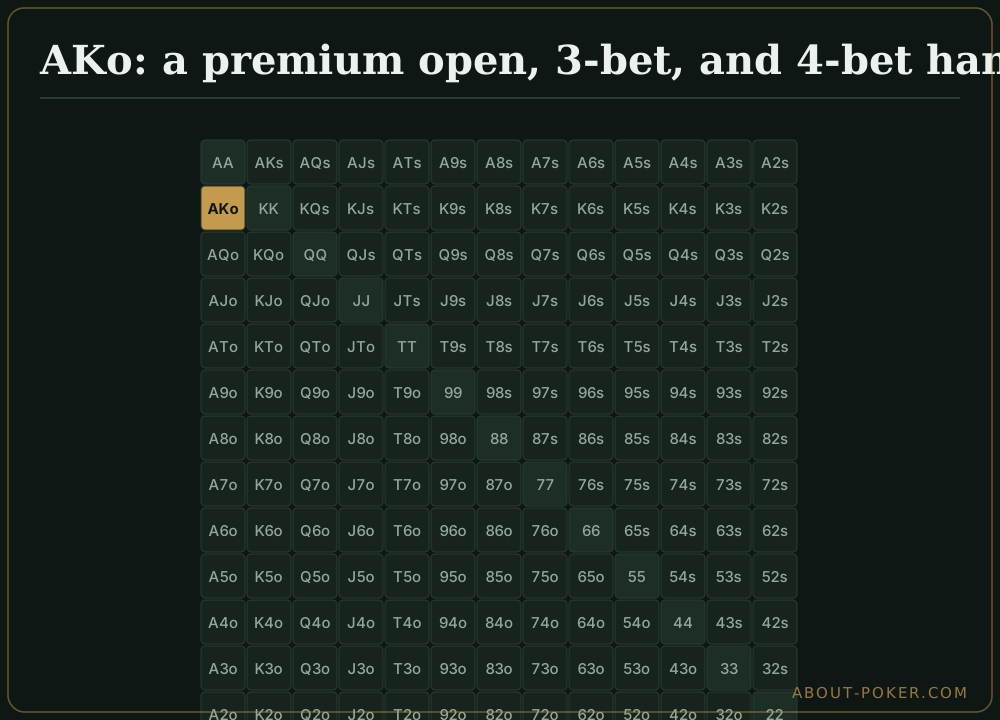
AKo is a standard open from any position and a core value hand in your 3-bet range. You want to build the pot and take initiative while you dominate the weaker aces (AQ, AJ, AT) and kings (KQ, KJ) that make up so much of your opponents’ continuing ranges. When you flop top pair top kicker, your kicker plays for stacks against all of those dominated holdings.
The key discipline is to keep AKo in your value range but not to treat it as untouchable. Against extremely tight resistance it is still just ace-high until the flop.
4-betting and the blocker effect
AKo is one of the best 4-bet-bluff hands in poker, and often a 4-bet for value too. Holding an ace and a king removes combinations of AA, KK, and AK from your opponent’s range — a powerful blocker effect that makes your 4-bet get through more often. That is why AKo is a mainstay of any solid 4-betting strategy.
Compared to AKs, solvers 4-bet AKo a little less and mix in more flatting or occasional folding against the tightest 4-bet ranges, precisely because it lacks the backup flush draw. When you get it all-in preflop, you are usually flipping against a pair or dominating a weaker ace — both fine outcomes for a hand this strong.
A worked example
You open A♥K♠ from the cutoff to 2.5bb. The button 3-bets to 8bb. You 4-bet to 20bb, and they call.
The flop comes K♦9♣4♠. You have top pair top kicker on a fairly dry board. Fire a continuation bet — you beat every worse king (KQ, KJ, KT), every pocket pair below kings, and all the ace-high bluffs. Size around 33–50% pot to keep dominated hands in. If your opponent 4-bet-called with QQ or JJ, you are now extracting maximum value from a hand that thought it was ahead. This is why AKo wants big pots: when it connects, it connects at the very top of the board.
Playing AKo when you miss
Two-thirds of the time you flop ace-high with no pair. That is expected, and AKo is built to keep applying pressure:
- Dry, low boards (8-5-2 rainbow): A single c-bet takes it down often. You hold two overcards and the range advantage as the preflop aggressor.
- Coordinated boards you whiff: Slow down. Ace-high has little equity against a range that connected, and floating is expensive without a draw.
- Turn barrels: With no flush draw, pick your double-barrels carefully — favor turns that improve your perceived range or add a gutshot/overcard equity.
The cardinal sin is turning ace-high into a hero call. If the board and action are against you, fold and move on.
How AKo changes by stack depth
The all-in-or-fold thresholds for AKo move with the effective stack, and getting this wrong is a common leak.
- Short (20-40bb): AKo is a get-it-in hand. Against most 3-bet and shove ranges you are either flipping or dominating, and there is no reason to flat and play a tricky postflop pot with a hand that whiffs two-thirds of flops. Re-shove and 4-bet-jam it freely.
- 100bb (standard): the mixed strategy appears — mostly 4-bet, some flat, occasional fold to the tightest ranges. You have room to realize equity postflop, so flatting a 3-bet in position and c-betting is a fine alternative to always blasting it in.
- Deep (200bb+): AKo gets slightly more cautious about committing preflop. Reverse implied odds grow — stacking off ace-high-that-becomes-top-pair against a deep, tight range can be a trap when they only continue with sets and better kickers. You still raise and pressure, but you are more willing to keep the pot controllable and let a marginal top pair pot-control rather than balloon.
The constant across all depths: AKo wants initiative. What changes is whether that initiative is expressed as a preflop shove (short) or as a build-the-pot-and-navigate plan (deep).
A quick decision checklist for AKo
When you pick up big slick offsuit, run through this:
- Raise or re-raise by default. Open it from any seat; 3-bet it as value against opens. Passive flatting from the start wastes its dominance edge.
- Facing a 3-bet, lean toward 4-betting. Your ace and king block AA, KK, and AK, so the 4-bet gets through more than its raw strength suggests. Flat or fold only against the very tightest 4-bet ranges.
- On the flop, ask if you paired. Top pair top kicker is a big-pot hand against the dominated aces and kings you beat. C-bet for value and be willing to stack off on dry boards.
- When you miss, ask if the board favors you. Dry, low, disconnected flops are c-bet-and-take-it spots. Coordinated boards that hit the caller’s range are check-and-give-up spots.
- Never hero-call with ace-high. If the story says you are beaten, ace-high is not a bluff-catcher. Fold.
AKo vs AKs is a small but real difference: the same raise-and-pressure blueprint, minus the flush safety net. Play AKo like the premium drawing hand it is — get money in against the weaker aces and kings you dominate, c-bet when the board favors you, and let ace-high go when the story says you are beaten.
Frequently asked
Should you 4-bet ace-king offsuit?
Often, but a bit less than AKs. AKo is a premium hand that blocks AA, AK, and KK, making it an excellent 4-bet or 4-bet-bluff candidate. Because it lacks a flush draw, solvers 4-bet it slightly less than AKs and mix in more flat-calls or folds against very tight 4-bet ranges.
Is AKo better than a pocket pair like TT?
All-in preflop, AKo is roughly a coin flip against TT (about 46% to 54%). AKo's edge is dominance: it crushes weaker aces and kings and flops top pair top kicker often. TT wins the raw flip but is dominated by higher pairs, so which you prefer depends on the situation.
How is AKo different from AKs?
The only difference is the missing flush draw, but it matters. AKs has a few percent more equity and continues on more boards, so it is 4-bet and barreled more aggressively. AKo follows the same raise-and-pressure plan but slightly tighter, folding a little more often to heavy resistance.