How to Play Ace-Six Offsuit (A6o)
A6o is a late-position steal and a classic dominated ace. Learn where A6 offsuit opens, why you should never cold-call with it, and how to avoid kicker traps.
On this page · 6 sections
Ace-six offsuit (A6o) is a weak, dominated ace — the kind of hand that looks fine because it has an ace but quietly loses money when played too loosely. It has real value as a late-position steal: the ace gives it decent raw equity and a blocker to the strongest hands. But the moment it’s up against a raising range, that same ace becomes a liability, because it’s so often out-kicked. The whole art of playing A6o is knowing it’s a raise-or-fold hand and refusing to cold-call with it.
Where A6o belongs preflop
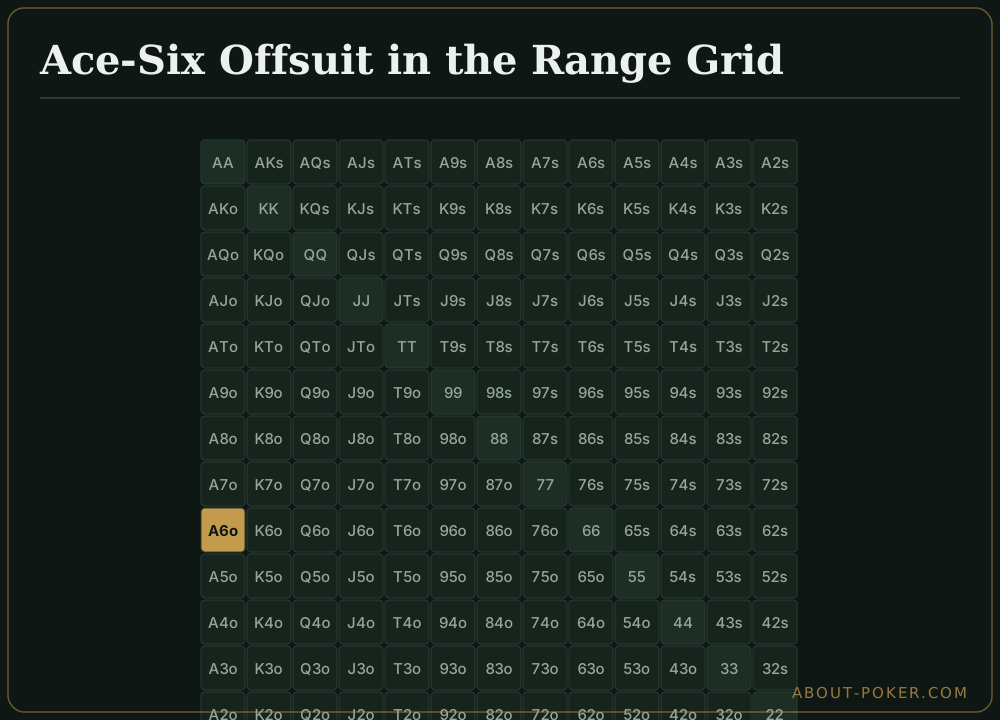
- Early and middle position (full ring): fold. Opening a weak offsuit ace here invites domination from every table position behind you.
- Late middle position: a fold at most tables, playable only in loose 6-max games.
- Cutoff: marginal — sometimes an open, sometimes a fold depending on how tight the table is.
- Button: a standard steal. This is A6o’s best seat.
- Small blind: a raise-first steal against the big blind, a spot covered in blind vs blind play.
- Big blind: defend against a single raise, since you’re getting a price and hold a blocker.
A6o is a raise-or-fold hand. Note what’s missing from that list: cold-calling. That omission is the single most important thing to internalize about weak offsuit aces.
The domination problem
A6o’s ace is a double-edged sword. Against a random hand it’s a favorite — roughly 60% equity heads-up — but poker isn’t played against random hands. It’s played against ranges, and a raiser’s range is loaded with the exact aces that crush A6o: A-K, A-Q, A-J, and A-T all have you dominated, meaning you share the ace but they out-kick you badly. When you flop top pair with your six kicker, a better ace has you drawing nearly dead.
This is why cold-calling is such a trap. Flatting a raise puts A6o into a pot against a range full of its worst nightmares. It plays almost identically to its slightly stronger neighbor ace-seven offsuit — a steal-or-fold hand that should never be flatted into an opener’s range.
A worked example
You open A♠6♦ on the button as a steal. The big blind calls. Flop: A♥ 9♣ 4♠.
You’ve flopped top pair — but with the worst possible kicker for the situation. This is exactly where A6o gets players into trouble. A small continuation bet is fine to charge weaker hands and take it down, but you must not treat this like a premium. If the big blind check-raises or calls two big bets, your six kicker is in dire shape against their better aces and two-pair combos.
The correct approach is pot control: bet the flop small, then be ready to check back the turn and get to a cheap showdown rather than building a big pot with a hand that’s ahead of bluffs but crushed by value. If you face serious aggression, one pair with a six kicker is a fold, not a stubborn call. Winning small and losing small with A6o is the goal; stacking off with top-pair-bad-kicker is the leak.
Facing a 3-bet
When you open A6o and get 3-bet, the default is to fold. You’re usually out-kicked by the 3-bettor’s value aces and don’t have the equity to continue profitably out of position. Occasionally A6o can be a light 4-bet-bluff candidate because the ace blocks A-A and A-K — but that’s an advanced, opponent-dependent play, not a default. For the framework on continuing versus folding, see defending against 3-bets.
Postflop shorthand
- Top pair (ace, six kicker): bet small for value against worse; pot-control against aggression, and fold to big pressure.
- Two pair or trips: a legitimately strong hand — bet for value.
- Ace-high with no pair: modest showdown value; check it down rather than bluffing off.
- Complete miss: give up; a weak offsuit ace has no reason to keep firing.
Where to go next
A6o is a lesson in discipline: a steal from the button and small blind, a fold to raises, and never a cold-call. Compare it to its neighbor in ace-seven offsuit, master its best spot in blind vs blind play, and learn when to let it go in defending against 3-bets.
Frequently asked
Is A6 offsuit a good hand?
A6o is a marginal hand: playable as a late-position steal but easily dominated. It has decent equity against a random hand thanks to the ace, but against a raising or 3-betting range it's frequently out-kicked. Open it only from the button and small blind, and don't cold-call raises with it.
From where should I open A6 offsuit?
A6o is a raise-or-fold hand from the button and small blind at most tables, and it can open from late middle position in loose 6-max games. From early and middle position at a full table it's a fold — you'll too often run into a better ace.
Should I cold-call a raise with A6o?
No. Cold-calling with A6o is a classic leak: you'll frequently be dominated by the raiser's stronger aces (A6 loses badly to AK, AQ, AJ, AT). Fold it against opens rather than flatting into a range full of the hands that beat it.