How to Play Ace-Six Suited (A6s)
A6s is a marginal suited ace that opens late and defends the big blind. Learn where A6 suited plays, why it trails the wheel aces, and how to play it postflop.
On this page · 8 sections
Ace-six suited (A6s) is a marginal suited ace — playable in the right seats, foldable everywhere else. The six kicker is essentially dead weight at showdown, so like every low suited ace, A6s earns its keep through the nut-flush draw and the ace blocker. It’s a fine hand to open late and defend from the big blind, but a mistake to open into a full field.
Where A6s belongs preflop
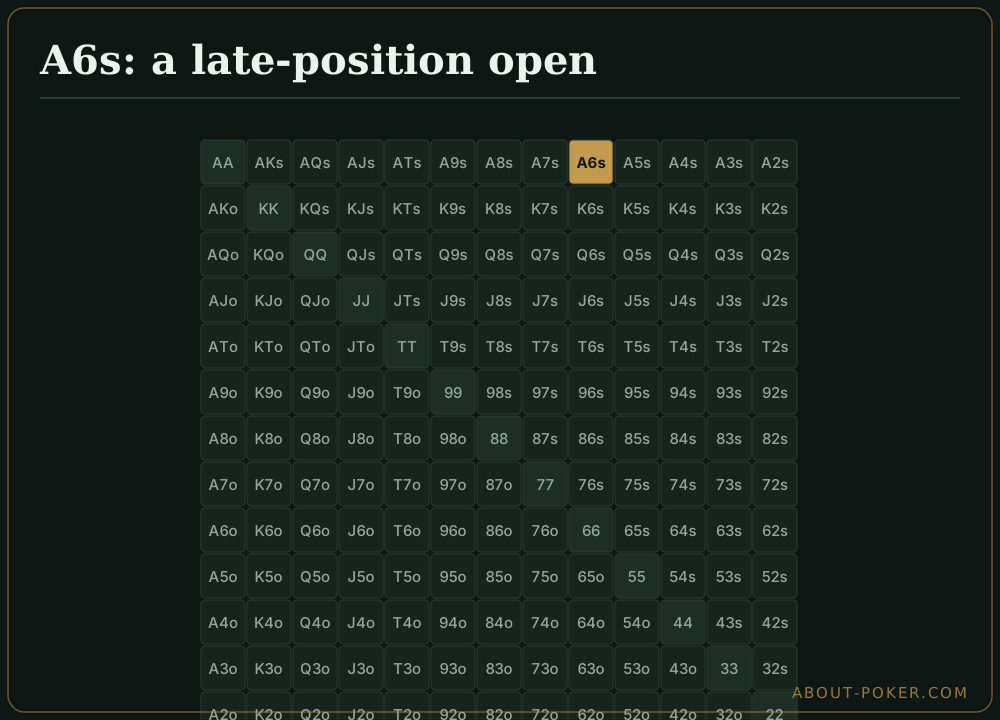
- Early position: fold. There’s no reason to open a dominated hand into a full table.
- Middle position: generally a fold; at most a marginal 6-max open near the bottom of the range.
- Cutoff and button: standard opens — this is where A6s makes money.
- Small blind: open by raising rather than limping.
- Big blind: defend against most single raises with a price. See defending the blinds.
For the exact borders by seat, use preflop opening ranges and poker ranges by position.
Why A6s trails the wheel aces
A6s and A5s look nearly identical — a low kicker with the same nut-flush upside — but they aren’t equal. The difference is straight potential:
- A5s makes the wheel with 2-3-4 and has genuine straight draws that add equity and disguise.
- A6s needs 2-3-4-5 to make the low straight (using the five as the connector) or higher combinations, so it flops far fewer usable straight draws.
That small gap makes A5s a better 3-bet bluff and a slightly stronger hand overall. When you’re building a polarized range, the wheel aces get picked first; A6s is a step behind. It’s still a fine open, just not one of the preferred bluffs.
Facing a raise
A6s is a call-or-fold hand.
- In position vs a late open: flat call, realize equity, flop draws.
- Out of position vs an early/middle open: fold. Domination and poor equity realization make this a losing spot.
- As a bluff-3-bet: possible but low priority — take A5s or A4s first.
A worked example
You defend A♦6♦ from the big blind against a button open. The flop is 9♦ 5♦ 2♣ — you’ve flopped the nut flush draw plus an ace overcard.
You check, the button c-bets, and you call (or check-raise, depending on your strategy). As a raw flush draw you have about 35% equity against a made hand, and your ace-overcard outs push it higher. Because it’s the nut draw, you can play aggressively without fear of a bigger flush.
Turn is the 8♦ — you’ve made the nut flush. Now the whole point of playing A6s pays off: you check-raise or lead for value and can stack an opponent holding a lower flush, two pair, or a set. The six kicker never mattered; the nut flush did. That single scenario — nut draw to nut flush, from the discounted big blind — is why A6s stays in the range at all.
Postflop shorthand
- Flush draw: nut draw, semi-bluff freely.
- Top pair (ace): weak kicker — value bet in position, pot-control out of position.
- Air with the ace: decent blocker bluff candidate.
- A pair of sixes or lower: showdown value at best; don’t build a big pot.
The two jobs of the ace blocker
A6s does more work preflop than its raw equity suggests, and the reason is the ace blocker. Holding an ace removes six of the combinations of AA (from three down to one available to opponents) and cuts the number of AK, AQ, and AJ hands your opponents can hold. That has two practical uses.
First, it makes A6s a legitimate light 3-bet bluff candidate — just a lower-priority one than A5s or A4s. When you 3-bet and get 4-bet, the ace in your hand means the opponent is less likely to hold the premium range they represent, so your bluffs get through more often. The reason A6s ranks behind the wheel aces here is not the blocker (that is identical) but the missing straight potential: A5s and A4s can flop a wheel draw and continue as a semi-bluff if called, while A6s more often flops nothing usable when the flush does not come.
Second, the blocker makes A6s a reasonable bluff on later streets when you have an ace and no showdown value. On a board where you can credibly represent a strong ace or a set, the card in your hand reduces the top of your opponent’s range and adds a little muscle to a river bluff. Do not overrate this — one blocker is a nudge, not a green light — but it is why a bare ace-high with A6s is a better bluffing hand than, say, a bare king-high.
A6s versus the field: multiway caution
Everything above assumes a heads-up or short pot. A6s degrades sharply multiway. In a three- or four-way flop, your top-pair-weak-kicker holdings are far more likely to be beaten, and even your flush draw is no longer guaranteed to be good if a second player is drawing to the same suit with a higher card. The nut-flush upside survives multiway — the nut flush is still the nuts against everyone — but the marginal made hands that make A6s a small winner heads-up become chip-burners in a family pot. Practically: peel for the nut-flush draw, but be quicker to fold weak pairs when more than one opponent is in, and do not turn a soft top pair into a three-street value hand against multiple players.
Where to go next
A6s is a discipline hand: open it late, defend it cheaply, and never fall in love with the pair. Know its place relative to the wheel aces, tighten your opens with preflop opening ranges, map the seat borders with poker ranges by position, and connect the seat logic through the preflop strategy hub.
Frequently asked
Is A6 suited a good hand?
A6s is a marginal but playable hand. It opens well from the cutoff, button, and small blind and defends fine in the big blind, but it's a fold from early and middle position. All of its value comes from the nut flush and the ace blocker.
Should I 3-bet with A6 suited?
Occasionally as a bluff. The ace blocks premium hands, but A6s is slightly worse than the wheel aces (A-5s, A-4s) because it makes fewer straights. Against most opens you'll call in position or fold out of position rather than 3-betting.
Why is A6s worse than A5s?
The six can only make a straight with 2-3-4-5 (needing all four cards) or a higher gutshot, while A5s completes the wheel with 2-3-4. A5s therefore has meaningfully better straight potential, making it a stronger bluff and a slightly better hand overall despite the near-identical kicker.