How to Play Ace-Ten Suited (ATs)
Ace-ten suited is a strong opener and a great bluff-3-bet, but a domination trap in big pots. Learn how to play ATs by position and situation.
On this page · 7 sections
Ace-ten suited (ATs) is one of the most versatile hands in the deck — and one of the easiest to misplay in the wrong direction. It flops the nut-flush draw, makes both the wheel and the Broadway straight, and dominates a pile of weaker aces. That makes it an excellent opener and a premium bluff-3-bet. At the same time, its ten kicker means that in big pots against tight ranges it is frequently dominated by AK, AQ, and AJ. Play ATs for its playability and blocker value, not as a hand to stack off with when the action gets heavy.
Open it in position
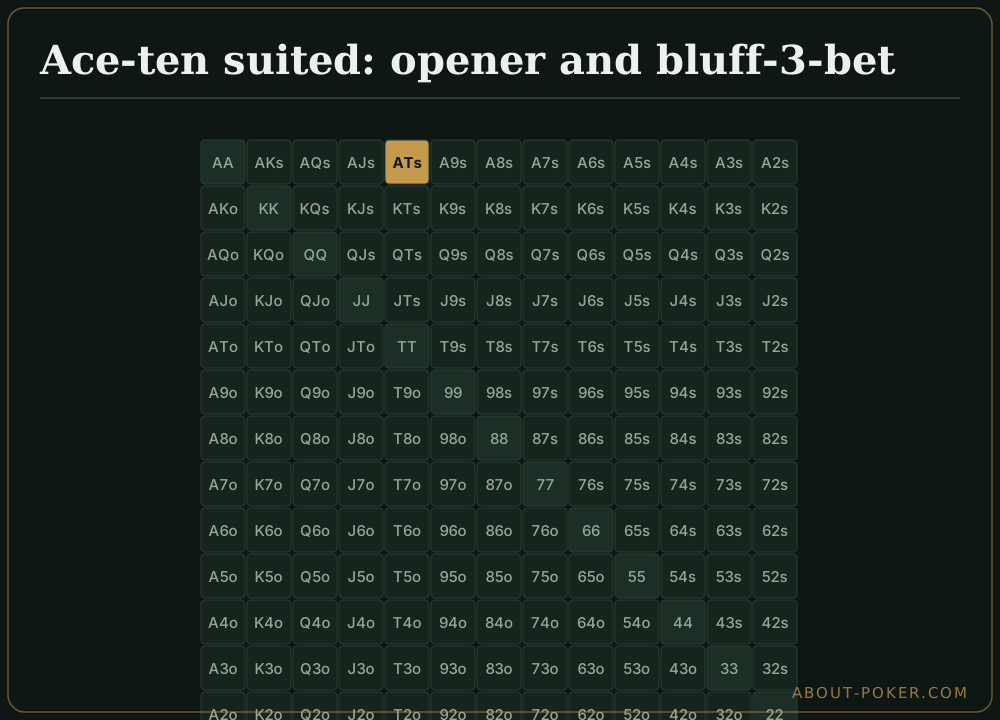
ATs is a clear raise-first-in from middle position, the cutoff, and the button, and it makes many under-the-gun ranges in 6-max as well. It belongs in your preflop opening ranges thanks to its combination of nut-flush draws, two-way straight potential, and dominance over the weak aces that call raises. From late position especially, ATs opens comfortably and steals blinds at a high rate.
The ideal bluff-3-bet
ATs shines as a light 3-bet, particularly against a cutoff or button steal. Two reasons make it perfect for the job:
- Blockers. Holding an ace removes several of the opponent’s strong ace combos (AA, AK, AQ), so they are less likely to have a hand that continues.
- Playability. When called, ATs flops flush draws, straight draws, and top pair often enough to keep barreling profitably.
This is a semi-bluff 3-bet, not a value 3-bet. Against a tight early-position raise you should mostly fold or flat instead — jamming into a range full of hands that dominate you is a losing play.
A worked example
You are in the big blind with A♥T♥ and the button opens to 2.5bb. You 3-bet to 10bb as a semi-bluff; the button calls.
The flop comes K♥7♥3♣. You have the nut-flush draw with an overcard — about nine outs to the nut flush plus three aces, giving you roughly 45% equity against a single made pair by the river. Fire a continuation bet. You have huge equity and heavy fold equity: many of the button’s hands (weak kings, pocket pairs, missed broadways) fold now, and when called you can hit the nuts. This is exactly the spot ATs is built for — semi-bluffing with real equity and blockers behind it. Playing the blinds well like this is central to defending the blinds.
Where ATs goes wrong
The trap is treating ATs like a made hand in raised-and-reraised pots. When a tight opponent 4-bets, ATs is dominated by AK/AQ/AJ and behind all the big pairs — fold it. And when you flop top pair with an ace on an ace-high board, remember your ten is a weak kicker: value bet the worse hands, but don’t pay off large aggression from a range that has you outkicked.
How ATs shifts by stack depth
The right way to play ATs changes with how deep the money is. At a standard 100bb, ATs is a comfortable open in position and a strong semi-bluff 3-bet, but you keep the pot manageable when you hit only top pair with the weak ten kicker. Deeper — 150bb or 200bb — domination gets more expensive: the times you make top pair and run into AK or AQ cost full stacks, so lean harder on ATs’s draw and blocker value and away from playing it as a made hand for a big pot. When you are short, say 20 to 40bb, the calculus flips the other way. There is little room to be outplayed after the flop, the hand’s raw equity and nut potential shine, and ATs becomes a clean open-shove or 3-bet-jam candidate against late-position steals, where its ace blocker reduces the combos that can call and beat you.
The through-line: the deeper you are, the more ATs wants to be a drawing and pressure hand rather than a stack-off hand; the shorter you are, the more you can commit it directly on its equity and blockers.
Reading the board texture
Because ATs is a draw-first hand, board texture dictates almost every postflop decision. On coordinated, suited-heavy, or connected boards, ATs frequently flops real equity — a flush draw, an open-ended or gutshot straight draw, or a pair with a redraw — and those are the textures where you keep barreling. On dry, disconnected boards like K-7-2 rainbow where you missed, a single continuation bet as a bluff is fine, but you should give up cheaply rather than fire multiple streets into a range that has connected. The mistake to avoid is treating every ace-high flop as a green light: when you pair your ace on an A-x-x board, your ten kicker is a liability against a range that raised and called, so size down for value from worse aces and refuse to build a huge pot. Match your aggression to the equity the board actually gives you, not to the fact that you hold two Broadway cards.
Postflop summary
- Nut-flush draw: Barrel it — you can win now or make the nuts.
- Top pair (ace or ten): Value bet worse hands, slow down against strong aggression.
- Straight draws (wheel/Broadway): Semi-bluff for the strong equity and fold-equity combination.
- Total whiff: C-bet on dry boards; give up on coordinated ones.
Play ATs for its draws, blockers, and steal power. It is a hand that wins pots by applying pressure and hitting big, not by grinding out dominated showdowns against tight ranges.
Frequently asked
Is ace-ten suited a good hand?
Yes, it is a strong hand — inside most opening ranges from middle position to the button and a common bluff-3-bet candidate. Its value comes from the nut-flush draw, wheel and Broadway straight potential, and the fact that it dominates many weaker aces. It is not, however, a hand you want in big raised-and-reraised pots against tight ranges.
Should you 3-bet ace-ten suited?
Often as a bluff or semi-bluff, especially against late-position steals. ATs has the blockers and playability that make it an ideal light 3-bet: it removes some of the opponent's strong ace combos and flops well when called. It is rarely a pure value 3-bet against tight opens.
How does ATs play from the blinds?
From the big blind you can defend ATs by calling against a raise, and it is strong enough to 3-bet against wide button and cutoff opens. From the small blind, 3-betting or folding is usually cleaner than calling out of position.