How to Play Jack-Eight Offsuit (J8o)
J8o is a weak, gappy offsuit hand that only opens from the button and small blind. Learn where J8 offsuit folds, when it steals, and how to play it postflop.
On this page · 6 sections
Jack-eight offsuit (J8o) is a hand with a little bit of everything and not enough of anything. It has two middling cards with a one-card gap, so it can make straights, but it’s offsuit — no flush help — and its high-card strength is weak. J8o is dominated by better jacks and any broadway that pairs the board, and it makes second-best pairs more often than winners. Like the other weak offsuit hands, its role is limited to late-position steals and cheap blind defends.
Where J8o belongs preflop
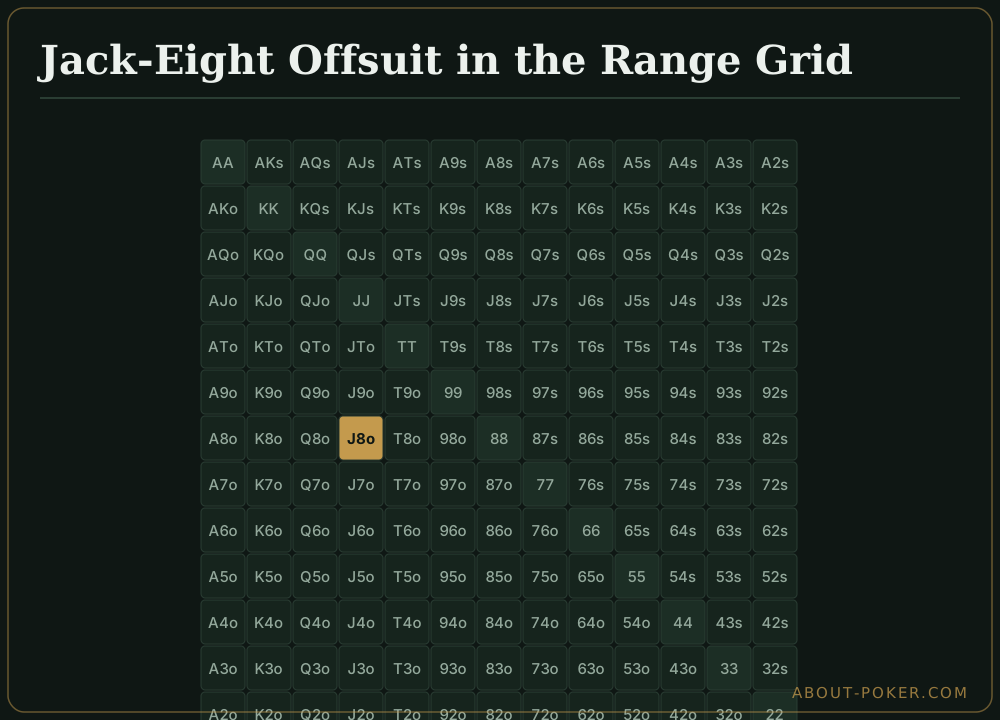
J8o is a raise-or-fold hand that only raises from the back seats:
- Early and middle position: fold. There’s no reason to open a weak, dominated gapper this early; it can’t handle 3-bets and it flops badly.
- Cutoff: marginal at best; many solid ranges fold it here.
- Button: a marginal open. With only the blinds behind, J8o steals dead money and has some straight potential.
- Small blind: open (raise) rather than limp when it folds to you.
- Big blind: defend against a single raise when you’re getting a price, especially versus late steals.
For the exact borders, ground yourself in the preflop opening ranges; J8o sits near the bottom of what’s openable, and only late.
What J8o can and can’t do
The good news about J8o is that its connectedness gives it some straight potential: a T9x or 79x-type board can hand it a big draw or a made straight, and hands like these occasionally win a stack from someone with top pair. The bad news is everything else. As an offsuit hand it never makes a flush, so its drawing equity is thin. And its pairs are usually second-best — top pair with a jack loses to better jacks, and a paired eight is behind almost everything that keeps betting. That’s why J8o should not be cold-called: flatting out of position with a dominated, flush-less hand is a leak.
Where J8o earns its keep is against wide ranges. In blind-vs-blind battles, its straight potential and the jack blocker let it show up as an occasional attack or defend. Those are marginal, board- and opponent-dependent plays — see blind vs blind play and defending the blinds for the framework.
Facing 3-bets and 4-bets
When you open J8o and face a 3-bet, fold in nearly every case. You’re dominated, out of position, and holding a hand with only modest straight equity — not enough to call profitably. Against a 4-bet, folding is automatic.
A worked example
You open J♦8♣ from the button and the big blind defends. The flop comes T♠ 9♥ 2♣ — you’ve flopped an open-ended straight draw (any queen or seven makes your straight). This is J8o at its best: you have eight clean outs to the nuts-ish end of a straight, plenty of equity to continue, and a hand that can barrel. You bet, and on a queen or seven you’re often getting max value. But notice how specific this is — J8o needs the board to cooperate. On a dry king-high or ace-high flop it has almost nothing and should give up cheaply. Heads-up, J8o has roughly 55% equity against a random hand, driven mostly by these connected-board scenarios.
Reading the flop: when to continue and when to quit
Because J8o lives and dies by the board, learning to sort flops into “continue” and “give up” buckets is the whole skill. Continue on connected, middling textures that give you a straight draw or a pair-plus-draw: T9x, 97x, T7x, and similar boards where a jack or eight pairs alongside straight outs. On these you have enough equity to bet as a semi-bluff or to call one bet. Give up on the many boards that leave J8o with a weak pair and nothing behind it — a jack-high flop where you make top pair with a terrible kicker is not a green light to build a pot, because better jacks and overpairs have you crushed.
Ace-high and king-high dry flops are automatic surrenders when you have no piece: J8o has no backdoor flush and usually no straight draw on those textures, so betting is spewing chips into a range that connected better than yours. The discipline to check and fold these boards is what separates a small-loss J8o from a big-loss one.
Counting the straight draws
It helps to know roughly how often J8o flops something real. As a one-gap offsuit hand, J8o flops an open-ended straight draw a little less often than a true connector like J9 or JT would, because the missing rank removes one of the straight structures. Across all possible flops, J8o makes an open-ender or a made straight only a small percentage of the time, and a bare gutshot somewhat more often. When you do flop the open-ender, you have eight outs, which is about 32% equity to complete by the river with two cards to come — enough to semi-bluff aggressively. When you flop only a gutshot, you have four outs, roughly 17% by the river, which is usually not enough to keep barreling without additional equity like an overcard or a backdoor draw. Knowing these numbers keeps you from turning a thin gutshot into a bloated pot. The same reasoning underpins how you defend marginal hands from the blinds, covered in defending the blinds.
Open J8o only from the button and small blind, defend it cheaply, and fold it everywhere else. Its value is entirely in the straight-y flops — respect that and don’t force it.
Frequently asked
Is J8 offsuit a good hand?
J8o is a below-average offsuit hand with a one-gap connection but no suit and weak high-card strength. It only opens from the button and small blind and is a fold from every earlier seat.
Should I open J8 offsuit?
Only from late position. J8o is a marginal button steal and a small-blind open when the action folds to you. It is a fold from early and middle position because it is dominated too often and cannot defend against 3-bets.
Is J8 offsuit better than J8 suited?
No. J8 suited is meaningfully stronger because the flush potential adds equity and lets you continue on more boards. J8o loses that flush help, so it opens from far fewer positions and folds more readily.