How to Play Jack-Four Offsuit (J4o)
Jack-four offsuit is a pure fold from every seat. Here is why J4o has no place in an opening range and the one marginal spot it ever appears.
On this page · 5 sections
Jack-four offsuit (J4o) is one of the weakest hands in Texas Hold’em. It combines a six-rank gap — meaning it can never make a natural straight — with the absence of a shared suit, so it has no flush potential either. Strip away both straights and flushes and you are left with a hand that only wins by pairing up and hoping your kicker holds, which it rarely does. Against a random hand J4o wins only about 43% of the time heads-up, and that number collapses against any real opening range. The correct play with J4o is almost always the simplest one: fold it before the flop.
Why J4o is an automatic fold
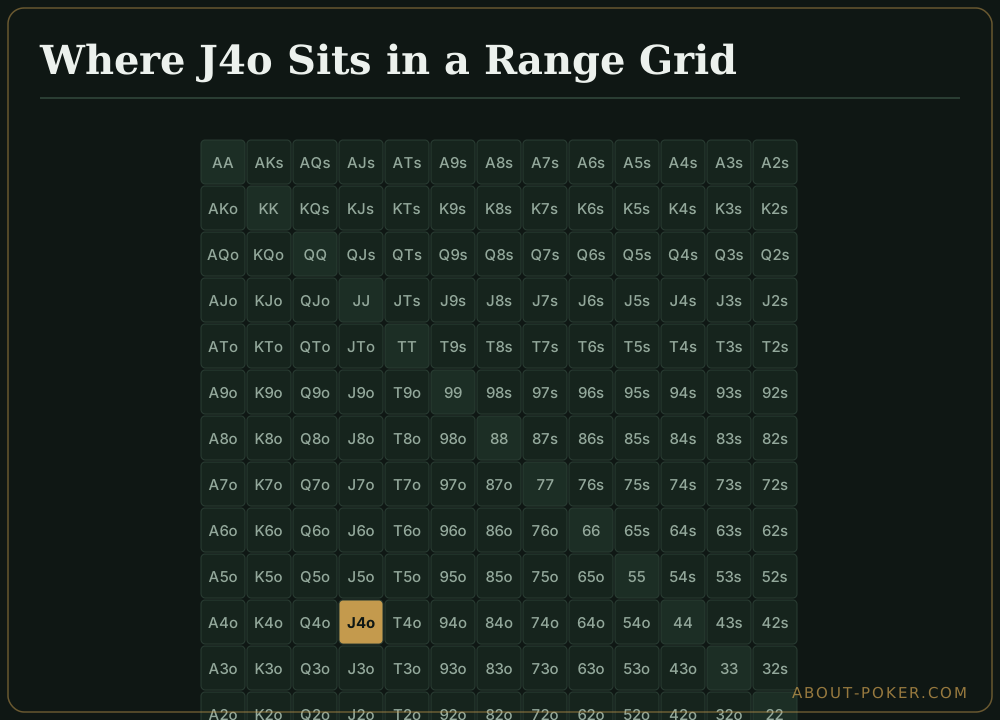
A starting hand earns its keep through three sources of equity: high-card strength, straight potential, and flush potential. J4o fails on all three. The jack is a decent-but-not-great high card that gets outkicked constantly, the four is a dead card for connectivity, and the offsuit nature removes any flush. When you pair the jack you are frequently dominated by better jacks; when you pair the four you are behind almost everything. There is no version of this hand that plays well in a raised pot.
Compare it to jack-four suited, which at least keeps a backdoor to a flush and squeaks into the widest, cheapest big-blind defends. Remove the suit and even that thin justification disappears. In every standard preflop opening range, J4o is listed as a fold from all nine seats, and treating it as an automatic muck removes a recurring losing spot from your game.
The one marginal exception
The only time J4o even enters the conversation is big-blind defense against a min-raise, specifically from the small blind when the pot is already bloated relative to the raise size. In that spot you are closing the action, no one can raise behind you, and you are getting a price good enough to peel almost any two cards. This is the extreme frontier of blind defense, where the defending range stretches far below what you would ever open.
Even here, J4o is on the chopping block. As soon as the raise size increases or the opener’s range tightens, J4o is among the first hands to fold. Treat this exception as a curiosity, not a green light — for practical purposes across almost every table you sit at, J4o is a fold.
A worked example
You are in the big blind with J♣4♦ and the button opens to 2.5 big blinds. You should fold. The button’s range is wide but still full of hands that dominate you — every better jack, every pair, every ace — and J4o has no suit to make a flush or connectivity to make a straight. If you call, you will flop something usable maybe a fifth of the time, and even then you will usually be second-best.
Now change the spot: the small blind min-raises to 2 big blinds and you are in the big blind getting roughly 3-to-1 with position guaranteed for the rest of the hand. Here J4o is a razor-thin call at best, and folding remains perfectly fine. The difference between the two spots is entirely price and range width — and it shows how narrow the window for a hand this weak really is.
How J4o compares to nearby trash
It helps to place J4o in context so the fold feels automatic rather than reluctant. Hands like J8o and J9o are one- and two-gappers with real straight potential and better kickers, and they still fold from most seats — so a six-gapper like J4o is nowhere close to the cutoff. The jack does give J4o a marginally better high card than something like 84o, but “marginally better trash” is still trash. When you group your starting hands mentally, J4o belongs in the same bin as the offsuit gappers you never think twice about: instant muck. Building that instinct is worth more than memorizing any single chart, because the same logic folds dozens of similar junk hands the moment you see them.
The takeaway
J4o is a fold-first hand. Do not open it, do not cold-call it, and defend with it only in the most extreme, cheapest big-blind spots against the widest ranges. Recognizing hands like this instantly — and mucking them without a second thought — is one of the easiest ways to plug leaks. If you want to sanity-check just how far behind you are, run J4o against a typical button range in an equity calculator and you will see the fold confirmed immediately.
Frequently asked
Should you ever open jack-four offsuit?
No. J4o is a fold from every seat, including the button. It is a six-gap offsuit hand with no straight potential and no suit to fall back on, so it sits well below the threshold of even the widest steal-position opening ranges.
Is J4o a playable big-blind defense hand?
Only at the very extreme edge, against a tiny min-raise from the small blind when you are getting an enormous price. Even then it is one of the first hands you drop. Against most opens, folding the big blind with J4o is correct.
How does J4o differ from J4 suited?
The suited version can make a flush, which gives J4s a rare home in cheap big-blind defense. J4o loses that flush equity entirely, which pushes it from marginal-trash to pure fold across the board.