How to Play Jack-Five Suited (J5s)
Jack-five suited is a five-gap near-trash hand that folds almost everywhere. Here is the narrow set of spots where J5s is playable and how to handle it.
On this page · 6 sections
Jack-five suited (J5s) is a five-gap suited hand and sits near the absolute bottom of what a winning player considers playable. Those five gaps between the jack and the five destroy almost all straight potential — J5s can technically only make a single straight (7-8-9-T-J does not even use the five), and in practice its five is a dead card for connectedness. That leaves a hand that survives almost entirely on flush possibilities and the occasional lucky two pair. It wins about 47% heads-up against a random hand — worse than a coin flip against an unknown holding. The honest verdict for J5s is that it folds in nearly every situation, with rare life only in cheap big-blind defense.
Big-blind defense, and almost nothing else
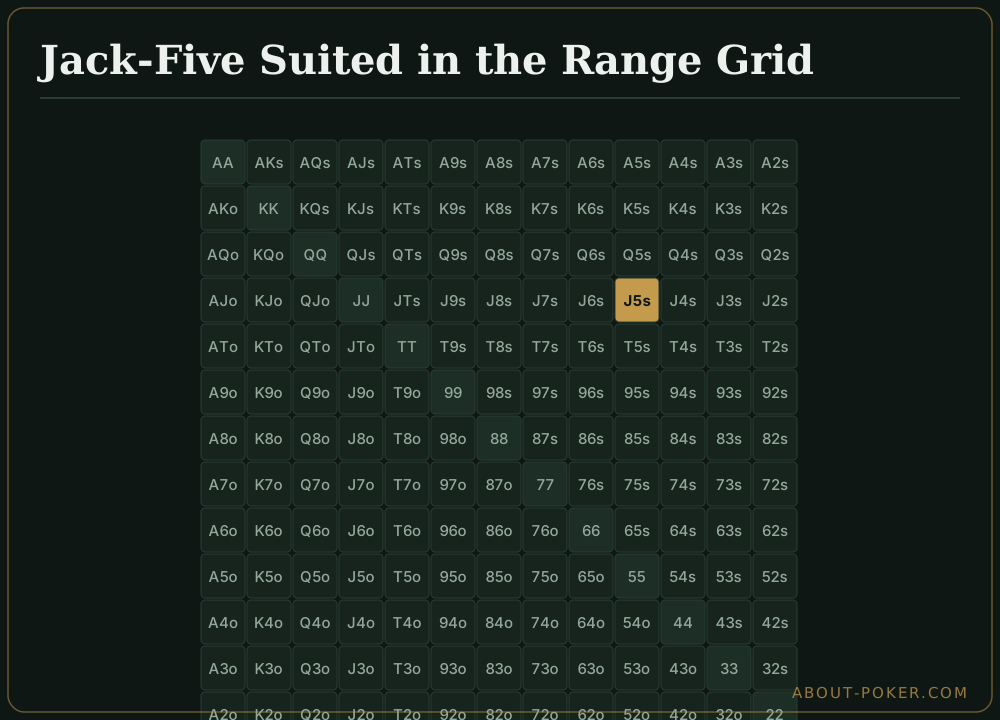
The one place J5s earns a look is defending the big blind at a deep discount. When a late-position player min-raises or makes a small open and you are getting excellent pot odds to close the action, J5s can occasionally call — you are already partly invested, you close the betting, and suitedness gives you a flush to chase. This is the widest edge of correct blind defense: you defend far more hands than you would ever open, and J5s scrapes in only at the very best prices against the widest ranges.
As an open, J5s is essentially always a fold. Even on the button, where marginal suited jacks like jack-six suited already struggle to qualify, J5s falls clearly below the line. Folding it costs you almost nothing, so your preflop opening ranges should show it as a fold from every standard seat.
Why it is so weak
Each gap in a suited hand removes straights and adds dominated pairs. J5s has five gaps — more than J6s — so it makes essentially the fewest straights of any jack-suited hand and the most easily outkicked pairs. When it flops top pair, a jack, it is regularly outkicked by better jacks. When it flops the five, it is almost always second-best. The flush is the only holding that reliably wins a big pot, which is why suitedness is the sole reason this hand appears in your range at all.
A worked example
You defend the big blind with J♣5♣ against a button open and see a flop of K♣-8♣-3♥.
This is the flop J5s needs to justify its existence: a flush draw, with any club completing your flush. That is nine outs — about 35% equity to hit by the river. You can check-call one reasonable bet with this much equity and the chance to win a large pot when a club lands. Now change it to a Q-9-2 rainbow flop, and you hold jack-high with no draw and no plan — a trivial check-fold to any bet. That contrast is the entire strategy for J5s: continue only when you flop real equity, and give up cheaply the many times you flop nothing.
How the decision shifts with stack depth and opponent
The narrow window where J5s is defensible narrows further or opens slightly depending on conditions, and knowing which way it moves keeps you from misplaying it.
- Stack depth: deeper stacks favor suited hands a little, because the implied odds on a flush pay more when stacks are 150-200bb than at 40bb. Even so, J5s is so weak that added depth only nudges it, never rescues it — at short stacks (say 30bb) drop it from your defending range entirely, since you cannot realize its flush equity when a shove ends the hand early.
- Opponent’s opening size: a min-raise (2bb) gives you a fantastic price to defend and is the one sizing where J5s most often slides in. Against a large open (3.5bb or more), the price worsens and J5s should fold even in the big blind.
- Opponent type: against a tight opener whose range is strong, fold J5s — you will be dominated when you pair and your flush can run into a bigger flush. Against a loose, wide opener, a cheap big-blind defend is more reasonable because their range is full of hands you can outflop.
- Position of the raiser: J5s only ever defends against late-position (button or cutoff) opens, where ranges are widest. Against an early-position raise it is a clean fold every time.
A quick decision checklist
Before you ever put a chip in with J5s, run this list:
- Am I in the big blind? If not, fold.
- Is it a small open (2 to 2.5bb) from late position? If not, fold.
- Are effective stacks deep enough (roughly 60bb or more) to get paid on a flush? If not, lean fold.
- Postflop, did I flop a flush draw, strong two pair, or a genuine straight? If not, check and fold.
If any early answer is “no,” releasing the hand costs you essentially nothing. That is the whole point of a bottom-of-the-range holding: the correct play is almost always the cheapest one. For the broader framework of which weak hands qualify, see the preflop opening ranges and the wider logic of defending the blinds.
The right mindset
Treat J5s as a fold-first hand. Never open it in a standard game, defend it only from the big blind at a genuine discount, and postflop continue solely with flush draws, strong two pair, or a rare disguised straight. Its tiny profit comes from the occasional flop where suitedness turns nothing into a real threat — and from the discipline to release it the far more common times it flops air.
Frequently asked
Is jack-five suited worth playing?
Rarely. J5s is a five-gap suited hand near the bottom of the deck's playability. Its only realistic home is defending the big blind at a deep discount against late-position raises. From every other seat it is a fold.
Should you open jack-five suited on the button?
Almost never. J5s falls below even wide button-opening ranges in most games. If you are unsure whether to open it, folding is the correct low-risk default and costs you essentially nothing.
How do you play J5s after the flop?
Only continue when you flop a flush draw or a strong made hand like two pair. Its flush potential is the sole reason to see a flop. On a jack-high or air flop with no draw, check and fold rather than bluffing into a stronger range.