How to Play Jack-Nine Offsuit (J9o)
J9o is a weak one-gap offsuit connector. Learn the few late spots where it opens, why it folds up front, and how its straight potential shapes postflop play.
On this page · 6 sections
Jack-nine offsuit (J9o) is a one-gap offsuit hand with a little straight potential and not much else. It can make the T-8 and Q-T straights, and it can flop top pair with the jack, but it has no flush and a nine kicker that offers little. Compared to its suited version, J9o loses the flush entirely, which drops it to the bottom edge of the hands worth opening.
Where J9o belongs preflop
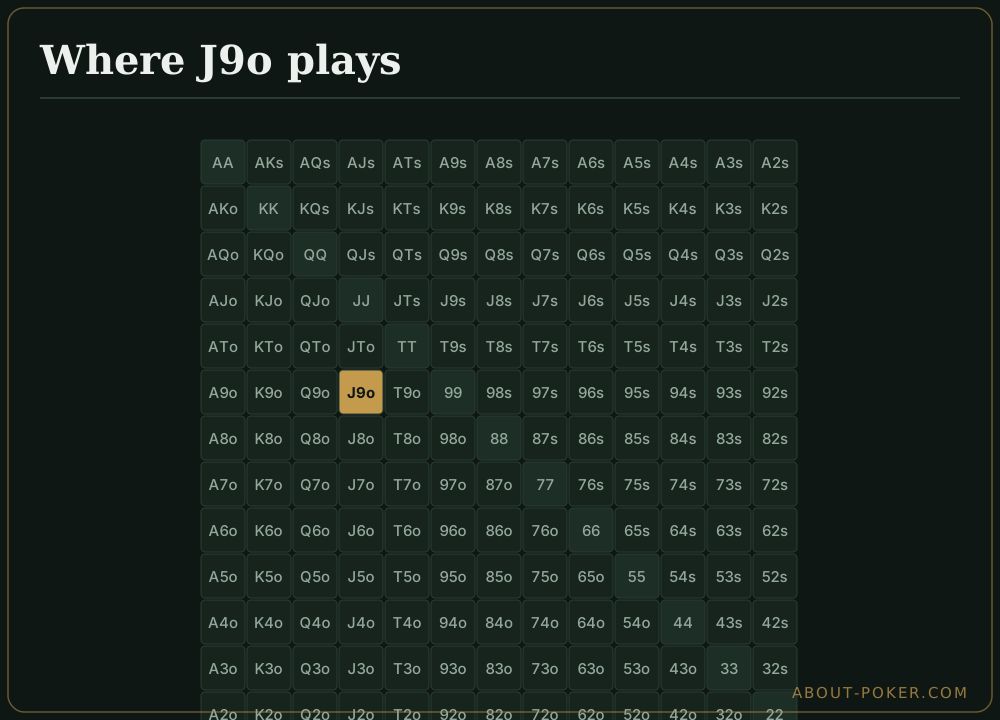
By seat, J9o is a late-position hand only:
- Early and middle position: fold. A dominated, no-flush offsuit hand does not belong in a wide field. Too many players behind hold better jacks, better connectors, and dominating broadways.
- Cutoff: a fold at a full ring and a borderline open only at short-handed tables. Lean toward folding when the button and blinds fight back.
- Button: a standard steal. This is where J9o earns its place — stealing blinds and playing its straight potential in position.
- Small blind: open as a raise against folded action rather than limping; you do not want to play a marginal hand out of position for a discount.
- Big blind: defend selectively against late opens, leaning on the connectivity that lets it flop straights and draws.
If those borders feel fuzzy, anchor them in the preflop opening ranges and in how ranges widen seat by seat in poker ranges by position.
Straight potential is the whole story
J9o’s one redeeming feature is connectivity. As a one-gapper, it can complete straights using the ten: J-9 fills the 8-10-J-Q-K neighborhood in more ways than a random offsuit hand, and open-enders and gutshots come up often enough to give it some semi-bluffing life.
That said, the value is modest. A jack-high straight is not the nuts on many boards, top pair with the jack is easily dominated by better jacks and by queens and kings, and the nine kicker is dead weight. The connectivity keeps J9o just barely playable in position, but it is never a hand you should be excited to build a big pot with.
Facing a raise: mostly fold
When someone else has opened, J9o becomes a fold-or-defend hand:
- Facing an open: fold. You are dominated by the opener’s better jacks and broadways, you are usually out of position, and you have no flush draw.
- Big blind vs a late open: defend a fraction of the time at a good price, leaning on the straight potential to justify continuing.
- As a 3-bet: essentially never for value and rarely as a bluff. Better bluffing hands exist; see how they get chosen in the 3-bet range breakdown.
A worked example
You open J♣9♦ from the button and the big blind defends. The flop comes T♠ 8♥ 3♣ — you have flopped an open-ended straight draw with two overcard-adjacent gaps, needing a queen or a seven to complete.
You bet as a semi-bluff. You have eight clean outs to the straight (four queens, four sevens) plus backdoor equity, so you have real fold equity and a strong draw to fall back on. On the turn 2♦, you can barrel again: your draw is still live, and the board is dry enough that the big blind folds many hands that missed. If you hit the straight on the river, you get paid; if you miss, you can give up having applied pressure with a genuine draw behind it. This is J9o’s best kind of flop — the connectivity doing the work.
Contrast that with the same J♣9♦ opened from early position: you would face more players, more domination, and worse odds of realizing that same draw. Same cards, far worse spot.
Postflop in one paragraph
J9o’s best flops are straight draws — open-enders and double-gutters — where it semi-bluffs with real equity and fold value. It also flops top pair with the jack, but that hand is easily dominated, so play it for pot control in position and avoid committing stacks. When it makes bottom pair or air, treat it as a bet-once-or-fold hand. The connectivity is the reason to play J9o at all, so favor boards where its straight outs are live.
Where to go next
J9o is a narrow, position-dependent connector — fine as a button steal, a fold nearly everywhere else. Compare it with the more forgiving J9 suited, anchor the seat logic in poker ranges by position, and connect it all through the preflop strategy hub.
Frequently asked
Is J9 offsuit a good hand?
No, J9o is a marginal hand. It is a one-gap offsuit holding with modest straight potential and no flush, so it opens only from the button and small blind and defends some big blinds. From early and middle position it is a fold.
Should I open J9 offsuit?
Only from the button, the small blind as a raise, and rarely the cutoff at a short table. It folds from every earlier seat because it is easily dominated and cannot realize its equity well out of position.
Can J9 offsuit call a raise?
Usually not. J9o plays poorly against an open: it is dominated, out of position, and lacks a flush draw. Its main defensive use is as an occasional big-blind defend at a good price, where its straight potential gives it some playability.