How to Play Jack-Eight Suited (J8s)
Jack-eight suited is a marginal two-gapper that only opens from late position. Here is when to play J8s, when to fold it, and how to handle it postflop.
On this page · 6 sections
Jack-eight suited (J8s) is a two-gap suited connector and a genuinely marginal hand. The two-card gap between the jack and eight strips away straight combinations and pushes the hand toward second-best pairs and weaker draws. It wins about 53% heads-up against a random hand — still ahead of a coin flip, but not by much — and it only earns a spot in your range from late position or as a blind defense. Played from the wrong seat, J8s is one of the quiet leaks that erodes a winrate.
Late position and blind defense only
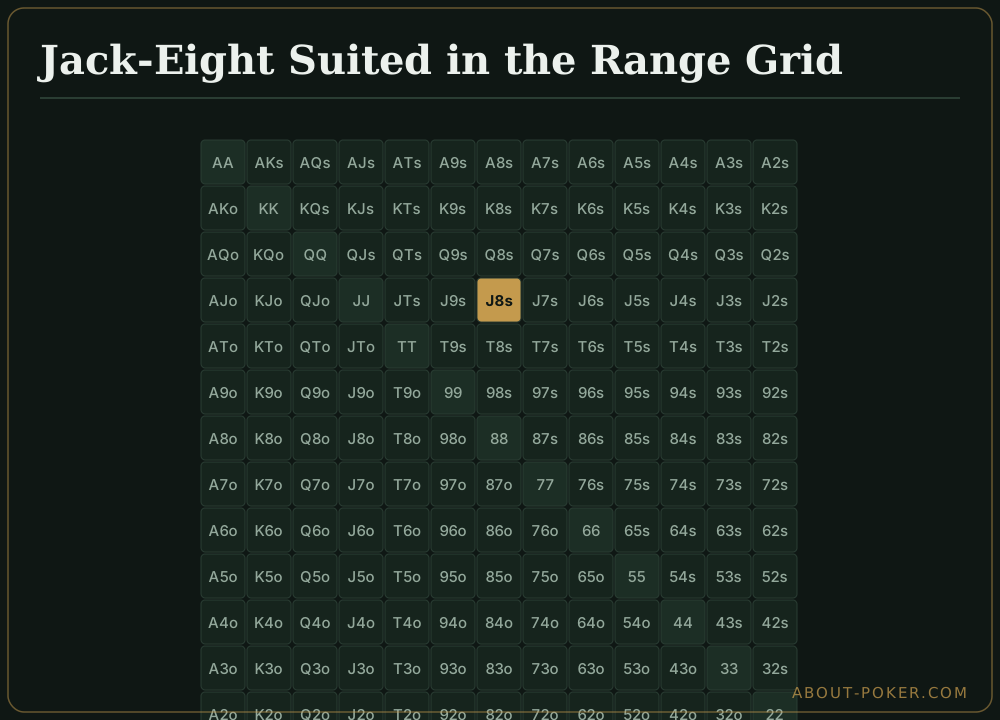
J8s opens from the cutoff, button, and sometimes the small blind, and it is a fine hand to defend with in the big blind at the right price. Everywhere earlier it is a fold. The logic is positional: from late seats you have fewer players left to act, more fold equity, and the last word postflop, all of which rescue a hand that is otherwise too thin. Check your preflop opening ranges — J8s should appear only at the bottom of your late-position openers, not in early or middle spots.
When you are in the big blind facing a raise, J8s is a reasonable call because you are getting a discount and closing the action. That is a core part of good blind defense: suited, semi-connected hands like this defend profitably at the right price even though you would never open them from up front.
Why the gap costs so much
Every gap between your cards removes straights and makes your pairs easier to dominate. Where jack-nine suited is a workable one-gapper you can open from middle position, J8s drops a full tier. Its jack-pairs run into better kickers, its eight-pairs are frequently second-best, and its straight draws are less common and less often to the nuts. The suitedness keeps it playable — flushes and flush draws are its main saving grace — but it never rises above marginal.
A worked example
You hold J♦8♦ on the button and open to 2.5bb. The big blind calls. The flop comes 9♣-7♠-2♦.
This is about the best non-flush flop J8s can hope for: an open-ended straight draw, with any ten or six completing a strong straight. You have roughly eight outs — about 31% equity to improve by the river. This is a clear continuation-bet as a semi-bluff. But note the caution: even your straight is not always the nuts (a ten gives you J-T-9-8-7, but T-J could beat a lower runout), so bet your draw for fold equity and reassess if you get big resistance. On a dry, high flop like A-K-4 you have essentially nothing and should give up.
The discipline that makes it profitable
J8s is a hand where folding is a skill. Open it only in position, defend it only at a good price, and be ready to abandon it postflop when you miss. When you do connect — a flush draw, an open-ender, or two pair on a low board — you can play it aggressively, because those are the spots that pay for all the times you correctly threw it away.
The domination problem in detail
The reason J8s is marginal rather than strong comes down to how often its made hands are already beaten. Think about the jack. When you flop top pair with J8s, your kicker is an eight, and a large share of the jacks other players open and defend with out-kick you: AJ, KJ, QJ, JT, and even J9 all have you dominated, and only J7, J6, and worse are behind. So your “top pair” is frequently second-best against exactly the hands that will keep putting money in. The eight is worse — an eight-pair is almost always dominated or an underpair to the board. This is why you cannot value-bet J8s pairs with confidence and must play them as bluff-catchers on all but the softest boards. The lesson generalizes: with weaker suited hands, the flush and the well-disguised straight are the holdings that win big pots, while the pairs mostly win small ones or lose medium ones.
How the spot changes against different openers
Whether to defend or open J8s depends heavily on the opponent. Against a tight, straightforward opener who continuation-bets honestly and gives up when he misses, J8s defends and floats well: you can call a raise, see a flop, and take the pot away on later streets when he checks. Against a loose-aggressive player who barrels multiple streets relentlessly, J8s struggles — your weak pairs cannot stand the heat and your draws will not always complete, so you should tighten your defends and lean on the flops where you actually flop equity. From the button facing weak, over-folding blinds, J8s is a comfortable steal; facing blinds that 3-bet aggressively, it slides toward a fold because it does not want to play a bloated pot out of position. The hand rewards you for adjusting to who you are up against rather than playing it the same way every time. For the one-gap version you can open a full seat earlier, see jack-nine suited, and confirm the seats where J8s enters using your preflop opening ranges.
Frequently asked
Is jack-eight suited worth playing?
Only from late position. J8s is a marginal two-gap suited hand that opens from the cutoff, button, and sometimes the small blind, and defends fine in the big blind. From early and most of middle position it is a fold — the gap and the modest ranks make it too weak against a full field.
Should you open jack-eight suited from early position?
No. J8s does not make the cut under the gun or in early middle position in 6-max. Too many players are left to act, and the hand makes too many dominated pairs. Wait until you reach the cutoff or button, where fold equity and position rescue its playability.
How does J8s compare to J9s?
J8s is clearly weaker. The two-card gap removes straight combinations and makes the hand more likely to flop dominated pairs and second-best draws. J9s opens from middle position onward; J8s is usually restricted to late position and blind defense.