How to Play Jack-Five Offsuit (J5o)
Jack-five offsuit is a five-gap trash hand that folds nearly everywhere. Here is the one spot J5o is playable and how to release it the rest of the time.
On this page · 5 sections
Jack-five offsuit (J5o) is one of the weakest hands in a full 169-hand grid. It combines two crippling flaws: it has five gaps between the jack and the five, which kills nearly all straight potential, and it is offsuit, which removes the flush safety net that keeps hands like jack-five suited barely relevant. Strip away the flush and you are left with a hand that makes weak, easily dominated top pairs and almost nothing else. J5o wins roughly 44% heads-up against a random hand — clearly below a coin flip against an unknown holding. The correct default is simple: J5o folds almost everywhere.
Why J5o is a fold from every seat
Opening ranges reward two things above all: high cards that make strong top pairs, and connectedness or suitedness that makes straights and flushes. J5o has neither. Its jack makes a top pair that a huge share of continuing hands outkicks, and its five is a dead card for straights in most flop textures. Because it is offsuit, it never makes a flush to win a big pot.
That is why your preflop opening ranges should show J5o as a fold from under the gun all the way through the button. Wide button-stealing ranges include suited junk and connected offsuit hands long before they reach a disconnected offsuit jack like this one. When you are unsure, folding J5o is the zero-risk answer.
The one playable spot: cheap big-blind defense
The single situation where J5o earns a look is defending the big blind at a steep discount. If a late-position player makes a small raise, you are last to act, and the pot is laying you a large price, J5o becomes a thin call. You are already partially invested through your blind, you close the action so no one can 3-bet you, and you will see a flop cheaply.
This is the widest frontier of correct blind defense: you defend far more hands than you would ever open, and J5o only qualifies at the best prices against the widest ranges. Against a larger raise, an early-position opener, or a strong tight range, fold and move on.
A worked example
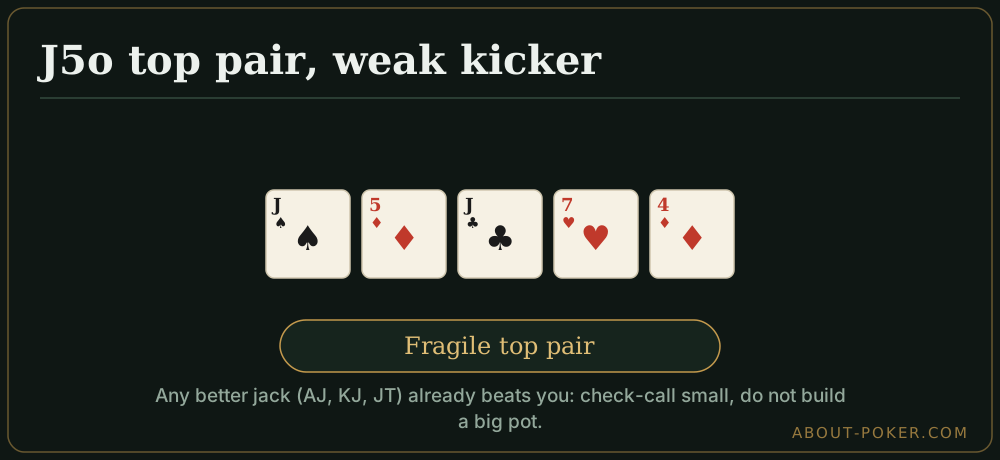
You are in the big blind with J♠5♦ and a loose button min-raises. You are getting a large discount to close the action, so you call. The flop comes J♣-7♥-4♦.
You have flopped top pair, jack-high, with a weak kicker. This looks decent, but be honest about it: your five is a poor kicker, and any better jack in your opponent’s range — jack-ten, king-jack, ace-jack — already beats you. You are also vulnerable to the many overcards that can arrive. The right approach is to treat this as a cheap-showdown, pot-control hand: check-call one small bet if the price is good, but do not build a big pot. If your opponent shows real aggression across multiple streets, your one weak pair is beaten far too often to continue.
Now change the flop to Q♥-9♠-2♣. You hold jack-high with no pair, no draw, and no plan. That is a trivial check-fold to any bet — exactly the outcome J5o produces most of the time.
Common leaks with J5o
The biggest mistake players make with J5o is treating a flopped jack as a hand worth building a pot around. Top pair with a five kicker feels strong, but on any jack-high board a large chunk of the hands that stack off with you have you crushed — ace-jack, king-jack, and jack-ten all dominate your kicker, and sets and two pairs are lurking too. If you find yourself putting in three streets of value with jack-five, you are almost always paying off a better hand.
A second leak is defending J5o too wide out of the big blind. Because it has no flush and almost no straight potential, it needs the very best prices to break even. Calling a middle-position raise, or a larger late-position sizing, turns a marginal spot into a losing one. And a third leak is bluffing with it on missed flops — J5o has essentially no equity when it whiffs, so betting into a stronger range as a bluff simply burns chips. When it misses, it should give up, not fire.
The right mindset
Treat J5o as a fold-first hand with essentially one exception. Never open it, defend it only from the big blind at a genuine discount, and postflop continue solely with top pair you can control the pot with or a rare two pair. Its tiny profit comes entirely from the discipline to fold it in the many spots where it flops nothing, and to keep pots small the few times it flops a fragile pair.
Frequently asked
Should you ever open jack-five offsuit?
No. J5o is a five-gap offsuit hand that sits below the folding line from every seat, including the button. Even the widest standard opening ranges do not include it. Folding it costs you nothing.
Can you defend the big blind with J5o?
Only at the very best prices. When a late-position player min-raises and you are closing the action getting a large discount, J5o is a marginal defend. Against any raise from an early or middle seat, or any larger sizing, fold it.
How should you play J5o after the flop?
Very cautiously. With no suit and almost no straight potential, J5o only continues when it flops top pair with a plan or two pair. On most flops it is a check-fold, because a jack is easily outkicked and the five is almost always second-best.