How to Play Jack-Seven Offsuit (J7o)
Jack-seven offsuit is a fold from almost everywhere — a rare bottom-of-range button steal at most. Learn why J7o is so weak and where the few playable spots are.
On this page · 6 sections
Jack-seven offsuit (J7o) is a hand most winning players fold without much thought. The jack is a middling high card, the seven is a weak kicker, and the two-gap between them means the hand rarely makes a strong straight draw. Without a suit to add flush equity, J7o has very little going for it. There is a narrow steal spot on the button, but the honest headline is simple: J7o is usually a fold.
Where J7o belongs
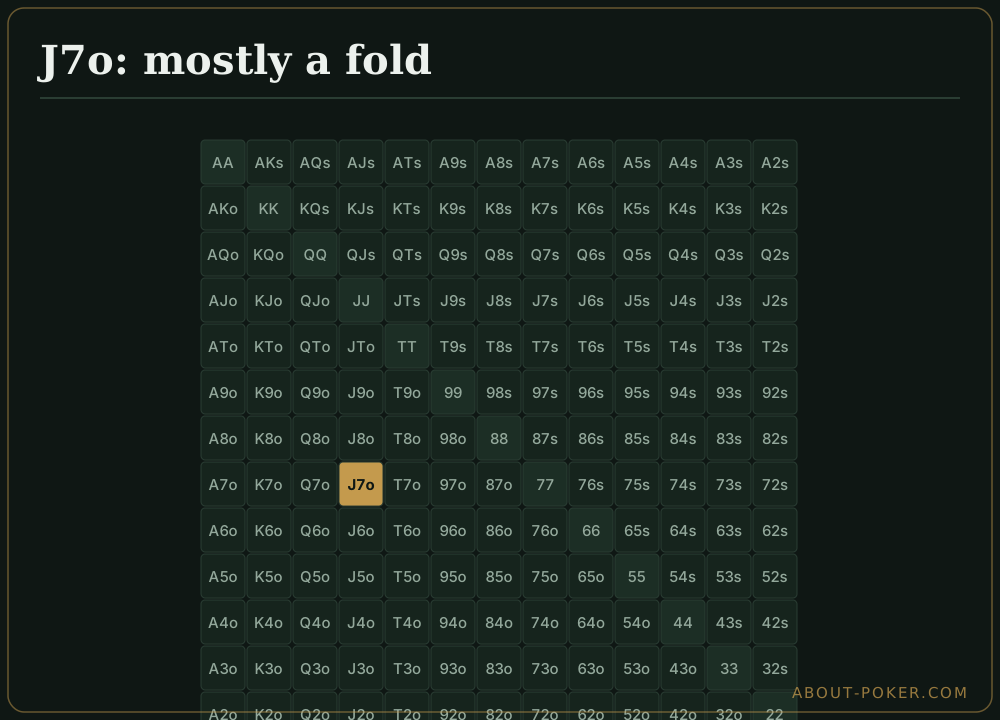
J7o is, at best, a bottom-of-range button steal. Against blinds that fold far too often, you can open it from the button purely to pick up dead money — but it sits at the very edge of your preflop opening ranges, and against normal or sticky blinds it comes out of the range entirely.
From the cutoff and everything earlier at a full-ring or 6-max table, fold it. The players behind hold ranges packed with better jacks, pairs, and high cards, and J7o has neither the strength nor the playability to fight them out of position. This is poker ranges by position at the margins: a hand that barely opens from the button and is an automatic fold everywhere else.
Why J7o is so weak
Three things work against J7o. First, the jack is not a top card — flop a jack and you are often behind JT, QJ, KJ, AJ. Second, the seven kicker is soft, so even your best pair is easily dominated. Third, the two-gap means J7 needs specific boards (like T-9-x or 9-8-x with the right cards) to make a real straight draw, and even then it is often drawing to the low end.
Put together, J7o makes weak pairs and thin draws — the recipe for second-best hands. It is not a 3-bet, because it has no value that wants a bigger pot and no flush to bluff with. When it plays at all, it plays for small pots and fold equity, never for stacks.
The rare defend
J7o can occasionally appear at the very bottom of a big-blind defend against a min-raise, where the pot odds are large and you are closing the action. That is the same blind defense logic behind any marginal call — the price is cheap, you are last to act, and you fold quickly postflop when you miss. Against a standard 2.5x open, J7o is simply a fold.
A worked example
Say you do open J7o on the button against a tight big blind and get called. The flop comes J-8-3 rainbow — top pair. It feels good and it is a trap. You bet a third of the pot; the big blind calls. Against a range with J8, better jacks, 88, 33, and gutshots, your seven kicker is behind much of what continues. Bet once for thin value at most, then check or fold. Committing chips here with a dominated jack is exactly how J7o turns a marginal steal into a real loss.
The better mindset is to fold J7o preflop in the vast majority of spots and reserve it only for clear button steals against opponents who over-fold. Recognizing that a “two Broadway-ish cards” feeling does not make J7o a real hand is the whole lesson.
How the spot changes by opponent and stack depth
J7o is one of the most opponent-dependent hands in the deck, precisely because its only source of profit is fold equity rather than raw hand strength. Against blinds that defend correctly — calling and 3-betting close to a game-theory frequency — the hand’s expected value on a button open drops to roughly break-even or below, and it should come out of your range. Against blinds that fold their big blind more than about 60% of the time to a 2.5x raise, the dead money alone can push a J7o steal into the black even though you will lose most pots that go to a flop. The read you need is simple: are the blinds too tight? If yes, J7o is a fine steal. If they are stationy callers who see flops with any two cards, drop it, because you will be forced to play a dominated hand out of position or with only a small skill edge to fall back on.
Stack depth matters less for J7o than for suited connectors, because the hand rarely wins a big pot regardless of depth — it makes no nut flush and few nut straights. If anything, shorter stacks (say 20-30bb) marginally favor the steal, since there is less room to get outplayed postflop and the fold equity of your open is a bigger share of the eventual pot. At very deep stacks, the reverse-implied-odds problem grows: when you flop top pair with your weak seven kicker, deep money means a bigger pot to lose when you are dominated. Deep-stacked, lean even harder toward folding J7o and playing hands that can make the nuts.
A quick decision checklist
Before you ever put chips in with J7o, run through four questions. First, are you on the button (or in the small blind with a limp-or-fold dynamic)? If not, fold. Second, do the blinds over-fold? If they defend properly, fold. Third, is anyone already in the pot? If there is a limper or an open ahead of you, fold — J7o has no business calling or 3-betting. Fourth, are you closing the action cheaply in the big blind against a small raise? If yes, a rare defend is defensible; if the price is anything but excellent, fold. If the honest answer to all four is “no clear yes,” the hand is a fold, which is the correct default the overwhelming majority of the time. For the offsuit tier just above this one, compare your reads here with how the poker ranges by position framework treats the wider button steals.
Frequently asked
Can you open jack-seven offsuit?
Rarely. At most it is a bottom-of-range button steal against blinds that fold far too often. From the cutoff and every earlier seat it is a fold — the jack is not high enough and the seven kicker with a gap gives it too little to work with.
Should you 3-bet J7o?
No. It has no value component and, without a flush, makes a weak bluff. Against any open it is a fold, or at most a bottom-of-range big-blind defend when the price is very cheap.
Why is J7o worse than J7s?
The suit. J7s adds flush potential and a bit of extra playability that pushes it into late-position opening ranges. J7o strips that away, leaving a gapped, mid-strength offsuit hand that is mostly a fold.